BPSC Announces Over 32000 Teacher Vacancies for TRE 4
Source:organiser ↗
Why It Matters
Large-scale recruitment drives like BPSC TRE are critical to state governance and social justice, aiming to improve educational outcomes and human development indicators (HDI) in Bihar by addressing teacher shortages in government schools.
Summary
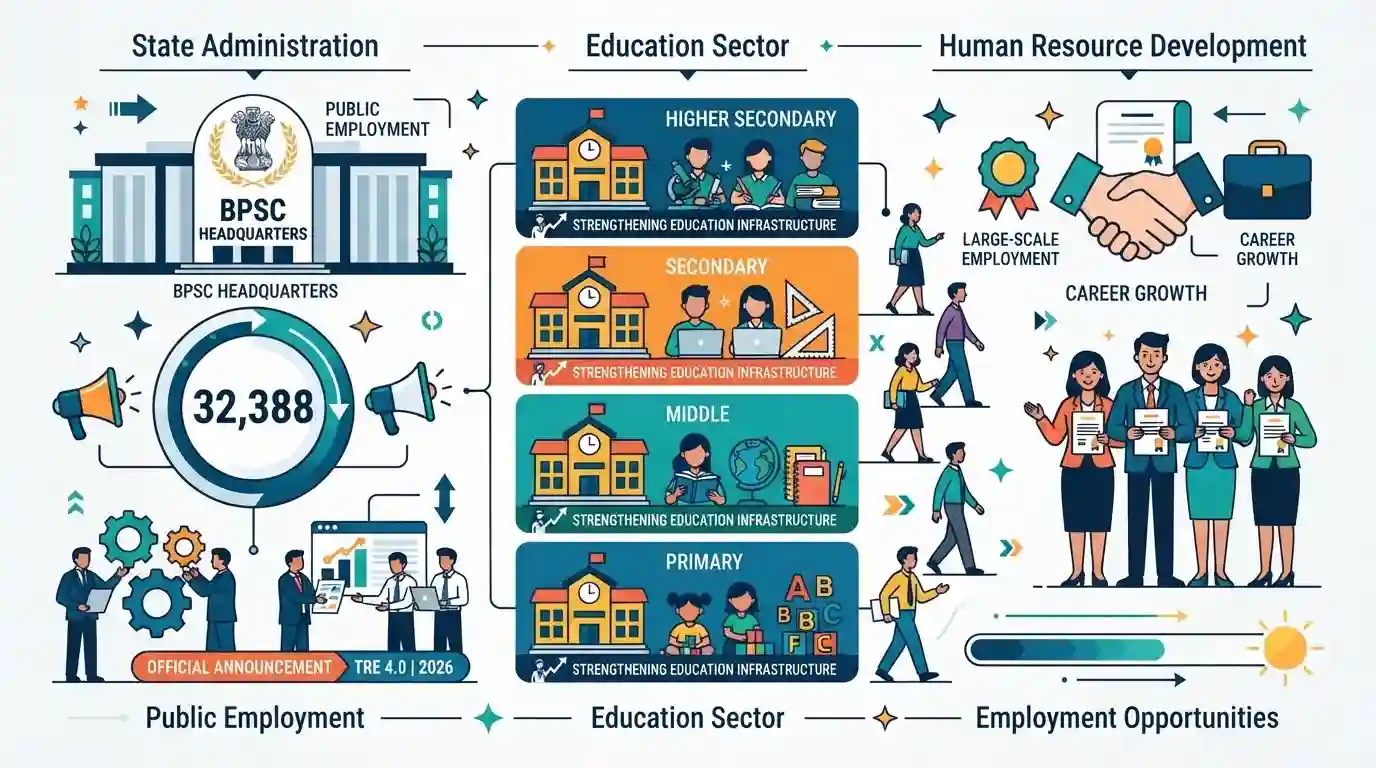
The Bihar Public Service Commission (BPSC) has officially announced 32,388 vacancies for the fourth phase of the Teacher Recruitment Exam (TRE 4.0) in 2026. This significant recruitment drive aims to fill positions across various school levels—Primary, Middle, Secondary, and Higher Secondary—to strengthen Bihar's public education infrastructure and provide large-scale employment opportunities for educators in the state.
Key Points
- The Bihar Public Service Commission (BPSC) has announced 32,388 teacher vacancies for the TRE 4.0 recruitment cycle in 2026.
- The recruitment drive will fill teaching posts across multiple levels, including Primary, Middle, Secondary, and Higher Secondary schools.
- This initiative is part of the Bihar government's ongoing efforts to enhance the public education system and improve the student-teacher ratio in the state.
Important Terms
Teacher Recruitment Exam (TRE) 4.0

The fourth phase of Bihar's massive state-level recruitment drive, conducted by BPSC to fill 32,388 teaching vacancies across primary, middle, secondary, and higher secondary schools to strengthen public education infrastructure.
UPSC context
Relevant to GS Paper 2 (Education, Human Resources). It highlights state-level public employment initiatives to improve teacher-pupil ratios and fulfill RTE mandates.
Bihar Public Service Commission (BPSC)
A constitutional body established under Article 315 of the Indian Constitution, responsible for conducting competitive exams and merit-based recruitment for state civil services, educational, and administrative posts in Bihar.
UPSC context
Relevant to GS Paper 2 (Constitutional Bodies). It tests understanding of Article 315 and the functions of State Public Service Commissions in state administration.
Bihar Education Department
The nodal state government department overseeing education policy, school infrastructure, Right to Education (RTE) compliance, teacher transfers, and workforce restructuring across Bihar's public schools.
UPSC context
Relevant to GS Paper 2 (Social Justice, Governance). It tests the role of state agencies in managing educational infrastructure and human resource development.
Prelims Trap
State legislatures have the power under Article 16 to reserve public employment vacancies solely for permanent residents of their respective states.
Under Article 16(3), only Parliament—not state legislatures—can prescribe residency requirements for employment within a state, to maintain national integration.
Static Concepts Connected
What are the key constitutional provisions governing State Public Service Commissions?
- Appointment and Removal: Members are appointed by the Governor, but can only be removed by the President under Article 317.
- Financial Autonomy: Expenses are charged on the Consolidated Fund of the State, shielding the SPSC from legislative or executive interference.
- Advisory Role: The commission must be consulted on methods of recruitment, promotions, transfers, and disciplinary actions of civil servants.
How does Article 16 regulate domicile-based residency requirements in public employment?
- Non-Discrimination: Article 16(2) prohibits discrimination in public employment based on place of birth or residence as a general rule.
- Parliamentary Supremacy: Article 16(3) empowers only the Parliament, not state assemblies, to make laws prescribing residency conditions for state employment.
Cross-Topic Patterns
Domicile quotas vs national citizenship
State-level resident-first employment policies test the limits of Article 16 and highlight the economic tensions between regional protectionism and unified national citizenship.
E-governance in educational administration
Portals like 'e-Shikshakosh' demonstrate how real-time digital databases are increasingly deployed to meet statutory public-sector mandates like the Right to Education Act's pupil-teacher ratios.

The division of power under Article 16(3) regarding domicile restrictions in public employment is likely to feature as a Polity statement.
Linked PYQs · 2
Linked PYQs · 2
- 2025BPSC_PRELIMSGS1
What is the primary objective of Bihar’s Mission Daksh?
- 2024-IBPSC_PRELIMSGS1
In April, 2020 the Bihar Education Department started the following program through DD Bihar
