Bihar MLC Steps Down Amid Constitutional Minister Debate
Source:The Hindu ↗
Why It Matters
This incident serves as a practical, high-profile case study of Article 164(4) of the Indian Constitution, highlighting the exact limits on unelected individuals serving as ministers, the role of the State Legislative Council, and judicial oversight of constitutional compliance by state governments.
Summary
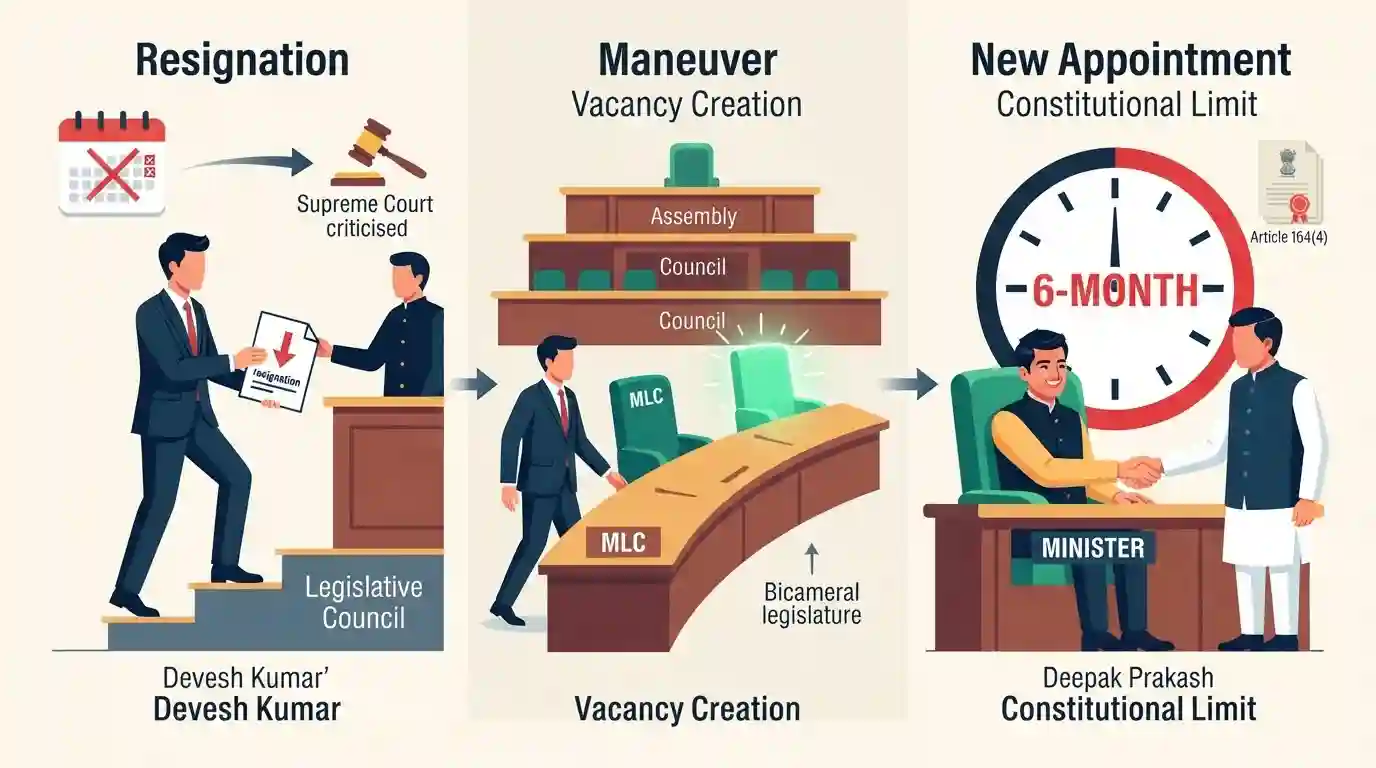
Following sharp criticism from the Supreme Court, Bihar BJP MLC Devesh Kumar has resigned from the State Legislative Council. The resignation is widely seen as a maneuver to accommodate Rashtriya Lok Morcha (RLM) leader Deepak Prakash, who has been a state minister without being a member of the state legislature for close to the six-month constitutional limit prescribed by Article 164(4). This development highlights the constitutional provisions regarding the appointment of unelected individuals to the Council of Ministers and the composition of State Legislative Councils.
Key Points
- Bihar BJP MLC Devesh Kumar resigned from the State Legislative Council, likely to allow unelected minister Deepak Prakash to be nominated or elected in his place.
- Deepak Prakash (RLM leader) has been serving as a state minister in Bihar for nearly six months without being a member of either house of the State Legislature.
- Article 164(4) of the Indian Constitution stipulates that a minister who is not a member of the State Legislature for six consecutive months shall cease to be a minister.
- The resignation follows severe criticism and questioning by the Supreme Court regarding the Bihar government's continuation of an unelected minister.
Important Terms
Article 164(4) of the Constitution of India

A constitutional provision allowing an unelected person to be appointed as a state minister, provided they secure a seat in the State Legislature within six consecutive months; otherwise, they cease to be a minister.
UPSC context
Crucial for GS Paper 2 (Polity); frequently tested regarding the state executive and constitutional limits on appointing unelected individuals as ministers.
Article 164 of the Constitution of India
The constitutional framework detailing the appointment, tenure, and collective responsibility of a state's Chief Minister and Council of Ministers to the Legislative Assembly.
UPSC context
Essential for GS Paper 2 (State Executive). It tests the formation of state governments and the principle of collective responsibility in parliamentary democracy.
Supreme Court of India
The highest judicial authority in India and final interpreter of the Constitution. It oversees appeals, resolves federal disputes, and safeguards citizens' fundamental rights.
UPSC context
Core topic in GS Paper 2 (Judiciary); tests understanding of constitutional interpretation, judicial review, and the separation of powers in India.
Prelims Trap
An unelected Minister must get elected to the Legislative Assembly within six months to continue.
A non-legislator minister can become a member of *either* House (Assembly or Council). Article 164(4) requires membership of the State Legislature, not strictly the directly elected lower house.
Static Concepts Connected
What are the constitutional limits on unelected individuals serving as State Ministers?
- Article 164(4): A non-legislator can serve as a Minister but must become a member of the State Legislature within six consecutive months, or automatically vacate the office.
- S.R. Chaudhuri Case: The Supreme Court (2001) ruled that resigning and getting reappointed without securing a legislative mandate to bypass the six-month cap is an unconstitutional subversion.
How is the membership of a State Legislative Council composed under Article 171?
- Mixed Electorate: Members are chosen indirectly: 1/3 by MLAs, 1/3 by local bodies, 1/12 by teachers of three years' standing, and 1/12 by graduates.
- Governor Nomination: The remaining 1/6 of members are nominated by the Governor for special knowledge in literature, science, art, cooperative movement, or social service.
Cross-Topic Patterns
Executive Accountability vs. Bicameralism
Ministers entering via the Legislative Council bypass direct elections. However, Article 164(2) maintains democratic accountability by making the Council of Ministers collectively responsible solely to the Legislative Assembly.
Coalition Politics & Statutory Loopholes
Political accommodations frequently leverage Article 164(4) alongside Governor nominations to reward coalition allies, testing the boundaries of democratic representation established in the landmark S.R. Chaudhuri judgement.

Expect a multi-statement Prelims question testing the interplay of Art 164(4), the S.R. Chaudhuri case, and collective responsibility.
Linked PYQs · 3
Linked PYQs · 3
- 2023BPSC_PRELIMSGS1
The Council of Ministers in a State is collectively responsible to
- 2024-IBPSC_PRELIMSGS1
Which of the following Constitutional Amendment in India has decided the maximum strength of the Council of Minister with Chief Minister in a State?
- 2022BPSC_PRELIMSGS1
The members of a State Legislative Council are not chosen by which of the following categories of persons?
