Election Expenditure Limits and ECI Complaint on By-Election
Source:The Hindu ↗
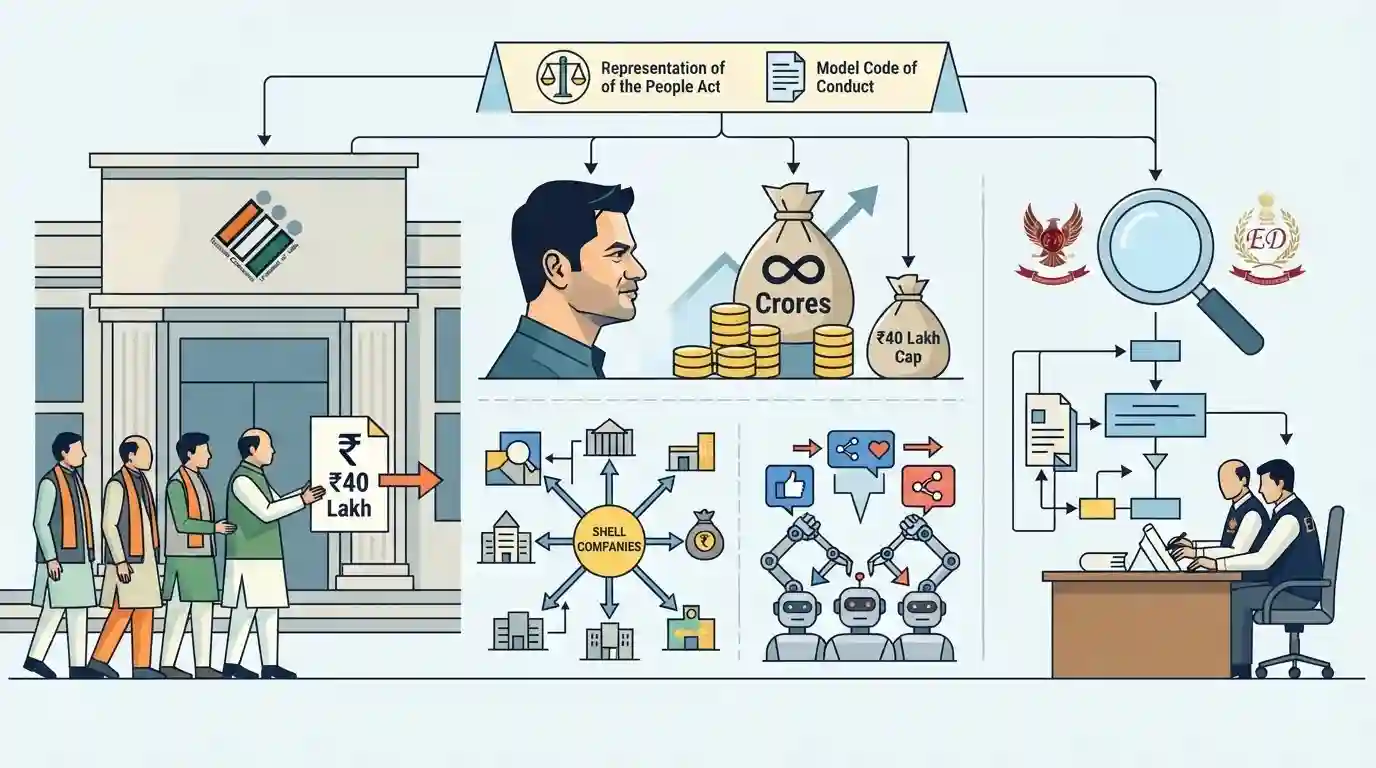
Why It Matters
The enforcement of election expenditure limits is crucial to maintaining a level playing field in democracies. Addressing issues like the use of shell companies, black money, and digital manipulation in elections highlights the evolving challenges for statutory bodies like the ECI in upholding the Model Code of Conduct and the Representation of the People Act.
Summary
A BJP delegation from Bihar approached the Election Commission of India (ECI) to demand an investigation into Jan Suraaj leader Prashant Kishor's alleged excessive spending during the Bankipur Assembly by-election. The BJP accused Kishor of spending crores of rupees, bypassing the ₹40 lakh cap on assembly election expenditure. The delegation alleged the use of shell companies for funding and fake social media bot networks to influence voters, citing violations of the Model Code of Conduct and the Representation of the People Act. The BJP also requested an Enforcement Directorate (ED) inquiry to trace the source of the illicit funds.
Key Points
- A BJP delegation filed a complaint with the Election Commission of India (ECI) against Jan Suraaj leader Prashant Kishor over alleged massive election expenditures in the Bankipur Assembly by-election.
- The BJP alleges that Kishor spent between ₹2 crore and ₹3 crore, grossly violating the statutory election expenditure limit of ₹40 lakh for assembly constituencies.
- The delegation accused the Jan Suraaj party of using funds from shell companies and urged the Enforcement Directorate (ED) to investigate the financial trails.
- Further allegations include the violation of the Model Code of Conduct and the Representation of the People Act, along with the use of bot networks and foreign social media accounts to influence voters.
Important Terms
Representation of the People Act

Enacted in 1951, this Indian law governs the conduct of elections, regulating candidate qualifications, defining corrupt practices, and establishing strict campaign expenditure limits.
UPSC context
Crucial for GS Paper 2 (Salient features of the RPA); tests knowledge of electoral reforms and legal frameworks for elections.
Model Code of Conduct (MCC)
A set of guidelines issued by the Election Commission of India to regulate the conduct of political parties and candidates during the election period.
UPSC context
Important for GS Paper 2; tests understanding of electoral fairness, ECI's moral authority, and campaigns against electoral malpractices.
Election Commission of India (ECI)
An autonomous constitutional body established under Article 324 to superintend, direct, and control federal and state elections in India.
UPSC context
Essential for GS Paper 2 (Constitutional Bodies); features in questions on electoral independence, reforms, and institutional autonomy.
Enforcement Directorate (ED)
A multi-disciplinary agency under the Ministry of Finance tasked with enforcing economic laws and fighting financial crimes, notably the Prevention of Money Laundering Act.
UPSC context
Significant for GS Paper 2 and 3; tests knowledge of statutory bodies, internal security (money laundering), and governance.
Prelims Trap
"The Representation of the People Act, 1951, imposes a strict cap on the election expenditure of both candidates and registered political parties."
While candidates face statutory expenditure caps (e.g., ₹40 lakh for Assembly) under the Conduct of Elections Rules, there is currently no legal ceiling on the amount a political party can spend.
Static Concepts Connected
What are the statutory rules governing candidate election expenditure?
- Sections 77 & 78: Candidates must maintain a correct account of all election expenses and lodge it with the District Election Officer within 30 days of the result.
- Section 10A Disqualification: The ECI can disqualify a candidate for three years if they fail to lodge their expense accounts on time without a valid reason.
- Rule 90 Caps: The Conduct of Elections Rules, 1961, sets candidate limits at ₹95 lakh (Lok Sabha) and ₹40 lakh (Assembly) for larger states.
Under what conditions can the Enforcement Directorate probe electoral funding?
- Predicate Offence Required: The ED cannot suo motu investigate MCC or RPA violations. It requires a registered predicate offence under the PMLA (e.g., fraud, forgery) to intervene.
- Shell Companies: If electoral funds are routed via shell companies involving money laundering, the ED traces the "proceeds of crime" based on an initial police FIR.
Cross-Topic Patterns
Electoral funding + PMLA framework
Routing campaign funds through shell companies bridges RPA election violations with PMLA. A joint reading of ECI disqualification and ED's asset-attachment powers is a prime Mains topic.
AI Bots + MCC + Cyber Security
Allegations of foreign bot networks influencing voters links the Model Code of Conduct with internal security, specifically the IT Rules 2021 and cross-border cyber interference.

Expect a multi-statement Prelims question testing the difference between candidate vs. party expenditure limits and ECI's Sec 10A powers.
Linked PYQs · 2
Linked PYQs · 2
- 2020BPSC_PRELIMSGS1
Which Article in the Indian Constitution is related with the establishment of the Election Commission of India?
- 2024-EBPSC_PRELIMSGS1
Who decides the disqualification of members of State Legislative Assembly, for matters other than those in the tenth schedule of the Constitution?
