Regional Stereotypes and Political Ethics in Digital Media Campaigns
Source:Indian Express ↗
Why It Matters
This controversy serves as an excellent case study for GS-1 (Regionalism vs Nationalism) and GS-4 (Ethics in Political Communication), illustrating how digital political campaigning can exacerbate societal fault lines through stereotyping.
Summary
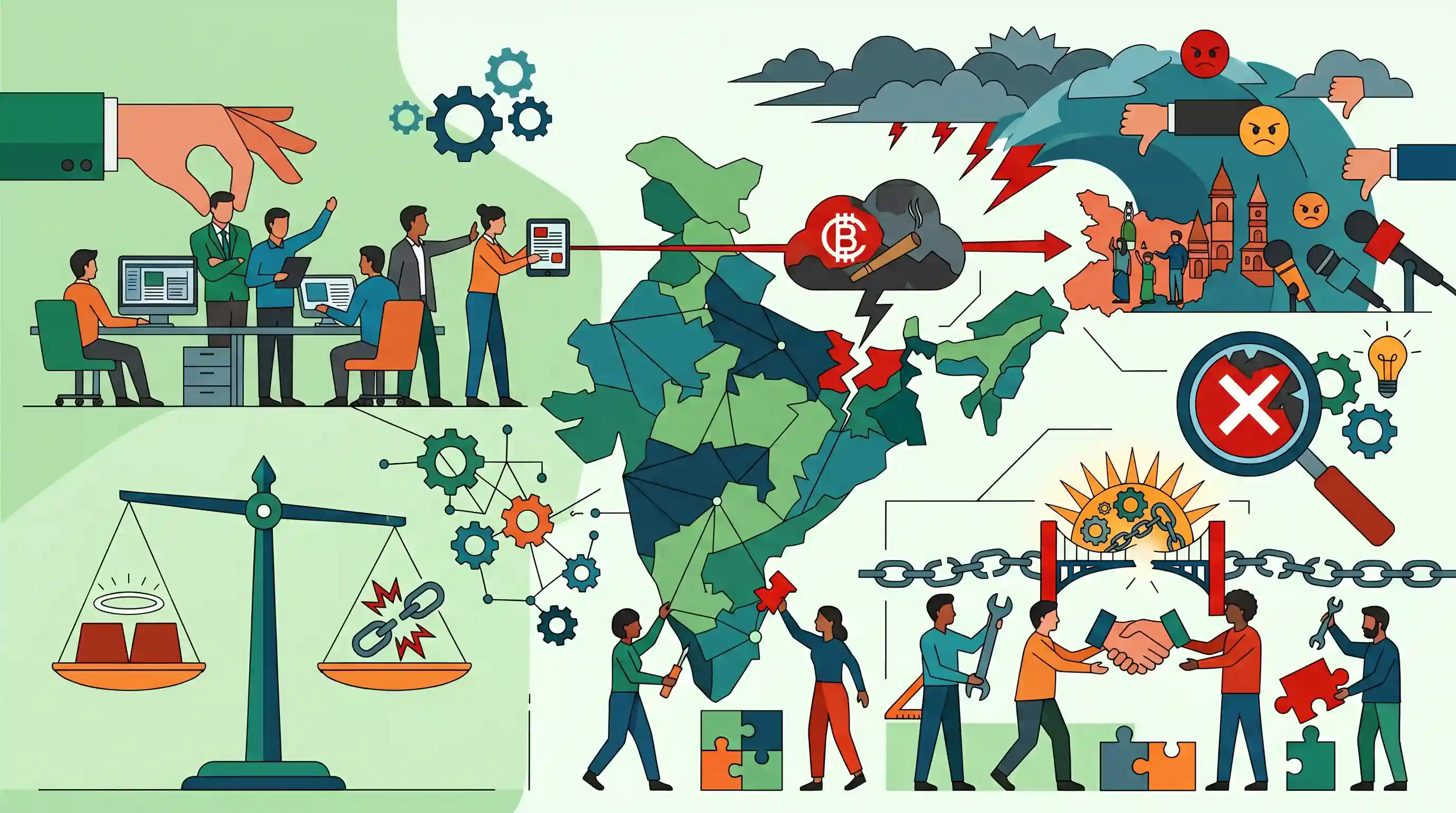
The Kerala unit of the Congress party has decided to "reconstruct" its social media team after facing severe backlash over a derogatory post that stereotyped people from Bihar. The controversial post, which mocked Bihar using the phrase "B for bidi," was widely condemned for promoting regional chauvinism. The incident brings to light the underlying biases and regional stereotypes that continue to surface in Indian political discourse. It also raises critical questions regarding the ethical responsibilities of political IT cells, the regulation of social media to prevent societal polarization, and the broader implications of such regional prejudices on national integration.
Key Points
- The Kerala unit of the Congress party announced a restructuring of its social media team following outrage over a derogatory post stereotyping Bihar.
- The post, which used the phrase "B for bidi, Bihar," sparked significant backlash for promoting regional chauvinism and stereotypes.
- The incident highlights the growing ethical deficit in digital political communication, where partisan IT cells frequently cross the line of basic decency.
- It serves as a case study for the tension between regionalism and national integration, underscoring the need for accountability and a strict code of ethics for political social media handles.
Important Terms
Regionalism

An ideology prioritizing the interests and identity of a specific region over national interests, sometimes manifesting as 'sons of the soil' sentiments or regional chauvinism.
UPSC context
GS Paper 1 (Society); tests understanding of internal threats to 'Unity in Diversity' and the impact of sub-nationalism.
National Integration
The process of creating a common national identity among diverse groups, overcoming divisions based on caste, religion, language, or geography to ensure unity.
UPSC context
GS Paper 1 (Society) and GS Paper 3 (Internal Security); critical for evaluating communal harmony and territorial integrity.
Model Code of Conduct
Non-statutory guidelines issued by the Election Commission of India to regulate the conduct of political parties and candidates, ensuring free and fair elections.
UPSC context
GS Paper 2 (Polity/Governance); relates to electoral ethics, political accountability, and the ECI's regulatory powers.
IT Cell
Specialized units within political parties responsible for managing social media presence, digital campaigning, and public messaging, often scrutinized for spreading misinformation.
UPSC context
GS Paper 4 (Ethics) and GS Paper 3 (Social Media); examines digital campaigning ethics and the role of technology in polarization.
Information Technology Rules, 2021
Regulations governing social media intermediaries and digital news publishers, mandating a grievance redressal mechanism and ethical codes for online content.
UPSC context
GS Paper 2 (Governance); important for understanding the regulatory framework for digital platforms and social media accountability.
Regional Chauvinism
An aggressive form of regionalism where individuals display excessive pride in their own region while holding derogatory or hostile views toward other regions.
UPSC context
GS Paper 1 (Social Issues); highlights psychological biases that disrupt social cohesion and foster inter-state friction.
Prelims Trap
The Election Commission's Model Code of Conduct (MCC) regulates the digital behavior of political party IT cells year-round.
The MCC is only active during election windows. Outside this period, political digital hate speech is regulated by general criminal laws (like BNS Section 196), not the ECI.
Static Concepts Connected
How does the Bharatiya Nyaya Sanhita (BNS) address promoting enmity between groups?
- Replaces IPC 153A: BNS Section 196 penalizes the promotion of enmity on grounds of religion, race, place of birth, or language.
- Digital inclusion: Explicitly adds 'electronic communication' to the statutory text, modernizing the legal framework to tackle digital hate speech and IT cell vitriol.
Code of Ethics vs. Code of Conduct in public life
- Code of Ethics: A principles-based framework guiding moral judgment and intrinsic values (e.g., upholding Constitutional fraternity and human dignity).
- Code of Conduct: A rules-based framework detailing specific prohibited actions and enforceable behaviors (e.g., the Model Code of Conduct during elections).
Cross-Topic Patterns
GST 'sin goods' & electoral populism
Lowering taxes on bidis (labor-intensive) while raising them on cigarettes highlights the governance friction between public health goals (taxing demerit goods) and electoral populism.
Fraternity in the digital age
Regional stereotyping by political handles undermines the Preamble's promise of 'Fraternity', acting as a sociological barrier to national integration and unity.

BNS Sec 196 (digital hate speech) and 'Fraternity' as a core constitutional ideal likely to pair in a 2026 Prelims polity MCQ.
Linked PYQs · 5
Linked PYQs · 5
- 2016MainsGS1
What is the basis of regionalism? Is it that unequal distribution of benefits of development on regional basis eventually promotes regionalism? Substantiate your answer.
- 2019MainsGS1
Are we losing our local identity for the global identity? Discuss.
- 2024MainsGS3
Social media and encrypting messaging services pose a serious security challenge. What measures have been adopted at various levels to address the security implications of social media? Also suggest any other remedies to address the problem.
- 2022MainsGS2
Discuss the role of the Election Commission of India in the light of the evolution of the Model Code of Conduct.
- 2024MainsGS4
“The 'Code of Conduct' and 'Code of Ethics' are the sources of guidance in public administration. There is code of conduct already in operation, whereas code of ethics is not yet put in place. Suggest a suitable model for code of ethics to maintain integrity, probity and transparency in governance.”
