Statewide Bihar Bandh Protests NEET UG Paper Leak
Source:the-economic-times ↗
Why It Matters
The article is crucial for understanding the dynamics of public protests and the enforcement of public order in state administration. It touches upon the constitutional balance between fundamental rights (freedom of assembly) and reasonable restrictions, while highlighting the administrative machinery (role of Chief Secretary, DGP) that manages statewide law and order crises. Furthermore, it reflects on the recurrent issues in the national education framework and examination governance.
Summary
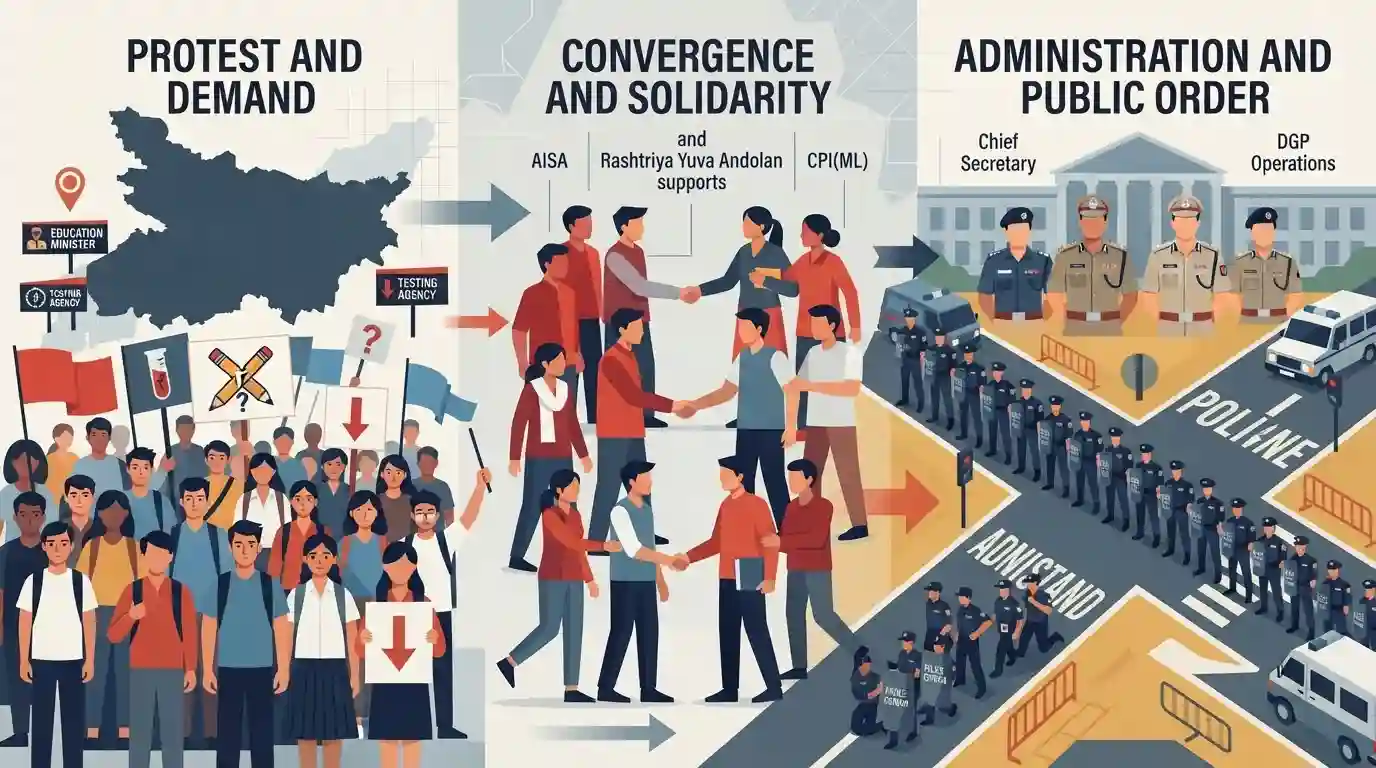
The All India Students' Association (AISA) and the Rashtriya Yuva Andolan initiated a statewide 'Bihar Bandh' on July 25, protesting the widespread controversies surrounding the NEET UG paper leak. Backed by CPI(ML) and various student groups, the demonstration demands the resignation of Union Education Minister Dharmendra Pradhan and an overhaul of centralized testing agencies like the NTA. To prevent untoward incidents and ensure public order, Bihar's top administration, overseen by the Chief Secretary and DGP Operations, deployed extensive security cordons across key transportation nodes in Patna and other districts.
Key Points
- The All India Students' Association (AISA) and the Rashtriya Yuva Andolan have jointly called for a statewide 'Bihar Bandh' to protest the NEET UG paper leak and corruption in centralized exams.
- Protesters are demanding the immediate resignation of Union Education Minister Dharmendra Pradhan and sweeping reforms in the examination structure, including scrapping the National Testing Agency (NTA).
- The movement has received backing from prominent political figures such as CPI(ML) MLA Sandeep Saurabh, drawing on Bihar's long history of robust student activism.
- State authorities, including Chief Secretary Pratyaya Amrit and DGP Operations Kundan Krishnan, have deployed comprehensive security measures to maintain public order and limit disruptions to essential services and transport.
- The bandh raises constitutional debates balancing the fundamental right to protest and assembly against the state's responsibility to impose reasonable restrictions for maintaining public order and citizens' freedom of movement.
Important Terms
National Testing Agency (NTA)

An autonomous, specialist organization under the Ministry of Education registered under the Societies Registration Act, 1860, established to conduct highly standardized, transparent, and secure entrance examinations for higher education in India.
UPSC context
GS Paper 2 (Governance/Education) - Tests regulatory bodies, educational reforms, and transparency in public examination systems.
National Eligibility cum Entrance Test (NEET)
A standardized, centralized nationwide entrance exam conducted for students seeking admission to undergraduate medical and dental programs across government and private colleges in India.
UPSC context
GS Paper 2 (Social Justice/Education) - Evaluates centralized testing governance, federal dynamics in education, and public policy issues.
Right to Protest
A democratic right derived from Article 19(1) of the Indian Constitution, allowing citizens to assemble peacefully and express dissent, subject to reasonable restrictions under Article 19(2).
UPSC context
GS Paper 2 (Polity/Fundamental Rights) - Examines civil liberties, limits of peaceful assembly, and judicial balance with public convenience.
Public Order
A state of peace, safety, and tranquility in society, listed under Entry 1 of the Seventh Schedule's State List, making it primarily a state government responsibility.
UPSC context
GS Paper 2 & 3 (Polity/Internal Security) - Assesses federal division of power and state administration of law and order.
Bandh
A form of protest demanding a complete strike or forced shutdown of services. The Supreme Court has ruled enforcing a 'bandh' unconstitutional as it infringes on others' fundamental rights.
UPSC context
GS Paper 2 (Fundamental Rights) - Evaluates the distinction between peaceful protest and coercion, and balancing individual vs. collective rights.
Prelims Trap
The Right to Strike and call for a state-wide Bandh is a fundamental right implicit under Article 19(1)(a) and (b).
The SC in T.K. Rangarajan held there is no fundamental right to strike. In CPI(M) v. Bharat Kumar, it ruled forced 'bandhs' are illegal as they disrupt others' fundamental rights.
Static Concepts Connected
Is the National Testing Agency (NTA) a statutory body and what is its legal status?
- Legal Nature: NTA is an autonomous, self-sustained premier testing organization. It is not established by an Act of Parliament and is non-statutory.
- Registration: It is registered as a society under the Societies Registration Act, 1860, to conduct entrance examinations for higher educational institutions.
What is the legal difference between a peaceful protest and a 'Bandh'?
- Right to Protest: Derived from Article 19(1)(a) and 19(1)(b), allowing peaceful, unarmed assembly subject to reasonable restrictions under Articles 19(2) and 19(3).
- Unconstitutionality of Bandhs: The SC in CPI(M) v. Bharat Kumar declared forced 'Bandhs' illegal because they violate fundamental rights of others, like freedom of movement and trade.
Cross-Topic Patterns
Centralized Exams vs Concurrent List Federalism
Centralized tests like NEET under NTA spark federal debates, as education is a Concurrent List subject but implementation is increasingly driven by central non-statutory entities.
Student Movements and Total Revolution
Historically, student-led agitations (like the 1974 JP Movement in Bihar) have escalated from local educational grievances to national-level democratic and constitutional course-corrections.

Constitutional validity of forced bandhs vs right to protest under Art 19 likely to be tested via judicial precedents in GS Paper 2.
Linked PYQs · 3
Linked PYQs · 3
- 2016BPSC_PRELIMSGS1
Who left Patna College with just 20 days remaining for his examination during the Non Cooperation Movement?
- 2025BPSC_PRELIMSGS1
The constitution of India provides for reasonable restrictions on Fundamental Rights but reasonableness must keep in mind that: 1. The restrictions must be necessary for the protection of the rights of others. 2. The restrictions must be proportionate to the end sought. 3. The restrictions must be reasonable in the light of the circumstances. 4. The restrictions must be in the public interest.
- 2002BPSC_PRELIMSGS1
The executive head of the State Government is:
