Bihar assembly enacts legislation to prohibit online digital gambling
Source:uni-india ↗
Why It Matters
This article covers multiple essential components of the Bihar economy, polity, and state administration: the transition from colonial-era legislation (Bengal Gambling Act, 1867) to tackle modern digital-age crimes; state-level healthcare reforms facilitating out-of-state medical practitioners; taxation debates at the local self-government level; and rural employment and poverty alleviation through JEEViKA, all of which are highly relevant to BPSC Prelims.
Summary
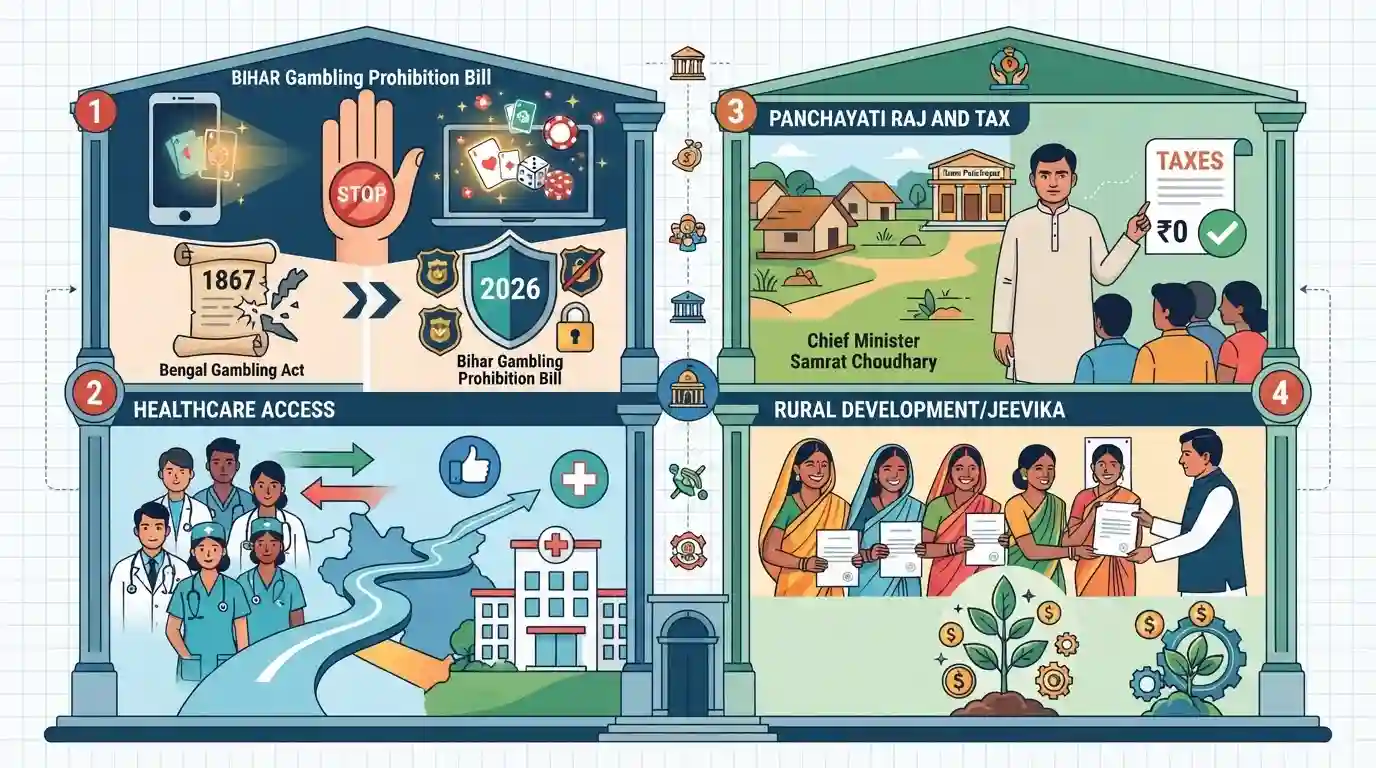
The Bihar Legislative Assembly passed the landmark Bihar Gambling Prohibition Bill, 2026, which replaces the archaic Bengal Gambling Act of 1867. This legislation aims to severely curb the rise of digital and online gambling by penalizing players, operators, facilitators, and commission earners. Additionally, the Assembly passed key healthcare bills to allow registered doctors and nurses from other states to practice directly in Bihar. Chief Minister Samrat Choudhary clarified that no new holding taxes are being levied on the rural poor under Gram Panchayats, and distributed 2,446 appointment letters under the state's JEEViKA scheme.
Key Points
- The Bihar Legislative Assembly passed the Bihar Gambling Prohibition Bill, 2026 by voice vote, which aims to curb online betting, mobile app-based gambling, and digital betting platforms.
- The new bill replaces the pre-independence Bengal Gambling Act of 1867, which was outdated and limited to traditional physical card and dice games.
- The legislation targets not just gamblers, but also digital platforms, operators, financial facilitators, and commission earners involved in online gambling.
- The Assembly approved two health bills allowing registered doctors and nursing professionals from other states to practice directly in Bihar without complex bureaucratic hurdles, aiming to boost the state's healthcare workforce.
- Chief Minister Samrat Choudhary refuted allegations of new holding taxes on poor rural residents in Gram Panchayats, confirming that the government is not imposing additional taxes on the poor.
- Under the Bihar Rural Livelihoods Promotion Society (JEEViKA), CM Samrat Choudhary distributed appointment letters to 2,446 newly selected candidates.
Important Terms
Bihar Gambling Prohibition Bill, 2026

A 2026 legislation passed by the Bihar Assembly to completely ban digital and online gambling. It prescribes strict penalties—up to seven years in jail—for players, operators, financial facilitators, and commission earners.
UPSC context
Relevant for GS-2 (State Policies) and GS-3 (Cybersecurity). Highlights state proactive measures regulating the booming digital betting ecosystem.
Bengal Gambling Act of 1867
An archaic colonial-era law that previously governed traditional gambling like card and dice games in Bihar. It is being repealed because it lacked provisions to regulate modern digital apps and online betting platforms.
UPSC context
Important for GS-2 (Governance), illustrating the administrative necessity of updating obsolete colonial-era statutes to address contemporary technological challenges.
JEEViKA (Bihar Rural Livelihoods Project)
A rural poverty alleviation initiative supported by the World Bank and Bihar government. It empowers rural women by organizing them into Self-Help Groups (SHGs), facilitating access to microfinance, and promoting sustainable livelihood opportunities.
UPSC context
Vital for GS-2 (SHGs, Poverty Alleviation) and GS-3 (Inclusive Growth). Serves as a successful case study for state-led rural socio-economic empowerment models.
Prelims Trap
States cannot ban online gambling because the Union Government has exclusive jurisdiction over internet platforms under the IT Act.
Under Entry 34 of List II, states retain sole competence over 'betting and gambling' in all forms, including digital platforms operating within their borders.
Static Concepts Connected
How is legislative power over online gambling divided in India?
- State Jurisdiction: Under List II Entry 34, states have exclusive legislative competence over betting and gambling, permitting them to ban digital wagering platforms.
- Union Jurisdiction: The Union regulates internet intermediaries and platforms under IT Rules 2023, drawing power from List I Entry 31 and residuary powers.
- Judicial Distinction: Courts consistently distinguish between 'games of skill' (constitutionally protected trade) and 'games of chance' (which states can completely prohibit).
What are the constitutional provisions for Panchayat financial powers?
- Article 243H: Authorises state legislatures to empower Panchayats to levy, collect, and appropriate taxes, duties, tolls, and fees.
- Article 243I: Mandates the periodic constitution of a State Finance Commission to review financial positions and recommend revenue sharing.
Cross-Topic Patterns
Federalism in borderless cyberspace
The clash between territorial State List powers (betting) and borderless Union List powers (internet regulation) highlights evolving federal challenges in digital-era governance.
SHG models and rural development
The integration of schemes like JEEViKA into formal public service delivery shows the transition of SHGs from micro-credit groups to state-backed economic engines.

Constitutional conflict between State power over betting (List II) and Central IT Act authority over online gaming likely for Mains 2026.
Linked PYQs · 3
Linked PYQs · 3
- 2016BPSC_PRELIMSGS1
'JEEVIKA' is an initiative of Bihar Govt for:
- 2024-EBPSC_PRELIMSGS1
Under Article “243J” which of the following can make provisions to the maintenance of accounts by Panchayats?
- 2025BPSC_PRELIMSGS1
What is true about the proceedings of the State Legislature?
