Bihar Legislative Assembly passes thirteen new reform bills
Source:hindustantimes ↗
Why It Matters
These bills highlight Bihar's strategic policy shift towards modernizing its economy through technology-focused education, urban planning, and a better business environment, making these legislative updates highly relevant for state-specific policy questions in the BPSC Prelims.
Summary
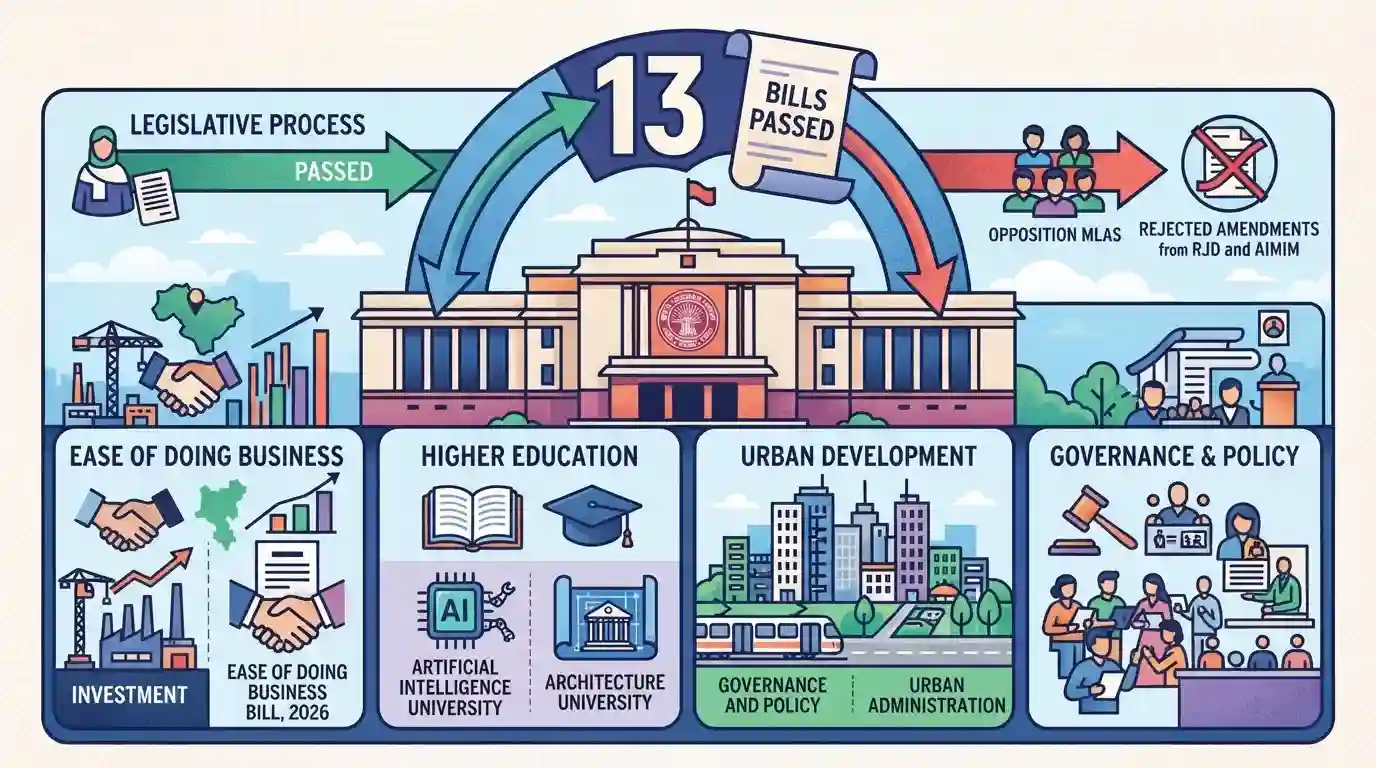
The Bihar Legislative Assembly recently passed 13 significant bills spanning education, urban administration, governance, and the business environment. Notable among these were the Bihar Ease of Doing Business Bill, 2026, aimed at attracting investment, and legislation establishing specialized universities focusing on Artificial Intelligence and Architecture. All amendments proposed by the opposition RJD and AIMIM MLAs were rejected.
Key Points
- The Bihar Legislative Assembly successfully passed 13 bills aimed at institutional reform, urban development, and educational modernization.
- Key legislative landmarks include the establishment of specialized institutions: Dr Syama Prasad Mookerjee Artificial Intelligence and Computer Science University, and Shaheed Jubba Sahni University of Architecture and Civil Engineering.
- The Bihar Ease of Doing Business Bill, 2026 was cleared to improve the investment climate and streamline corporate regulations in the state.
- The Bihar Urban Development Bill, 2026 was passed to foster planned infrastructure and urban growth.
- Amendments proposed by opposition MLAs from the RJD and AIMIM were dismissed during the proceedings.
Important Terms
Bihar Ease of Doing Business Bill, 2026

A legislation introducing a single-window clearance system for businesses in Bihar. It mandates a 30-day deadline for issuing No Objection Certificates (NOCs), after which proposals receive a "deemed approval" to eliminate red tape and delays.
UPSC context
Relevant for GS 3 (Economy). Tests knowledge of state-level investment climate reforms, single-window systems, and "deemed approval" administrative frameworks.
Bihar Prisons and Correctional Services Bill, 2026
A new state law replacing the colonial-era Prisons Act, 1894. It shifts the focus of incarceration from punishment to rehabilitation, emphasizing skill development, mental health counseling, and the technological modernization of prison administration.
UPSC context
Relevant for GS 2 (Governance/Social Justice). Highlights state-level criminal justice reforms and the modernization of obsolete colonial-era laws.
Bihar Urban Development Bill, 2026
A bill establishing the Bihar Urban Development Authority (BUDA), chaired by the Chief Secretary. It aims to accelerate planned urbanization, oversee greenfield satellite townships, and manage public-private partnerships for urban infrastructure.
UPSC context
Relevant for GS 1 and 3 (Urbanization). Crucial for topics on urban governance, satellite townships, and managing demographic expansion.
Dr Syama Prasad Mookerjee Artificial Intelligence and Computer Science University Bill, 2026
Legislation establishing a specialized university in Bihar dedicated to Artificial Intelligence and computer science. It aims to promote advanced research, technological innovation, and skill-oriented higher education while retaining local students.
UPSC context
Relevant for GS 2 (Education) and GS 3 (Science & Tech). Highlights state capacity-building initiatives in emerging technologies like AI.
Indian Stamp (Bihar Amendment) Bill, 2026
An amendment increasing the maximum penalty for stamp duty evasion—such as undervaluing property or misclassifying commercial land as agricultural—from 10% to 100%, aiming to curb state revenue losses.
UPSC context
Relevant for GS 2 (State Finances) and GS 3 (Economy). Illustrates measures to boost state revenue and curb real estate corruption.
Prelims Trap
"In a bicameral state, a deadlock over an ordinary bill can be resolved by a joint sitting summoned by the Governor."
State legislatures do not have joint sittings. Under Article 197, the Legislative Council can only delay an ordinary bill for a maximum of 4 months (3+1). The Assembly's will ultimately prevails.
Static Concepts Connected
How is an ordinary bill deadlock resolved in a bicameral state legislature?
- No Joint Sitting: Unlike Parliament (Art 108), the Constitution provides no mechanism for a joint sitting in state legislatures to resolve legislative deadlocks.
- Delaying Power: The Legislative Council can only delay an ordinary bill for a maximum of 4 months (3 months initially, plus 1 month on second passage).
- Assembly Supremacy: If the Legislative Assembly passes the bill a second time, it is deemed passed by both Houses, regardless of the Council's rejection.
What is the Business Reforms Action Plan (BRAP)?
- Nodal Agency: Released by the Department for Promotion of Industry and Internal Trade (DPIIT) to rank states based on their investment climate and regulatory environment.
- Assessment Framework: It evaluates states on parameters like labor regulation, environmental clearance, and information access. The latest iterations heavily emphasize ground-level feedback from businesses.
Cross-Topic Patterns
State tech universities and Entry 32
Establishing specialized AI state universities falls under Entry 32 (State List). This highlights states proactively building future-tech human capital, blending Education (Concurrent List) with State corporatization powers.
Low urbanization dragging demographic gains
Bihar's low 11.3% urbanization (2011) severely hampers its massive demographic dividend. New state urbanization bills link directly to creating non-farm hubs to absorb rural surplus labor.

Expect a 2026 Prelims statement comparing Rajya Sabha's deadlock resolution (Art 108) with State Legislative Councils' mere delaying powers.
Linked PYQs · 3
Linked PYQs · 3
- 2023BPSC_PRELIMSGS1
In the year 2020, Bihar gained the __ rank out of 36 States in the Ease of Doing Business, awarded by Business Reforms Action Plan (BRAP).
- 2023BPSC_PRELIMSGS1
The urbanization of the State has increased very rapidly in the last ten years. According to the 2011 Census, the level of urbanization in Bihar was just __ percent, which has increased to __ percent at present.
- 2022BPSC_PRELIMSGS1
The new ministry proposed in the Bihar Budget for the year 2021-22 focuses on
