Bihar Watershed Development Plan for Agricultural Drought Resilience
Source:uni-india ↗
Why It Matters
State-level interventions for water and soil conservation are critical for ensuring sustainable agriculture and climate resilience, which are core components of the UPSC and BPSC syllabi on agriculture and resource management.
Summary
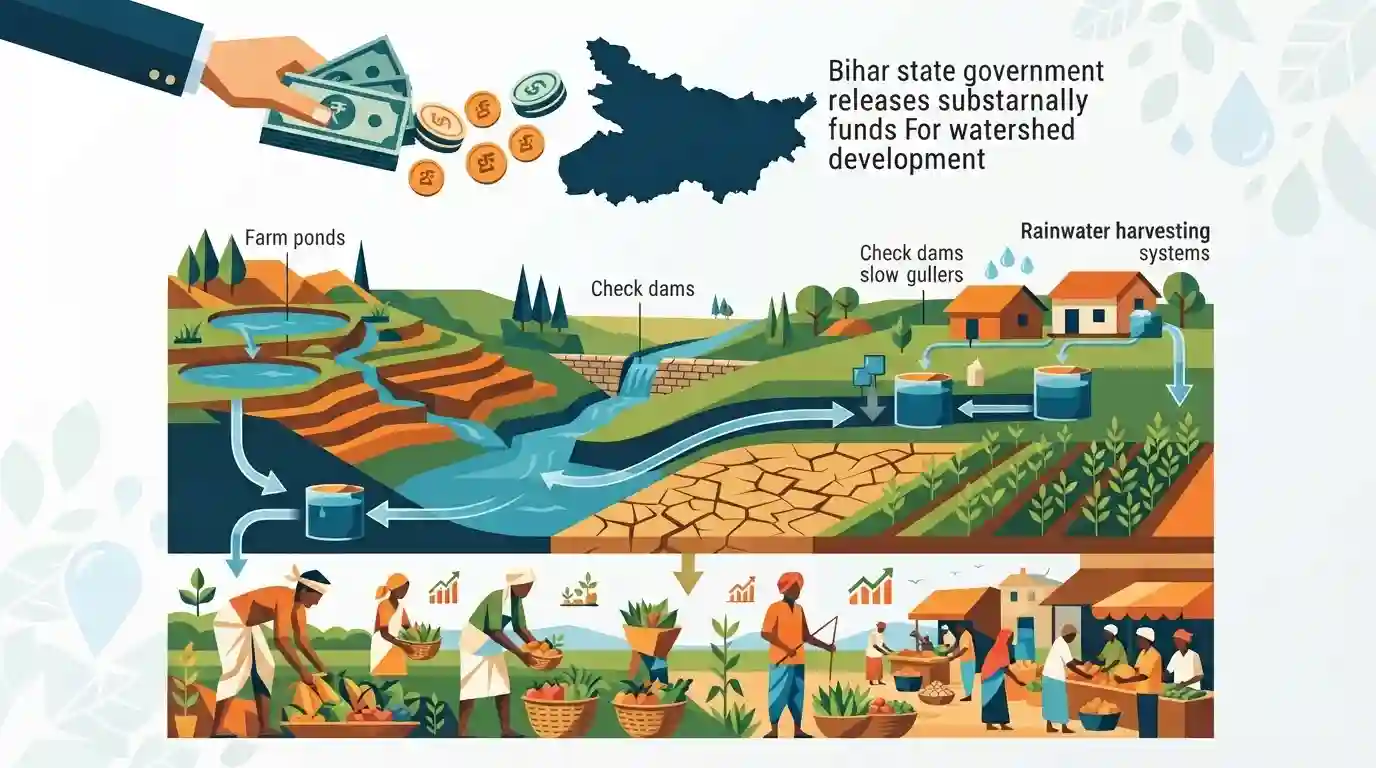
Bihar's state government has sanctioned Rs 66.15 crore for watershed development in the 2026-27 financial year. Announced by Agriculture Minister Vijay Kumar Sinha, the initiative focuses on constructing farm ponds, check dams, and rainwater harvesting structures across selected watershed areas. The project aims to mitigate drought impact, prevent soil erosion, and stabilize crop production, thereby reinforcing the state's rural economy and promoting sustainable agricultural practices.
Key Points
- The Bihar government has approved a Rs 66.15-crore watershed development plan for the 2026–27 financial year.
- Funds will be directed toward building and strengthening farm ponds, check dams, rainwater harvesting structures, and field bunding.
- The initiative seeks to enhance soil and water conservation, offering greater agricultural resilience against drought-like conditions.
- Expected outcomes include stabilized crop production, improved soil fertility, and promotion of allied activities to strengthen the rural economy.
Important Terms
Watershed Development Component

A centrally sponsored scheme under PMKSY aiming to restore degraded land, conserve soil, and harvest rainwater. Approved as WDC-PMKSY 2.0 (2021-2026), it uses integrated watershed management to boost agricultural productivity and rural livelihoods.
UPSC context
Relevant for GS-3 (Agriculture, Water Conservation). Tests knowledge of government schemes targeting rainfed areas, drought mitigation, and sustainable resource management.
Watershed Development
A geographic area where all surface water drains into a single common outlet. Its development emphasizes conservation, regeneration, and judicious use of resources like soil, water, and vegetation to maintain ecological balance.
UPSC context
Crucial for GS-1 (Geography) and GS-3 (Environment/Agriculture). Tests understanding of natural resource management, ecological restoration, and dryland farming strategies.
Check dams
Small structures built across channels or gullies to slow water flow, trap sediment, reduce soil erosion, and promote groundwater recharge. They are a primary biological/mechanical measure used in watershed and stormwater management.
UPSC context
Important for GS-3 (Environment, Disaster Management). Highlights sustainable structural interventions to control floods, curb soil erosion, and stabilize watersheds.
Rainwater Harvesting
The practice of collecting, storing, and utilizing rainwater instead of allowing it to run off. In agriculture, it reduces reliance on groundwater, lowers irrigation costs, and helps stabilize soil moisture and crop yields.
UPSC context
Key topic in GS-1 (Geography) and GS-3 (Environment). Demonstrates sustainable water management, climate resilience, and methods to address groundwater depletion.
Government of Bihar
The state executive body comprising the Governor, Chief Minister, and the Council of Ministers. It manages administration, enforces policies, and implements state and centrally sponsored schemes within Bihar.
UPSC context
Relevant for GS-2 (Polity and Governance). Demonstrates the role of state-level executives in formulating and implementing localized welfare and developmental policies.
Prelims Trap
Watershed projects are demarcated by district boundaries, and the PMKSY-Watershed Development Component is a Central Sector scheme.
Watersheds are natural hydrological drainage units, not administrative boundaries. Additionally, WDC-PMKSY is a Centrally Sponsored Scheme (cost-shared with states), not a Central Sector scheme.
Static Concepts Connected
What is the 'Ridge-to-Valley' approach in watershed management?
- Top-down principle: Interventions start from the highest point (ridge) and progress downward to the valley to effectively slow runoff velocity.
- Erosion control: Treating the upper catchments first prevents rapid siltation and damage to water harvesting structures in the lower reaches.
- Integrated methods: Combines vegetative cover (afforestation) at the top with engineering structures like check dams and farm ponds in the valley.
What are the 4 core components of Pradhan Mantri Krishi Sinchayee Yojana (PMKSY)?
- AIBP: Accelerated Irrigation Benefit Programme focuses on the faster completion of ongoing major and medium irrigation projects.
- Har Khet Ko Pani: Focuses on creating new water sources through minor irrigation and restoring traditional water bodies.
- Per Drop More Crop: Enhances water use efficiency at the farm level through micro-irrigation systems like drips and sprinklers.
- Watershed Development: Manages runoff, arrests soil erosion, and regenerates groundwater in rain-fed and degraded areas.
Cross-Topic Patterns
Dual Disasters: Flood & Drought in Bihar
North Bihar's Himalayan rivers cause severe floods, whereas South Bihar faces chronic droughts, requiring distinct localized solutions like watershed development to stabilize agriculture.
Climate Resilience & Rural Migration
Drought-proofing rain-fed agriculture through micro-watershed projects mitigates agrarian distress, directly curbing seasonal distress migration from rural drylands to urban centers.

Expect 2026 Prelims statements testing the 'ridge-to-valley' watershed principle and distinguishing PMKSY's WDC from AIBP.
Linked PYQs · 4
Linked PYQs · 4
- 2016BPSC_PRELIMSGS1
Which of the following canal systems irrigate areas of Bihar?
- 2024-EBPSC_PRELIMSGS1
Which of the following drainage systems drains the lands of Bihar?
- 2022BPSC_PRELIMSGS1
Water passes from the soil into the roots by a physical process called
- 2024-EBPSC_PRELIMSGS1
Which of the following is a cause of rural to urban migration in India?
