AIIMS Patna Infrastructure Expansion and Healthcare Upgrades
Source:indianmasterminds ↗
Why It Matters
Strengthening tier-1 medical institutions like AIIMS Patna through land acquisition, specialized units (like skin banks), and dedicated transit corridors reflects the state's emphasis on healthcare governance, social sector spending, and quality public service delivery.
Summary
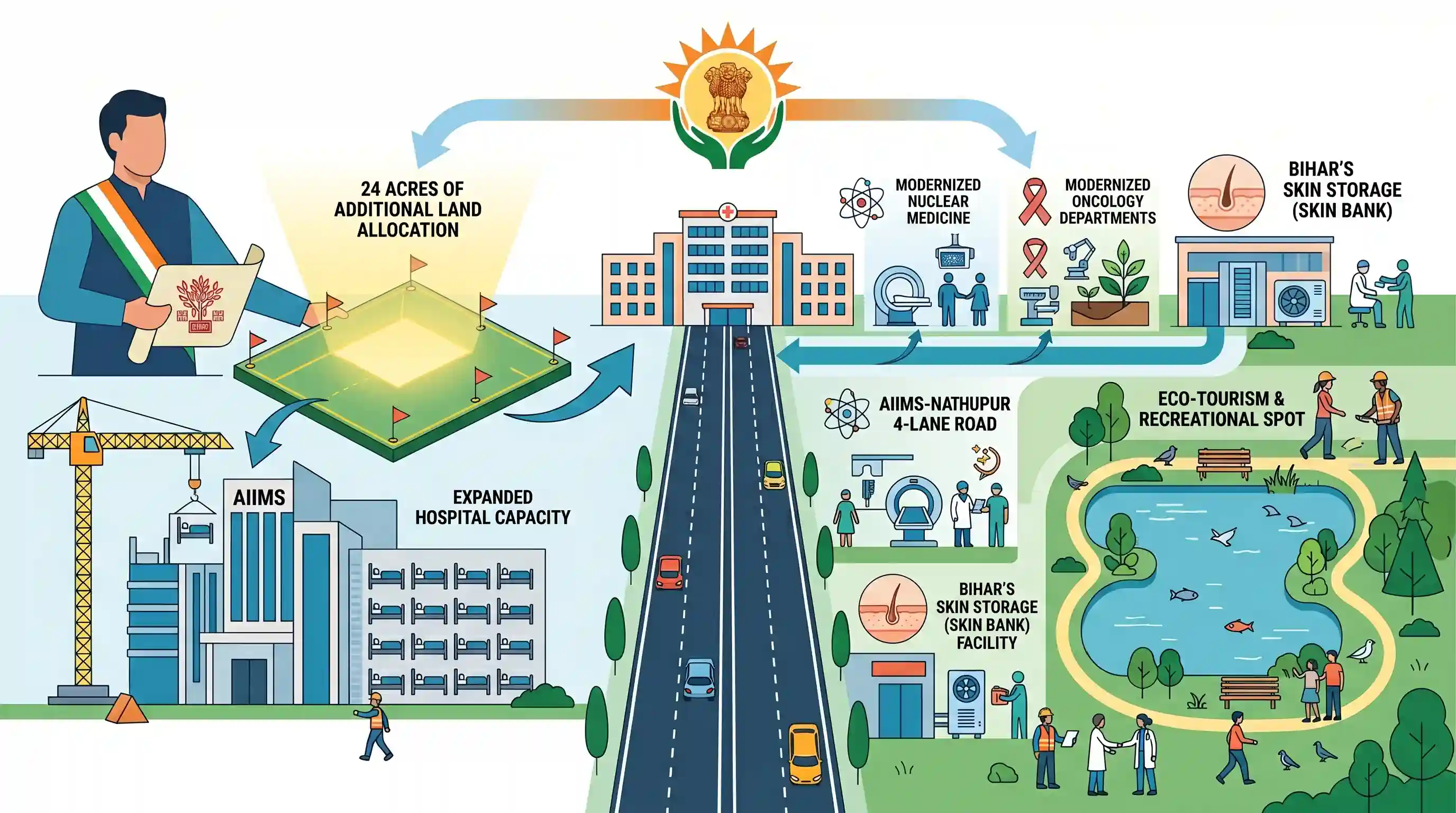
Bihar Chief Minister Samrat Choudhary inspected AIIMS Patna and announced a major expansion plan. The Bihar Government will provide 24 acres of additional land to add 200 new beds, increasing the hospital's capacity. Key features of the upgrade include the construction of the AIIMS–Nathupur 4-lane road for better connectivity, the establishment of Bihar's skin storage (skin bank) facility for burn patients, and the modernization of nuclear medicine and oncology departments. Additionally, the on-campus pond will be beautified as an eco-tourism and recreational spot.
Key Points
- Bihar state government has announced the allocation of 24 acres of additional land for the expansion of AIIMS Patna to accommodate rising medical demands.
- The expansion will add 200 new beds to AIIMS Patna, boosting overall inpatient care capacity and emergency medical response efficiency.
- A new AIIMS–Nathupur 4-lane road will be constructed to reduce travel time, improve emergency accessibility, and ensure smoother transport for patients and attendants.
- A major healthcare upgrade includes setting up a specialized skin bank (skin storage facility) to provide timely skin grafts and improve recovery rates for critically burned patients.
- Advanced medical units such as the PET-CT room under the Nuclear Medicine Department, SPECT-CT facility, Radiopharmacy laboratory, and Oncology division were reviewed for operational improvements.
- The pond located within the AIIMS Patna campus will undergo restoration and beautification to be developed as a tourist attraction, recreational spot, and environmental conservation initiative.
Important Terms
Pradhan Mantri Swasthya Suraksha Yojana (PMSSY)

A central sector scheme launched in 2003 to correct regional imbalances in affordable tertiary healthcare and strengthen medical education by establishing new AIIMS-like institutes and upgrading government medical colleges.
UPSC context
GS Paper II: Government policies, public health infrastructure, and schemes for vulnerable sections.
Ayushman Bharat Pradhan Mantri Jan Aarogya Yojana (AB-PMJAY)
A flagship national public health insurance scheme launched in 2018 providing cashless, paperless secondary and tertiary hospitalization cover of up to ₹5 lakh per family per year to vulnerable families.
UPSC context
GS Paper II: Governance, social sector initiatives, and issues relating to health and poverty.
All India Institute of Medical Sciences (AIIMS) Patna
A premier autonomous public medical institution in Bihar, established under Phase I of PMSSY, designed to provide high-quality tertiary healthcare, medical pedagogy, and clinical research.
UPSC context
GS Paper II: Public health delivery, infrastructure development, and addressing regional medical disparities.
Nuclear Medicine
A medical specialty using trace radioactive materials (radiopharmaceuticals) for diagnostic imaging (such as PET/SPECT scans) and target-directed therapeutic treatment of diseases like cancer.
UPSC context
GS Paper III: Science and Technology applications, specifically nuclear technologies in medical diagnostics.
Oncology
The medical specialty focused on the clinical research, diagnosis, therapeutic treatment (such as chemotherapy and radiation), and long-term care of patients suffering from cancer.
UPSC context
GS Paper II & III: Public health, management of non-communicable diseases, and advanced therapeutics.
Prelims Trap
PMSSY is a Centrally Sponsored Scheme with a 60:40 fund sharing formula, given the active role of states in land acquisition.
PMSSY is a 100% Central Sector Scheme. State governments only provide free land and infrastructure support; they do not share capital costs.
Static Concepts Connected
What is the Pradhan Mantri Swasthya Suraksha Yojana (PMSSY) and its core features?
- Core Objective: Aims to correct regional imbalances in the availability of affordable tertiary healthcare and augment medical education facilities.
- Dual Components: Consists of setting up new AIIMS-like institutions and upgrading existing State Government Medical Colleges.
- Funding Architecture: Funded 100% by the Central Government as a Central Sector Scheme, while state governments provide free land.
How do PET-CT and SPECT-CT imaging technologies differ in diagnostic physics?
- Positron Annihilation: PET utilizes positron-emitting isotopes that undergo annihilation, producing dual 511 keV gamma rays emitted in opposite 180-degree directions.
- Collimation Constraint: SPECT relies on single-photon emitting isotopes and utilizes heavy physical collimators to filter and discard non-aligned rays.
- Sensitivity and Resolution: PET-CT features 100 to 1,000 times higher sensitivity and superior spatial resolution than SPECT-CT due to better photon collection.
Cross-Topic Patterns
Federal Health Governance
Central Sector Schemes like PMSSY depend on cooperative federalism, where states must actively clear land and improve local transport links to operationalize tertiary care.
Biomaterials and Tissue Banking
The use of biological grafts like glycerol-preserved skin showcases the intersection of advanced clinical care and regulatory oversight under India's organ transplantation laws.

Comparing the diagnostic physics of PET-CT vs SPECT-CT, or PMSSY's central-sector funding design, is highly probable for GS-3/GS-2 in 2026.
Linked PYQs · 3
Linked PYQs · 3
- 2024-EBPSC_PRELIMSGS1
Which sector received the highest allocation in the Bihar Budget 2024-25?
- 2018BPSC_PRELIMSGS1
Which scheme was recognized as world's largest insurance scheme launched in India in September 2018?
- 2024-EBPSC_PRELIMSGS1
In which city of Bihar the recently inaugurated National Dolphin Research Centre is located?
