Bihar lymphatic filariasis elimination and survey transition
Source:uniindia ↗
Why It Matters
Understanding regional milestones in vector-borne disease control is vital for BPSC Prelims, which frequently tests biology, mosquito vectors (such as Anopheles and Culex transmitting filaria), state health parameters, and government target years (like India's 2027 LF elimination target).
Summary
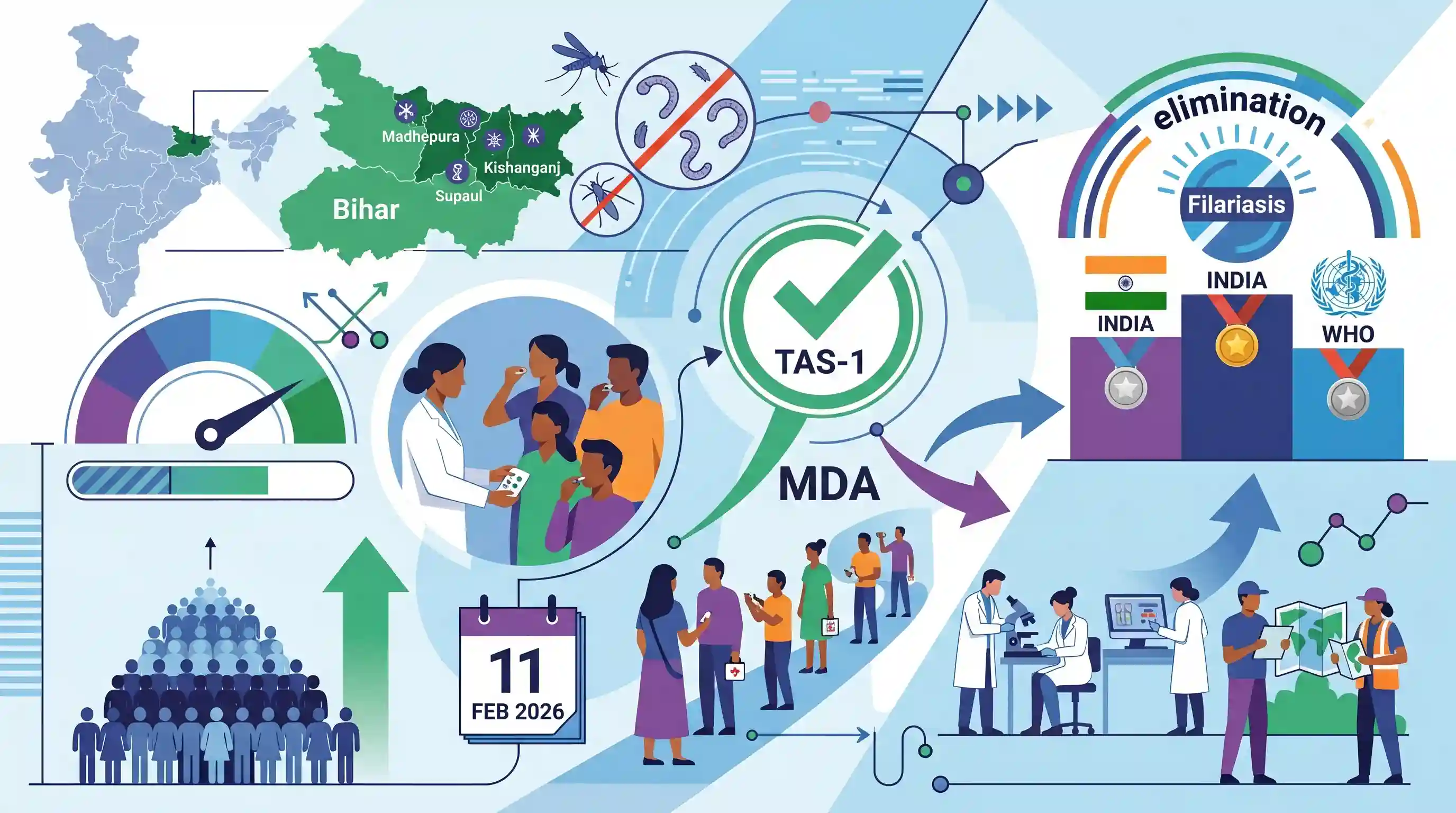
Four districts in Bihar—Araria, Madhepura, Supaul, and Kishanganj—have cleared the Transmission Assessment Survey-1 (TAS-1) to transition from the Mass Drug Administration (MDA) phase to active surveillance under the National Lymphatic Filariasis Elimination Programme. Bihar exceeded its 2026 MDA campaign target by 35% on February 11, 2026, administering anti-filarial medicine to 1.35 crore people using the Directly Observed Treatment (DOT) method. This marks a vital step toward achieving India's national goal of eliminating lymphatic filariasis by 2027, ahead of the WHO's global target of 2030.
Key Points
- Bihar achieved a major milestone in public health as four districts—Araria, Madhepura, Supaul, and Kishanganj—successfully qualified for the surveillance phase of the National Lymphatic Filariasis Elimination Programme after passing the Transmission Assessment Survey-1 (TAS-1).
- By passing the TAS-1, these districts are able to move beyond the Mass Drug Administration (MDA) phase into long-term active disease surveillance.
- On February 11, 2026, Bihar's Health Department surpassed its single-day MDA campaign target by 35%, administering anti-filarial medications to 1.35 crore (13.5 million) individuals against a planned target of 1 crore.
- The campaign effectively utilized the Directly Observed Treatment (DOT) methodology to verify medicine consumption and control transmission.
- The overall prevalence of filariasis has fallen below the critical 1% threshold across 89 implementation blocks (units) in 11 districts of Bihar.
- India's target year to eliminate Lymphatic Filariasis is 2027, which is three years ahead of the World Health Organization's (WHO) global deadline of 2030.
- Pre-TAS (Pre-Transmission Assessment Surveys) involving nocturnal blood sample collection (night blood tests due to nocturnal periodicity of microfilariae) are slated for July 2026 in 107 units across 25 districts to check for active transmission.
Important Terms
National Lymphatic Filariasis Elimination Programme (NLFEP)

India's national health initiative launched in 2004 to eliminate lymphatic filariasis (elephantiasis) through mass drug administration, morbidity management, and vector control.
UPSC context
GS Paper II (Social Justice/Health); tests knowledge of government health policies, neglected tropical diseases, and national disease elimination timelines.
Mass Drug Administration (MDA)
A public health strategy of administering preventive anti-filarial medicines (such as DEC, Albendazole, and Ivermectin) to an entire eligible population in endemic areas to halt disease transmission.
UPSC context
GS Paper II & III (Health/Science); tests mechanisms of public health interventions, communicable disease control, and preventative therapeutic strategies.
Transmission Assessment Survey-1 (TAS-1)
A standardized WHO-designed epidemiological survey used to determine if lymphatic filariasis transmission has fell below critical thresholds, allowing districts to safely transition from mass drug administration to active surveillance.
UPSC context
GS Paper II (Governance/Health); evaluates scientific protocols for epidemiological assessment and transitioning from active treatment campaigns to active surveillance.
Directly Observed Treatment (DOT)
A healthcare delivery approach requiring patients to consume their prescribed medication in the physical presence of a trained health worker, ensuring compliance and preventing medicine wastage.
UPSC context
GS Paper II (Health/Social Sector); tests grassroots administrative strategies for ensuring therapeutic compliance and improving public health program outcomes.
World Health Organization (WHO)
The specialized United Nations agency for global public health that sets international health standards, provides technical guidelines, and monitors progress toward disease elimination targets.
UPSC context
GS Paper II (International Relations); examines global health governance, multilateral organizations, and the alignment of national goals with international targets.
Prelims Trap
Nocturnal blood tests are mandatory because Culex mosquitoes only bite and transmit the filarial parasite between 10 PM and 2 AM.
The survey timing is due to 'nocturnal periodicity' (microfilariae circulating in peripheral blood at night), not because transmission or mosquito bites are restricted to those hours.
Static Concepts Connected
What are the biological and transmission characteristics of Lymphatic Filariasis?
- Causal Parasites: Caused by microscopic, thread-like parasitic roundworms (nematodes), primarily *Wuchereria bancrofti* and *Brugia malayi*, which damage the human lymphatic system.
- Vectors: Transmitted by mosquitoes; *Culex quinquefasciatus* is the primary vector in urban India, though *Anopheles* species can also transmit it.
- Nocturnal Periodicity: Microfilariae circulate in peripheral blood primarily at night (10 PM to 2 AM) to match vector feeding habits, requiring night-time diagnostic blood collection.
What is India's policy framework for Lymphatic Filariasis elimination?
- Dual Targets: India targets national elimination by 2027, three years ahead of the World Health Organization's (WHO) global target of 2030.
- Mass Drug Administration: Under the NLFEP, preventive chemotherapy (combinations like DEC and Albendazole) is distributed annually to eligible populations in endemic districts.
- Surveillance Transition: Districts transition from MDA to active surveillance after passing the Transmission Assessment Survey-1 (TAS-1), proving microfilaria prevalence is below 1%.
Cross-Topic Patterns
NTDs and multi-dimensional poverty
Lymphatic Filariasis is a Neglected Tropical Disease (NTD). Its eradication directly supports SDG 1 (No Poverty) and SDG 3 (Good Health) by preventing permanent physical disability in working-class populations.
Center-State execution in health
While the NLFEP sets centralized policy, successful elimination hinges on state-level execution and decentralized health machinery, as seen in Bihar's Directly Observed Treatment (DOT) model.

Questions may test the biological reason for nocturnal blood tests (periodicity) alongside India's 2027 national elimination target.
Linked PYQs · 1
Linked PYQs · 1
- 2024-IBPSC_PRELIMSGS1
Besides spreading Malaria, Anopheles mosquito’s are also vectors of
