Bihar Clears TAS-1 Milestone in Lymphatic Filariasis Elimination
Source:who ↗
Why It Matters
This development is highly significant for the BPSC Prelims, given Bihar's historical struggle with high endemicity of vector-borne tropical diseases. It highlights policy interventions (MDA, DOT), state-WHO partnerships, and biology concepts related to disease vectors and parasitic infections that are frequently tested in BPSC science and state-specific sections.
Summary
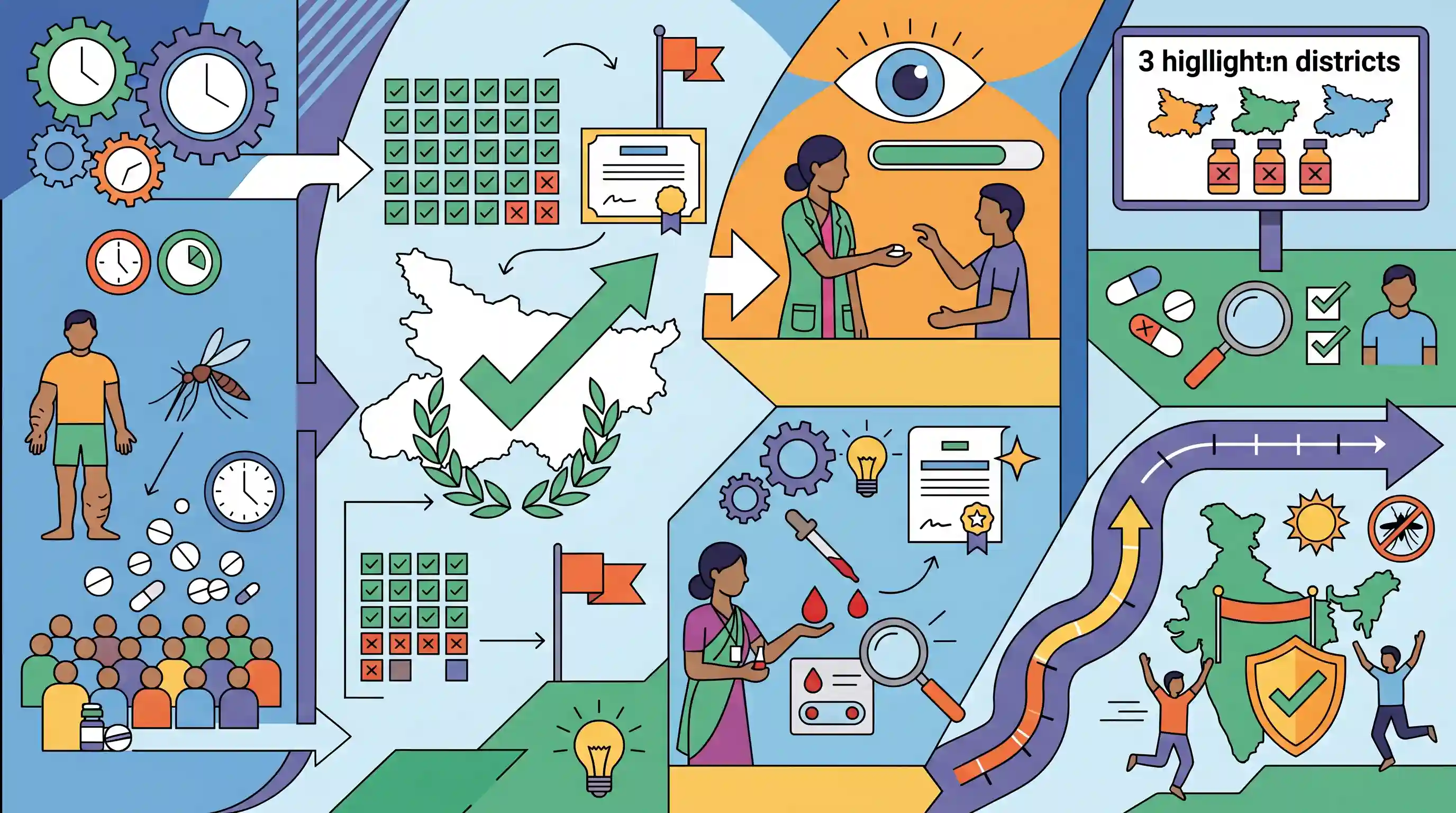
Bihar has achieved a historic milestone in its public health sector by clearing the Transmission Assessment Survey-1 (TAS-1) for Lymphatic Filariasis (LF) for the first time since starting Mass Drug Administration (MDA) in 2004. Fifty-five of Bihar's 57 assessed implementation units passed the survey, enabling the districts of Araria, Madhepura, and Supaul to stop MDA and shift to post-MDA surveillance. The breakthrough is attributed to a focus on Directly Observed Treatment (DOT) and frontline training of Community Health Officers (CHOs) for antigen testing. This achievement accelerates India's target to eliminate Lymphatic Filariasis as a public health issue by 2027.
Key Points
- Bihar has successfully cleared its first Transmission Assessment Survey-1 (TAS-1) since launching the Mass Drug Administration (MDA) in 2004, marking a historic breakthrough in Lymphatic Filariasis (LF) elimination.
- Out of 57 implementation units assessed across four districts, 55 cleared the survey. Three districts—Araria, Madhepura, and Supaul—fully cleared and have stopped MDA to transition to post-MDA active surveillance. Kishanganj narrowly missed clearing all units.
- As of May 2026, LF remains endemic in 350 districts across 20 states and union territories in India, with Bihar historically having all of its 38 districts categorized as endemic.
- The key strategy shift that enabled this achievement was the rigorous emphasis on Directly Observed Treatment (DOT), ensuring that medicines are consumed in the presence of health workers rather than just being distributed.
- The National Centre for Vector Borne Diseases Control (NCVBDC) and WHO provided extensive microplanning, technical, and quality assurance support, while trained Community Health Officers (CHOs) performed high-accuracy LF antigen testing.
- Lymphatic Filariasis is a vector-borne neglected tropical disease caused by filarial roundworms and transmitted by mosquitoes, including Anopheles, which is also a vector for malaria and encephalitis.
Important Terms
Mass Drug Administration (MDA)

A public health strategy of administering safe, preventive anti-filarial medicines annually to an entire eligible at-risk population in endemic districts to interrupt disease transmission.
UPSC context
GS Paper II (Social Justice/Health) and Paper III (Science & Tech); tests strategies for eradicating neglected tropical diseases.
Transmission Assessment Survey-1 (TAS-1)
A standardized WHO-guided epidemiological survey that tests a sample of children to determine if disease transmission has fallen below thresholds to safely stop Mass Drug Administration.
UPSC context
GS Paper II (Public Health Governance); tests methodologies for evaluating national health programs and adherence to international health benchmarks.
Directly Observed Treatment (DOT)
A public health compliance protocol where patients consume their prescribed medicines under the direct physical observation of a trained healthcare worker to ensure actual ingestion.
UPSC context
GS Paper II (Health Service Delivery); tests ground-level execution, compliance, and governance challenges in nationwide disease control campaigns.
National Centre for Vector Borne Diseases Control (NCVBDC)
The apex national body under India's health ministry coordinating the prevention, control, and elimination of vector-borne illnesses, including malaria, dengue, and lymphatic filariasis.
UPSC context
GS Paper II (Government Bodies & Health Policies); tests knowledge of institutional systems responsible for epidemic management and disease control.
World Health Organization (WHO)
The United Nations specialized agency for global public health that sets clinical guidelines, coordinates international disease surveillance, and provides technical assistance for country-level elimination programs.
UPSC context
GS Paper II (International Institutions); tests multilateral collaboration, global health governance, and technical support in regional eradication efforts.
Government of Bihar
The state executive body in India responsible for healthcare governance, mobilizing grassroots health personnel, and executing state-wide interventions to eliminate endemic diseases like lymphatic filariasis.
UPSC context
GS Paper II (State Governance & Federalism); tests cooperative federalism and decentralised health service delivery performance in high-burden regions.
Prelims Trap
Lymphatic filariasis is transmitted solely by Culex mosquitoes, while Anopheles mosquitoes transmit only malaria.
Anopheles mosquitoes are recognized vectors for both malaria and lymphatic filariasis, debunking the misconception that they exclusively transmit malaria.
Static Concepts Connected
What are the biological causes and drug regimens used to treat Lymphatic Filariasis?
- Causative agents: Parasitic roundworms (nematodes)—predominantly Wuchereria bancrofti (90% cases), alongside Brugia malayi and Brugia timori.
- Vector transmission: Spread by multiple mosquito genera, including Culex, Anopheles, Aedes, and Mansonia.
- Drug regimens: Preventive chemotherapy uses Double Drug Therapy (DEC + Albendazole) or Triple Drug Therapy (Ivermectin + DEC + Albendazole, known as IDA).
What defines a Neglected Tropical Disease (NTD) under WHO's classification?
- Target population: A diverse group of tropical infections most common in marginalized, low-income communities lacking clean water and sanitation.
- Pathogen diversity: Caused by a variety of pathogens including viruses, bacteria, parasites, fungi, and toxins.
- Key examples: Includes Lymphatic Filariasis, Trachoma, Kala-azar, Rabies, Soil-Transmitted Helminthiases, and Dengue.
Cross-Topic Patterns
National health targets vs. SDG 3.3
India's aggressive 2027 target for LF elimination highlights how domestic public health missions outpace global SDG 2030 targets to showcase subnational governance breakthroughs.
Vector biology + Climate shifts
Warming temperatures expand the geographical range of Culex and Anopheles vectors, complicating local eradication efforts and demanding climate-resilient epidemiologic surveillance.

Prelims 2026 may test LF vectors (Anopheles/Culex) and India's 2027 elimination target against WHO's global 2030 SDG framework.
Linked PYQs · 1
Linked PYQs · 1
- 2024-IBPSC_PRELIMSGS1
Besides spreading Malaria, Anopheles mosquito’s are also vectors of
