Higher Education Expansion Under State Development Programme
Source:patnapress ↗
Why It Matters
This initiative is a critical development in decentralising higher education in Bihar to the block level under Saat Nishchay-3. It highlights the state's strategic focus on increasing gross enrolment in higher education, improving safety for female students via targeted transit (Pink Bus), and implementing massive rural educational infrastructure.
Summary
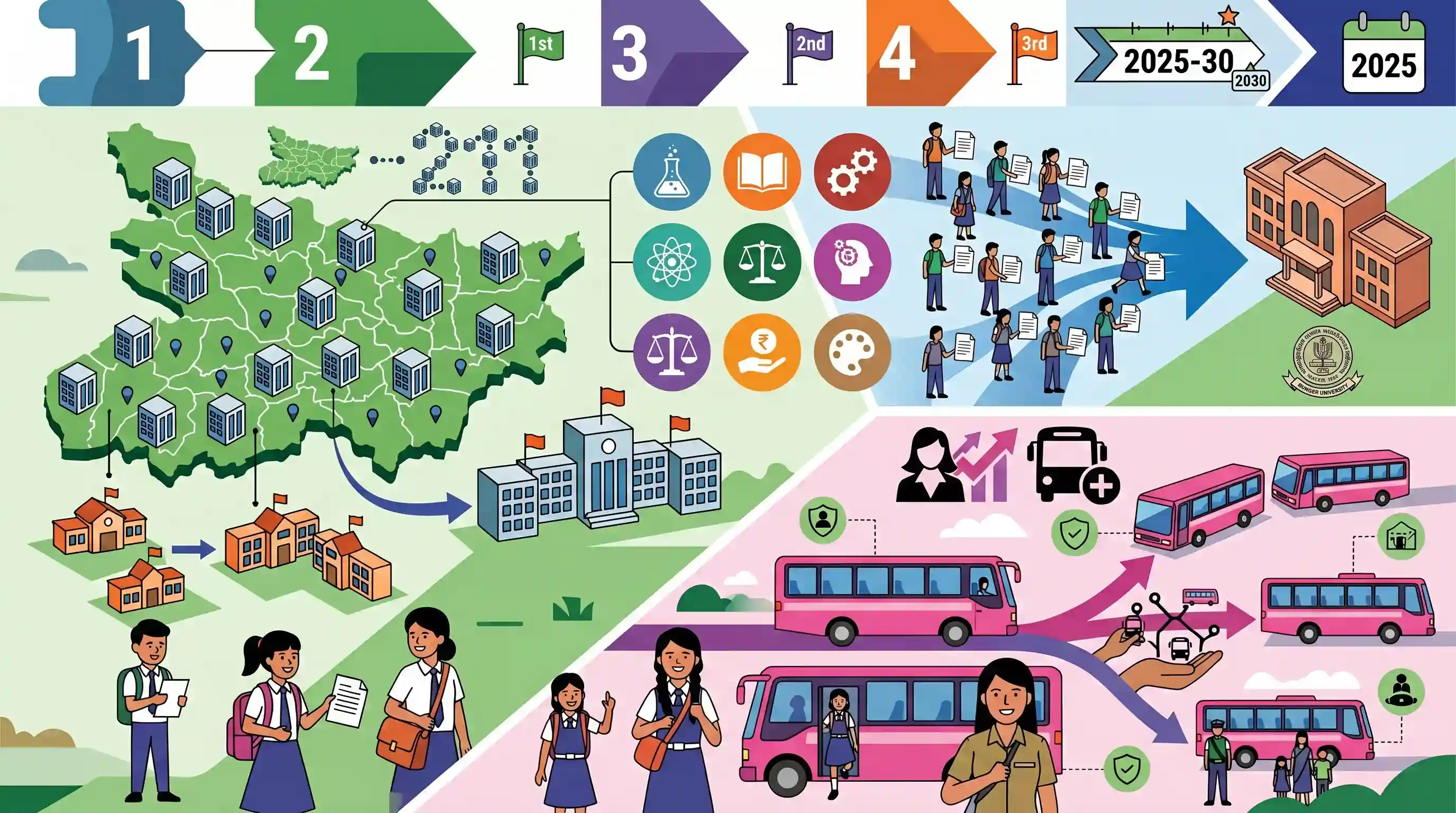
Under the fourth component of the Saat Nishchay-3 (2025-30) programme, the Bihar government will open 211 new 'Rajkiya Degree Mahavidyalayas' across blocks starting July 1, 2026. The colleges will initially operate from temporary school campuses, offering six core disciplines, with Munger University handling the highest volume of applications. Additionally, the state will expand its Pink Bus service to enhance transit access and safety for female students.
Key Points
- Bihar is launching 211 new government degree colleges named 'Rajkiya Degree Mahavidyalaya [Block Name]' across the state from July 1, 2026, marking the start of the 2026-30 academic session.
- This massive higher education expansion is being implemented under the fourth component of Bihar's flagship Saat Nishchay-3 (2025-30) programme.
- In the first phase, teaching will begin in six core disciplines: Hindi, English, Economics, History, Political Science, and Sociology, with Hindi and History receiving the highest number of applicants.
- Munger University received the highest share of college admission applications (31,218 out of 57,421 total applications received statewide).
- The institutions will initially run from temporary school premises, with Rs 30 lakh allocated per college for furniture and academic equipment, and Rs 20 lakh allocated for temporary campus renovations.
- For permanent campuses, a minimum land requirement of 2.5 acres in urban areas and 5 acres in rural areas has been set, with colleges potentially named after land donors.
- To promote female participation in higher education, the Bihar government will expand its 'Pink Bus service' from July 1, and a welcome event called 'Pravesh Utsav' will mark the opening day.
Important Terms
Saat Nishchay-3 (2025-30) programme

Bihar government's flagship multi-year development agenda outlining seven priority resolves (including employment, industry, agriculture, education, and health) to drive inclusive growth and make Bihar a developed state.
UPSC context
GS Paper II: Welfare schemes and state policies. Tests sub-national governance, cooperative federalism, and socio-economic planning.
Rajkiya Degree Mahavidyalayas
Government degree colleges established across administrative blocks in Bihar to decentralize higher education, expand academic access in rural areas, and curb student out-migration.
UPSC context
GS Paper II: Social Justice and Education. Tests public policies for educational decentralization and enhancing rural access to higher education.
Pink Bus service
A gender-sensitive public transport initiative by the Bihar government providing safe, subsidized, and dedicated transit options for female students and working women to access education and employment.
UPSC context
GS Paper II: Women Empowerment and Social Justice. Tests gender-inclusive urban planning, safety interventions, and access to educational infrastructure.
Higher Education Department (Bihar)
A newly created separate department of the Bihar Government responsible for upgrading academic standards, strengthening state universities, regulating research, and establishing block-level colleges.
UPSC context
GS Paper II: Governance and Education Policies. Tests administrative restructuring, public sector capacity building, and human resource management.
Pravesh Utsav
A state-level special school enrollment drive and awareness campaign aimed at bringing out-of-school and dropout children back to government schools, ensuring 100% enrollment.
UPSC context
GS Paper II: Social Justice and Education. Tests grassroots enrollment strategies, primary education governance, and school retention policies.
Munger University
A public state university in Bihar established in 2018 to manage higher education and affiliate colleges across five districts under the Munger Division.
UPSC context
GS Paper II: Issues Relating to Education. Tests regional higher education infrastructure, administrative decentralization, and state university operations.
Prelims Trap
Saat Nishchay-3 is a centrally sponsored scheme under the Union Ministry of Education designed to establish model colleges.
Saat Nishchay is Bihar's domestic flagship development framework funded by the state, not a Union Ministry initiative or a Centrally Sponsored Scheme.
Static Concepts Connected
What is the Gross Enrolment Ratio (GER) in Higher Education and its targets?
- Definition: GER measures the student population enrolled in higher education (18-23 years) as a percentage of the total population in that age bracket.
- NEP 2020 Target: The National Education Policy (NEP) 2020 sets a target to raise India's higher education GER to 50% by the year 2035.
- Current Status: India's higher education GER stands at approximately 28.4% (per AISHE 2021-22), showing wide regional and gender disparities across states.
Under which constitutional schedule does Education fall, and how is it governed?
- Concurrent List entry: Education was moved from the State List to the Concurrent List (Entry 25) via the 42nd Constitutional Amendment Act of 1976.
- Dual Legislative Authority: Both central and state governments can legislate, but the Parliament maintains supremacy in establishing coordination and standards of higher education.
- Regulatory Oversight: While states can establish and fund state universities, they must adhere to standards set by the University Grants Commission (UGC) under federal entry 66.
Cross-Topic Patterns
Fiscal federalism & sub-national welfare models
State-specific flagship programs like Saat Nishchay demonstrate how states address regional deficits through targeted fiscal resource allocations independent of central sponsorship.
Gender-responsive transit and educational access
Combining rural collegiate expansion with dedicated transit (Pink Bus) tackles structural safety and distance barriers, directly accelerating female Gross Enrolment Ratio.

Mains 2026 may contrast physical educational infrastructure expansion with digital learning modes to address regional GER disparities.
Linked PYQs · 2
Linked PYQs · 2
- 2020BPSC_PRELIMSGS1
Which of the following is not included in Seven Resolves (Saat Nishchay) of Bihar Government?
- 2025BPSC_PRELIMSGS1
What is the primary objective of Bihar’s Mission Daksh?
