Big tech artificial intelligence capital expenditure market risks
Source:Indian Express ↗
Why It Matters
The article highlights the macroeconomic risks and sector-specific vulnerabilities associated with rapid AI advancements, particularly the threat posed to India's crucial IT export sector and the broader implications of massive global capital reallocation.
Summary
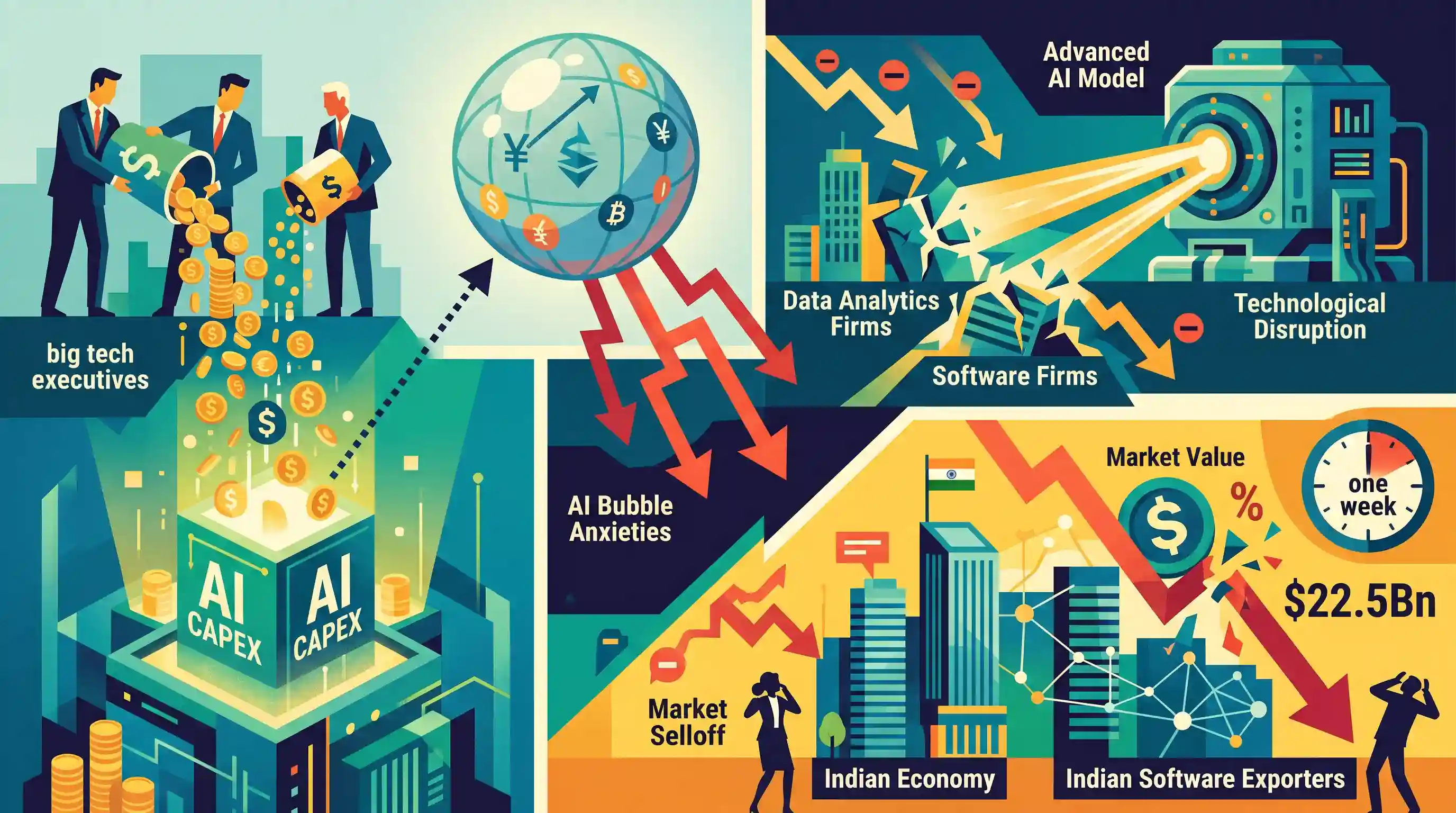
The anticipated $600 billion AI capital expenditure by major US tech companies has triggered anxiety in global markets over potential 'investment bubbles' and uncertain returns. Simultaneously, the release of advanced AI models has led to steep selloffs in data analytics and software firms, erasing $22.5 billion from Indian software exporters' market value in just one week due to fears of technological disruption.
Key Points
- Major US technology companies, including Amazon, Alphabet, Meta, and Microsoft, are planning to spend a combined $600 billion on AI infrastructure by 2026.
- The massive scale of capital expenditure is causing unease among investors due to concerns over profitability, return on investment, and a potential AI investment bubble.
- The release of advanced AI agents capable of complex tasks has triggered steep market selloffs in traditional software, data analytics, and professional services firms.
- Indian software exporters suffered significant collateral damage, losing $22.5 billion in market value in a single week over fears of AI-driven business disruption.
- Despite investor anxiety, tech leaders maintain that the unprecedented demand for AI processing power justifies the heavy capital outlays.
Important Terms
Nvidia

A dominant semiconductor company whose Graphics Processing Units (GPUs) serve as the essential hardware backbone for training and deploying large-scale artificial intelligence models globally.
UPSC context
GS III: Science & Technology and Economy; critical for understanding semiconductor geopolitics, supply chains, and national AI infrastructure needs.
Anthropic
An AI safety and research company, creator of the 'Claude' models, focused on building 'reliable, interpretable, and steerable' systems through a framework known as Constitutional AI.
UPSC context
GS III: Science & Technology; relevant to AI ethics, safety frameworks, and technological disruption in the global software services sector.
Alphabet
The parent company of Google, utilizing massive capital expenditure to develop its Gemini AI models and maintain its competitive edge in cloud computing and digital advertising.
UPSC context
GS III: Economy; highlights the impact of massive corporate investment on global market volatility and digital economy competition.
Microsoft
A technology giant leading the AI transition through its partnership with OpenAI and integration of generative AI into its Azure cloud platform and enterprise software.
UPSC context
GS III: Science & Technology; representative of corporate-led innovation models and their influence on the global IT service industry.
Amazon
The global leader in e-commerce and cloud services (AWS), undertaking record-level capital spending to build infrastructure for corporate AI contracts and maintain cloud dominance.
UPSC context
GS III: Economy; illustrates the scale of private investment in digital infrastructure and its effects on international capital flows.
Meta Platforms
The parent company of Facebook and Instagram, which advocates for an 'open-source' AI strategy by releasing its 'Llama' models for free public use and development.
UPSC context
GS III: Science & Technology; central to debates over open vs. proprietary technology and democratizing access to emerging digital tools.
Prelims Trap
"Agentic AI models require continuous human prompting and step-by-step guidance to execute complex workflows."
Agentic AI differs from standard LLMs specifically because of its autonomy—it sets goals, reasons, and executes multi-step workflows independently without needing continuous human intervention.
Static Concepts Connected
What distinguishes Agentic AI from traditional Generative AI?
- Autonomy: Acts independently to achieve defined goals without requiring constant step-by-step human prompting.
- Action-oriented: Goes beyond merely generating text or images to directly executing software workflows and API calls.
- Self-correction: Capable of perceiving its environment, reasoning through errors, and adjusting its approach dynamically.
What is the macroeconomic significance of India's traditional IT-BPM sector?
- Export anchor: IT services dominate India's invisible exports, playing a critical role in offsetting the merchandise trade deficit.
- Employment engine: The sector is India's largest organized private-sector employer, vital for urban mass-hiring.
- Revenue model: Historically reliant on scale, volume-based billing, and labor arbitrage—legacy models now structurally threatened by AI.
Cross-Topic Patterns
Agentic AI + Demographic Dividend
Automation of routine coding and BPO tasks threatens the IT sector's mass-hiring model, directly challenging India's ability to provide organized employment for its educated youth.
Global Tech Bubbles + Capital Flight
If the $600 billion US AI capex fails to yield returns, a burst bubble could tighten global liquidity, triggering severe FPI outflows from emerging markets like India.

Agentic AI's autonomy vs GenAI is a prime Prelims target; Mains will likely test the structural disruption of India's IT export model.
Linked PYQs · 3
Linked PYQs · 3
- 2023MainsGS3
Introduce the concept of Artificial Intelligence (AI). How does Al help clinical diagnosis? Do you perceive any threat to privacy of the individual in the use of Al in healthcare?
- 2020PrelimsGS1
With the present state of development, Artificial Intelligence can effectively do which of the following? 1. Bring down electricity consumption in industrial units 2. Create meaningful short stories and songs 3. Disease diagnosis 4. Text-to-Speech Conversion 5. Wireless transmission of electrical energy Select the correct answer using the code given below:
- 2023MainsGS3
What is the status of digitalization in the Indian economy? Examine the problems faced in this regard and suggest improvements.
