Iran Rejects United States Terms in Islamabad Talks
Source:Indian Express ↗
Why It Matters
The collapse of US-Iran negotiations and the ongoing closure of the Strait of Hormuz present critical risks to global energy security and geopolitical stability. For India, heightened tensions in West Asia and disruptions to strategic oil transit chokepoints directly threaten energy imports, economic stability, and strategic interests in the region.
Summary
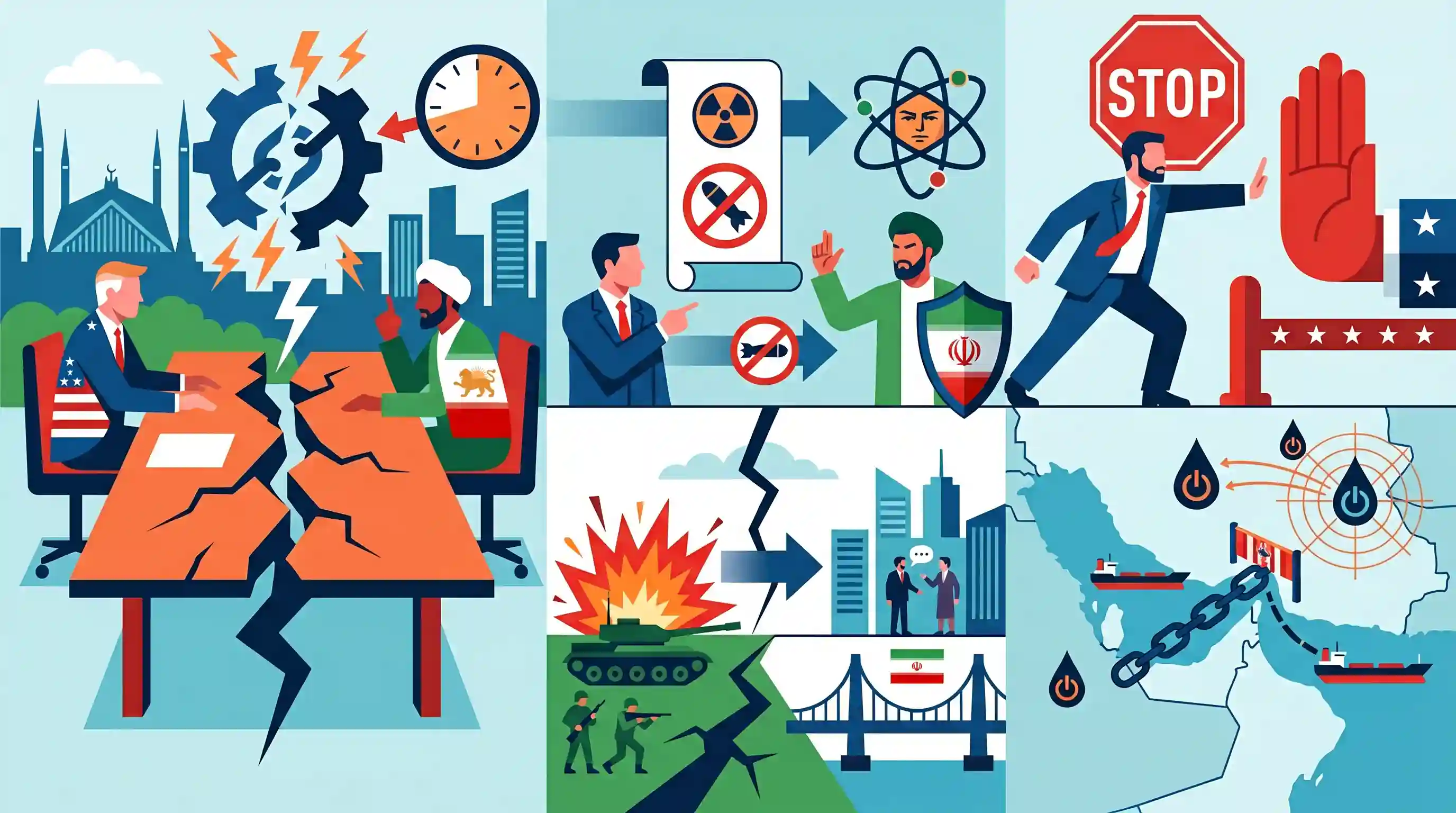
Recent US-Iran talks held in Islamabad, Pakistan, aimed at resolving ongoing tensions, collapsed after 21 hours of negotiations. Iran definitively rejected US demands concerning its nuclear program, specifically refusing to commit to not seeking a nuclear weapon. US Vice President JD Vance characterized Iran's response to the proposed terms as a "BIG NO." In response, Iran asserted that the US was attempting to secure concessions diplomatically that it had failed to achieve through warfare. Additionally, Iran highlighted its continued strategic leverage by emphasizing that the Strait of Hormuz, a critical chokepoint for global energy transit, remains closed.
Key Points
- Intensive 21-hour negotiations between the US and Iran in Islamabad concluded without an agreement.
- Iran rejected US terms demanding an affirmative commitment that it will not seek to acquire a nuclear weapon.
- US Vice President JD Vance stated that Iran described the US conditions as a 'BIG NO.'
- Iran accused the US of seeking diplomatic concessions that it could not obtain through military conflict.
- Iran underscored its geopolitical leverage by noting that the strategic Strait of Hormuz remains closed.
Important Terms
Strait of Hormuz

A narrow waterway connecting the Persian Gulf and the Gulf of Oman; it is the world's most critical oil chokepoint, handling ~20% of global oil trade.
UPSC context
GS Paper II (International Relations). Tests knowledge of maritime chokepoints, West Asia geopolitics, and energy supply chain vulnerabilities.
Islamabad Talks (2026)
A high-level 2026 diplomatic engagement mediated by Pakistan between US and Iranian officials to resolve conflict and reopen the Strait of Hormuz; ended without agreement.
UPSC context
GS Paper II (International Relations). Tests understanding of bilateral mediation, the role of regional actors (Pakistan), and crisis diplomacy.
Energy Security
The uninterrupted availability of energy sources at an affordable price; India is highly vulnerable to disruptions in the Strait of Hormuz for its crude oil and LNG imports.
UPSC context
GS Paper III (Economy). Tests understanding of India's import dependency, inflation risks, and the need for strategic petroleum reserves.
Nuclear Proliferation
The spread of nuclear weapons and technology to countries not recognized as "Nuclear Weapon States"; a central point of contention in US-Iran negotiations.
UPSC context
GS Paper II (International Relations). Tests knowledge of global security frameworks, NPT compliance, and nuclear diplomacy.
Strategic Leverage
The use of a specific tactical advantage—such as control over a geographic chokepoint or military assets—to influence diplomatic outcomes or gain concessions.
UPSC context
GS Paper II (International Relations). Tests ability to analyze asymmetrical power dynamics and geopolitical bargaining strategies.
Naval Blockade
The use of naval power to prevent ships from entering or leaving a nation's ports; threatened by the US following the failure of the Islamabad talks.
UPSC context
GS Paper II (International Relations). Tests understanding of international conflict escalation and maritime law (UNCLOS).
Prelims Trap
"The Strait of Hormuz is a strategic chokepoint bordered by Iran to the north and Saudi Arabia to the south."
Saudi Arabia does not border the Strait of Hormuz. The southern coast is controlled by Oman (the Musandam Peninsula) and the UAE.
Static Concepts Connected
What is the geographical and economic significance of the Strait of Hormuz?
- Location: It acts as a narrow maritime bottleneck connecting the Persian Gulf to the Gulf of Oman and the Arabian Sea.
- Bordering Nations: It is bordered by Iran to the north, and the United Arab Emirates and Oman (Musandam exclave) to the south.
- Global Significance: It is the world's most critical energy transit chokepoint, handling roughly 20% of global daily crude oil supply (approx. 20 million barrels per day).
How do the NPT and JCPOA frameworks govern Iran's nuclear activities?
- NPT Status: Iran ratified the Non-Proliferation Treaty in 1970 as a non-nuclear-weapon state, legally binding it not to acquire nuclear weapons.
- JCPOA Framework: The 2015 agreement (with P5+1 and EU) placed strict, temporary limits on Iran's uranium enrichment in exchange for lifting international economic sanctions.
- IAEA Oversight: Under these treaties, the International Atomic Energy Agency (IAEA) is responsible for inspecting and verifying that Iran's nuclear program remains strictly peaceful.
Cross-Topic Patterns
Chokepoints & Current Account Deficit
Closure of Hormuz threatens 50% of India's crude imports, directly risking imported inflation, widening the Current Account Deficit, and putting severe downward pressure on the Rupee.
US-Iran friction vs. Chabahar Port
Heightened US-Iran tensions complicate India's strategic balancing act regarding its 10-year Chabahar Port agreement and broader International North-South Transport Corridor (INSTC) ambitions.

Expect a 2026 prelims question mapping West Asian maritime chokepoints alongside India’s strategic petroleum reserves and import dependencies.
Linked PYQs · 3
Linked PYQs · 3
- 2018MainsGS2
In what ways would the ongoing US-Iran Nuclear Pact Controversy affect the national interest of India? How should India respond to this situation?
- 2017MainsGS2
The question of India's Energy Security constitutes the most important part of India's economic progress. Analyze India's energy policy cooperation with West Asian countries.
- 2024PrelimsGS1
Consider the following statements : Statement-I : Sumed pipeline is a strategic route for Persian Gulf oil and natural gas shipments to Europe. Statement-II : Sumed pipeline connects the Red Sea with the Mediterranean Sea. Which one of the following is correct in respect of the above statements?
