Jodhpur High Court Bench Clears All Pending Death Penalty Cases
Source:lawsandlegals ↗
Why It Matters
State judiciary mechanisms, especially the statutory requirement under CrPC for High Courts to confirm trial court death sentences, are important for the RPSC Prelims Polity syllabus. It tests knowledge of judicial hierarchies, capital punishment jurisprudence (rarest of rare doctrine), and the specific territorial jurisdictions/seats of the Rajasthan High Court.
Summary
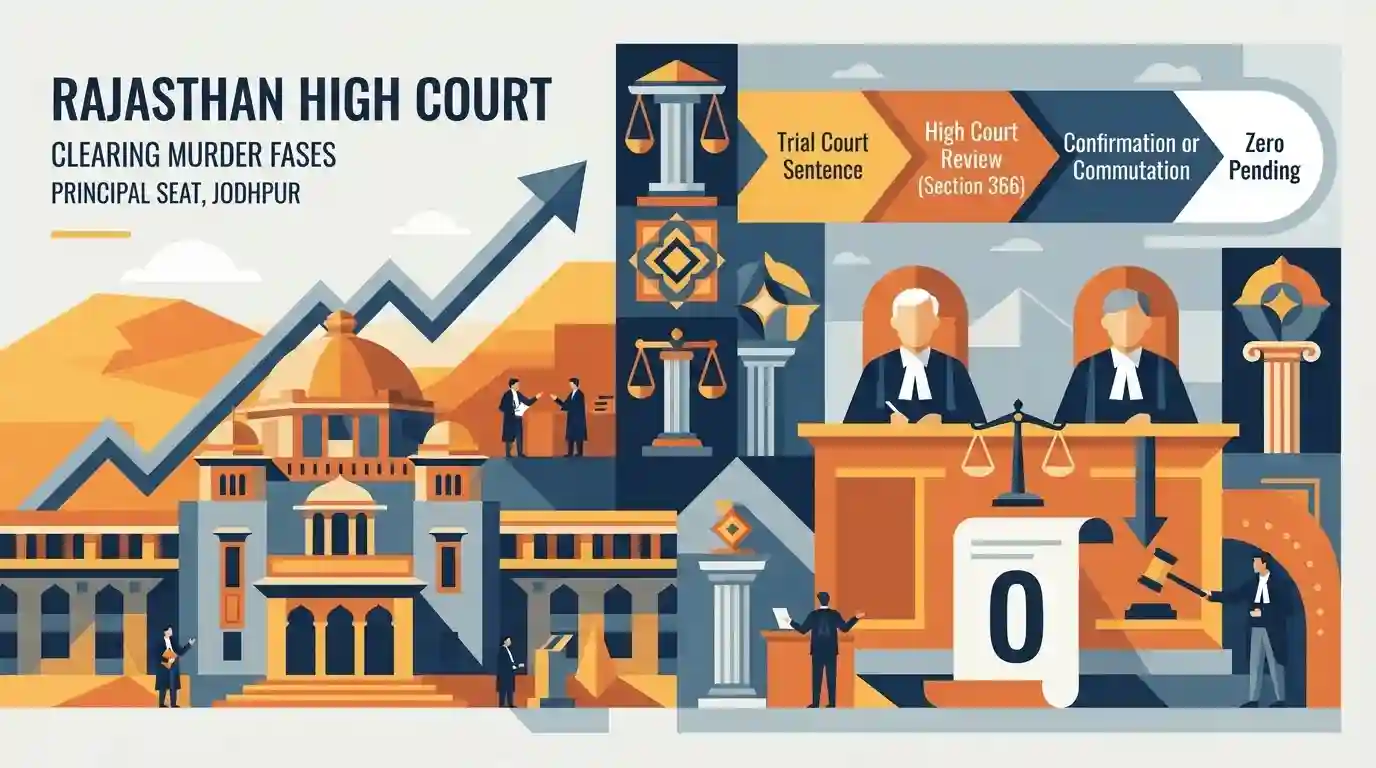
The Principal Seat of the Rajasthan High Court at Jodhpur has achieved a notable judicial milestone by clearing all pending death penalty confirmation cases, legally termed as 'murder references'. Under Section 366 of the CrPC, a death sentence passed by a Court of Session cannot be executed unless it is confirmed by the High Court. A Division Bench comprising Justices Pushpendra Singh Bhati and Munnuri Laxman decided the final pending murder reference by commuting a trial court's death penalty to life imprisonment, bringing the pendency of such critical cases at the Jodhpur bench to zero. This highlights the court's efficiency in handling high-stakes capital punishment cases, which in India are governed by the 'rarest of rare' doctrine.
Key Points
- The Principal Seat of the Rajasthan High Court in Jodhpur achieved zero pendency of death penalty confirmation cases (murder references).
- Under Section 366 of the Code of Criminal Procedure (CrPC), any death sentence awarded by a Sessions Court must be submitted to the High Court for mandatory confirmation before it can be executed.
- Such cases are admitted in the High Court as 'murder references'.
- The final pending case was cleared by a Division Bench, which upheld the conviction but commuted the trial court's death sentence to life imprisonment.
- In India, capital punishment is strictly guided by the 'rarest of rare' doctrine established by the Supreme Court in the Bachan Singh v. State of Punjab (1980) case.
Important Terms
Murder Reference

A legal procedure under Section 366 of the CrPC where a death sentence awarded by a Court of Session must be submitted to the High Court for mandatory confirmation before execution.
UPSC context
Important for GS Paper 2 (Judiciary); tests knowledge of appellate procedures and capital punishment safeguards in India's criminal justice system.
Rarest of Rare Doctrine
A judicial principle from the 1980 Bachan Singh case restricting the death penalty to exceptional crimes that shock society's collective conscience, ensuring it remains an exception.
UPSC context
Highly relevant for GS Paper 2 (Judiciary); tests debates on capital punishment, Article 21, and judicial discretion constraints.
Section 366 of the CrPC
A procedural safeguard mandating that a death sentence pronounced by a Court of Session cannot be executed unless independently evaluated and confirmed by the High Court.
UPSC context
Useful for GS Paper 2 (Judiciary); highlights statutory safeguards preventing arbitrary execution of capital punishment at the district level.
Court of Session
The highest criminal trial court in a district. It has the authority to try severe offenses like murder and can impose the death penalty, subject to High Court approval.
UPSC context
Crucial for GS Paper 2 (Subordinate Judiciary); tests understanding of the district court hierarchy and its sentencing limits.
Code of Criminal Procedure (CrPC)
The principal legislation outlining the procedural mechanisms for administering substantive criminal law in India, governing processes like police investigation, trials, bail, and sentencing appeals.
UPSC context
Relevant to GS Paper 2; tests awareness of India's procedural criminal laws and overarching criminal justice system frameworks.
Indian Penal Code (IPC)
India's official, substantive criminal code that defines various criminal offenses—such as murder and rape—and prescribes their corresponding punishments, including the death penalty.
UPSC context
Relevant for GS Paper 2; fundamental to understanding how crimes are substantively defined and penalized before procedural mechanisms are applied.
Prelims Trap
"A Sessions Court's death sentence can be executed immediately if the convict chooses not to file an appeal."
A death sentence requires mandatory High Court confirmation (BNSS Sec 407 / CrPC Sec 366) to be executed, even if the convict does not appeal.
Static Concepts Connected
What is the procedure for confirming a death sentence in India?
- Mandatory Confirmation: A death sentence passed by a Sessions Court cannot be executed unless it is submitted to and confirmed by the High Court (BNSS Sec 407).
- Bench Strength: The confirmation proceeding (murder reference) must typically be heard and decided by a Division Bench of at least two High Court judges.
- Further Recourse: If confirmed by the High Court, the convict can still appeal to the Supreme Court or seek executive clemency via mercy petitions.
What is the 'Rarest of Rare' doctrine in Indian criminal law?
- Landmark Origin: Established by a 5-judge Constitution Bench of the Supreme Court in the Bachan Singh v. State of Punjab (1980) case.
- Core Principle: It mandates that life imprisonment is the rule, and the death penalty is the exception, applied only when alternative options are unquestionably foreclosed.
- Balancing Test: Courts must weigh the aggravating circumstances of the crime against the mitigating circumstances of the criminal before awarding a death sentence.
Cross-Topic Patterns
Judicial Commutation vs Executive Clemency
Judicial commuting by a High Court contrasts with the President’s Article 72 pardoning powers, providing a classic UPSC comparative testing ground on separation of powers in capital cases.
CrPC to BNSS procedural transitions
The translation of CrPC Sec 366 to BNSS Sec 407 makes procedural criminal law highly testable this year alongside broader justice system reforms and pendency issues.

Expect a multi-statement question contrasting High Court death sentence confirmations under BNSS 407 with Article 72 Presidential clemency.
Linked PYQs · 2
Linked PYQs · 2
- 2023RPSC_PRELIMSGS1
According to Article 217 (1) of the Constitution, the President shall make the appointment of a judge of the Rajasthan High Court (other than the Chief Justice) after consultation with whom?
- 2023RPSC_PRELIMSGS1
According to Article 217(1) of the Constitution, who does the President appoint on the advice of whom, other than the Chief Justice of the Rajasthan High Court?
