Rani Lakshmibai Scooty Yojana for Female Students in Uttar Pradesh
Source:infomance ↗
Why It Matters
The Rani Lakshmibai Scooty Yojana is a major state-level welfare and education scheme. UPPSC often asks direct factual questions regarding newly launched state schemes, their beneficiary criteria, and their core objectives. Knowledge of this scheme's name, target audience (top 5% female undergraduates), and nuances (choice of petrol over electric) is crucial for the UP specific current affairs section.
Summary
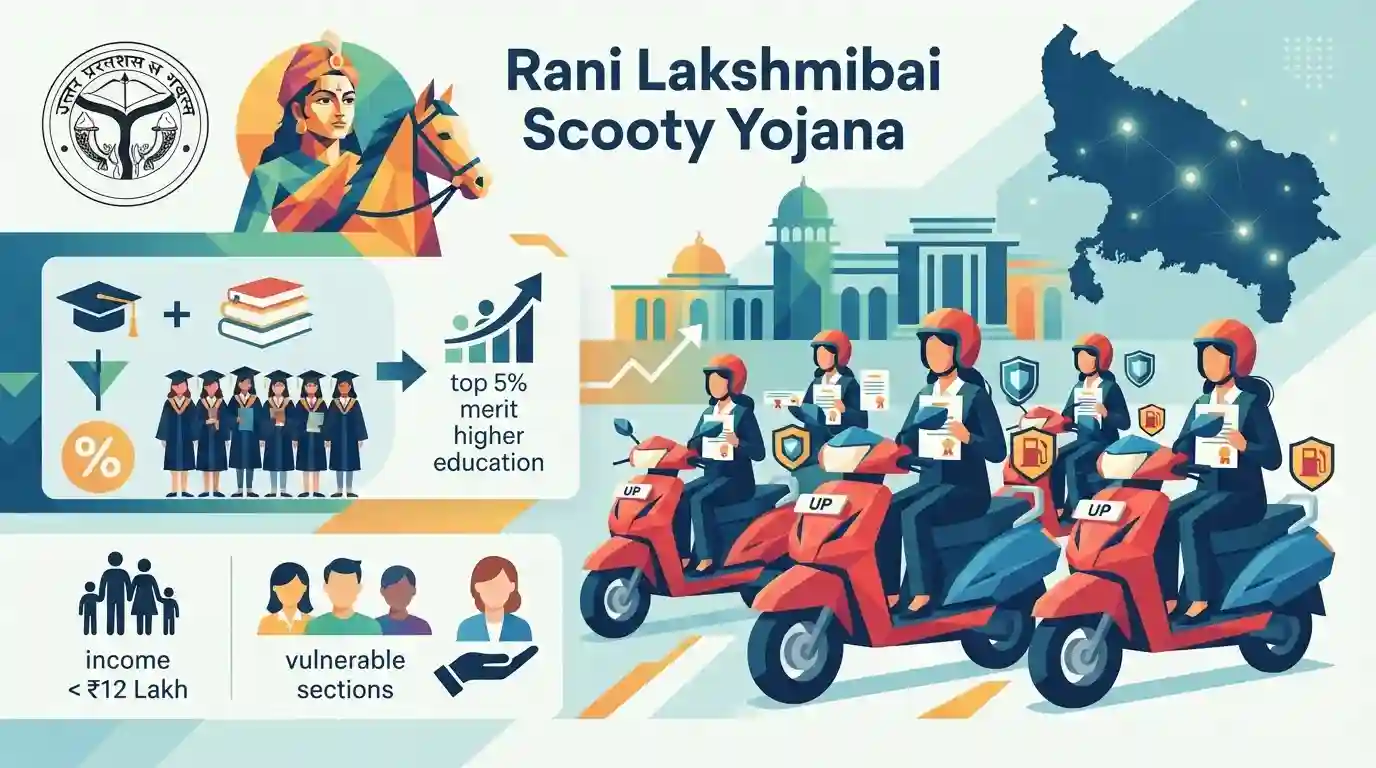
The Uttar Pradesh government has launched the Rani Lakshmibai Scooty Yojana to provide free petrol scooters to 50,000 meritorious female undergraduate students. Aimed at empowering women and facilitating their higher education, the scheme targets students in the top 5% of their institutions for the 2025-26 session, with specific relaxations for vulnerable groups. Beneficiaries must meet an income criteria of under ₹12 lakh and hold a valid driving license. The state will fund the scooter, registration, insurance, helmet, and initial fuel, opting for petrol vehicles due to existing infrastructure constraints for electric vehicles.
Key Points
- The Uttar Pradesh Cabinet, chaired by CM Yogi Adityanath, approved the Rani Lakshmibai Scooty Yojana to distribute 50,000 free scooters to female students.
- Eligible beneficiaries must be undergraduate students in the top 5% merit list of their respective institutions for the 2025-26 academic session.
- Applicants must have a valid driving license, and their family's annual income must not exceed ₹12 lakh.
- Relaxations on the merit requirement are provided for students with disabilities, daughters of martyrs, and girls from destitute families.
- The scheme provides petrol-powered scooters instead of electric ones due to concerns over charging and servicing infrastructure in remote areas.
- The government will cover the cost of the scooter along with registration fees, insurance, a helmet, necessary accessories, and 5 liters of petrol.
Important Terms
Rani Lakshmibai Scooty Yojana

A welfare initiative of the Uttar Pradesh government providing free petrol-powered scooters to meritorious undergraduate female students to promote mobility, facilitate higher education, and reduce dropout rates.
UPSC context
GS Paper II: Welfare schemes for vulnerable sections, women empowerment, state-specific social justice interventions.
Government e-Marketplace (GeM)
A paperless, cashless, and contactless online public procurement portal launched in 2016 by the Ministry of Commerce and Industry to facilitate transparent and efficient procurement of goods and services by government bodies.
UPSC context
GS Paper II & III: E-governance, public finance, transparency in procurement, and administrative reforms.
Women Empowerment
The process of enabling women to exercise agency over their lives, participate equally in decision-making, access equal opportunities in education and employment, and enjoy full social, political, and economic rights.
UPSC context
GS Paper I & II: Social empowerment, gender equality, and development processes related to women.
Government Policies & Interventions
Legislative, executive, or administrative actions designed and implemented by the government to foster socio-economic development, solve public challenges, and manage progress across various sectors.
UPSC context
GS Paper II: Core syllabus topic evaluating the design, implementation, and outcomes of developmental policies.
Welfare Schemes for Vulnerable Sections
Target-oriented state and central programs designed to support socio-economically marginalized or disadvantaged groups, ensuring financial security, basic amenities, healthcare, and equal opportunities.
UPSC context
GS Paper II: Social justice, inclusive development, and the performance of welfare mechanisms.
Prelims Trap
The Rani Lakshmibai Scooty Yojana provides electric scooters to beneficiaries to promote green mobility alongside women's education.
Aspirants assume modern state welfare schemes automatically promote green energy (EVs). However, this scheme explicitly distributes petrol scooters due to rural charging deficits.
Static Concepts Connected
What is Gender Budgeting and what are its two main components in India?
- Definition: An exercise to assess the gender-differential impact of government budgets and translate commitments into fiscal allocations.
- Part A (100% Women): Comprises schemes where 100% of the allocation is targeted specifically for women and girls.
- Part B (Pro-Women): Comprises schemes where at least 30% of the allocation/benefits are expected to flow to women.
What infrastructure bottlenecks hinder rural Electric Vehicle (EV) penetration in India?
- Grid Capacity: Low-voltage rural grids struggle to handle sudden load spikes from fast-charging systems without frequent transformer failures.
- CAPEX Barriers: High upfront capital expenditure yields poor ROI in low-density rural markets, discouraging private charging station installation.
- Service Ecosystem: A severe shortage of certified EV mechanics and battery-servicing centers in remote districts forces reliance on ICE vehicles.
Cross-Topic Patterns
Welfare schemes vs. EV transition trade-offs
Highlights how lack of rural EV charging infrastructure forces welfare schemes to choose petrol over green energy, exposing gaps between national climate goals and grassroots realities.
Physical mobility and female GER
Illustrates how addressing the physical "last-mile transport gap" is a recognized structural tool to arrest dropout rates of women transitioning to higher education.

Mains 2026 may use state scooter schemes to analyze how rural infrastructure deficits force trade-offs between EV transition and welfare.
Linked PYQs · 4
Linked PYQs · 4
- 2023UPPSC_PRELIMSGS1
Which of the following scheme/s is/are related to Uttar Pradesh? (1) Anuthee Uphar Scheme (2) Matra Shakti Udyamita Scheme (3) Kaushalya Matritva Scheme (4) Stree Nidhi Scheme Select the 'correct' answer using the code given below -
- 2023UPPSC_PRELIMSGS1
Which of the following Scheme/Programme is not the Central Government Programme and it is Uttar Pradesh Government's Programme?
- 2024UPPSC_PRELIMSGS1
Arrange the following schemes launched by the Government of India in chronological order and choose the correct answer from the codes given below : 1. Swachh Bharat Mission 2. Pradhan Mantri Kaushal Vikas Yojana 3. Pradhan Mantri Garib Kalyan Yojana 4. Pradhan Mantri Mahila Shakti Kendra Scheme Codes :
- 2017UPPSC_PRELIMSGS1
Consider the following schemes and arrange these in chronological order of their launching. i. Pradhan Mantri Jan Dhan Yojana ii. Digital Gender Atlas for Advancing Girls Education in India iii. Pradhan Mantri Suraksha Bima Yojana iv. Mudra Bank Yojana Select correct answer from the codes given below.
