Market concentration and MSME growth challenges in Indian economy
Source:The Hindu ↗
Why It Matters
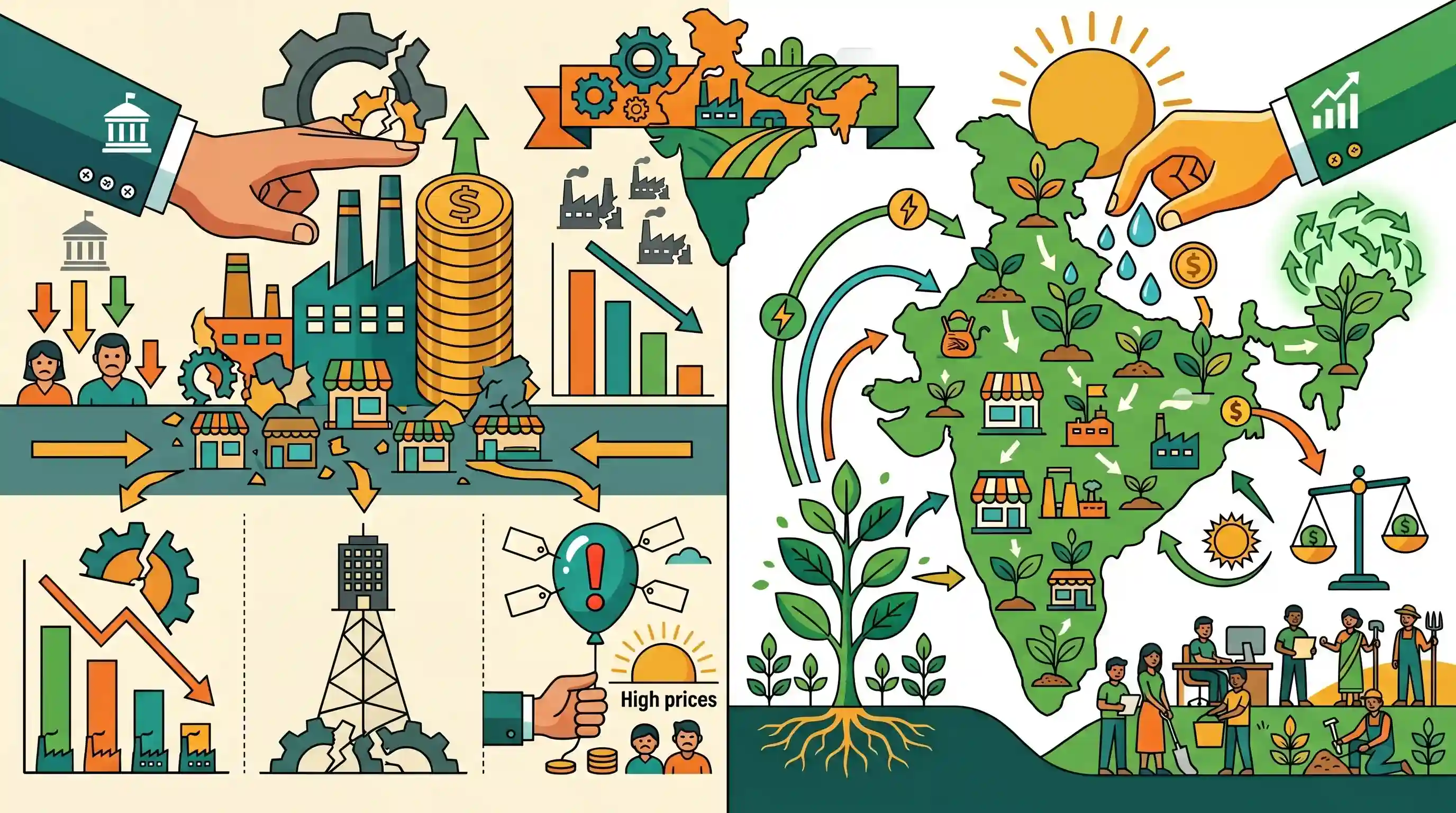
This article highlights core macroeconomic issues relevant to GS Paper 3, specifically the debate surrounding market concentration (monopolies/oligopolies), its impact on inflation, and the lagging contribution of the manufacturing sector to GDP. It also underscores the critical role of MSMEs in fostering inclusive growth compared to large conglomerates.
Summary
Congress General Secretary Jairam Ramesh has raised concerns over India's current economic growth trajectory, criticizing the government's perceived fixation on big businesses. He highlighted three main issues: a declining share of the industrial sector in the GDP, increasing market concentration among a few top business groups, and the resulting inflation caused by reduced competition. Ramesh argued that the disproportionate growth of the top tier of businesses is not accelerating overall economic growth, and instead, the government must refocus its policies to support small and medium enterprises (MSMEs) for sustainable and inclusive development.
Key Points
- Congress leader Jairam Ramesh criticized the Modi government for focusing excessively on large corporate groups rather than small and medium enterprises (MSMEs).
- He claimed that the industry's overall share in the GDP is shrinking, while market concentration among a few top conglomerates is rising.
- Ramesh stated that this growing market concentration has reduced competition, leading to higher consumer prices and contributing significantly to inflation.
- The Congress emphasized that true economic acceleration and inclusive growth require betting big on MSMEs rather than just the top 'G5' or 'G25' business groups.
Important Terms
Inclusive Growth

Economic growth that is distributed fairly across society and creates opportunities for all, ensuring marginalized groups participate in and benefit from development.
UPSC context
GS3 Syllabus topic. Tests ability to link macroeconomic performance with social equity, poverty reduction, and regional balance.
MSMEs (Micro, Small, and Medium Enterprises)
Enterprises classified by investment and turnover; as of April 2025, 'Micro' (Inv <₹2.5cr/TO <₹10cr), 'Small' (Inv <₹25cr/TO <₹100cr), and 'Medium' (Inv <₹125cr/TO <₹500cr).
UPSC context
GS3 Indian Economy. Crucial for understanding employment generation, export contribution (approx 45%), and decentralized industrial growth.
Market Concentration
The extent to which a small number of large firms dominate an industry's total sales or production, potentially leading to oligopolistic power and reduced competition.
UPSC context
GS3 Industrial Growth. Relevant for analyzing competition policy, the role of big businesses, and their impact on pricing/inflation.
Industrial Policy
A government's strategic framework of interventions—including subsidies, regulations, and incentives—designed to influence the development, scale, and structure of the country's industrial sector.
UPSC context
GS3 Economy Syllabus. Tests knowledge of India's shifts from 1956 state-led models to 1991 reforms and current PLI schemes.
Sustainable Development
Development that meets present needs without compromising the ability of future generations to meet theirs, balancing economic growth, social inclusion, and environmental protection.
UPSC context
GS3 Environment and Economy. Core concept for integrating ecological health with economic progress and intergenerational equity.
GDP (Gross Domestic Product)
The total monetary value of all finished goods and services produced within a country's borders in a specific time period.
UPSC context
GS3 Economy. The fundamental metric for growth assessment and sectoral contribution analysis in the Indian economy.
Prelims Trap
"The industrial sector's share in India's GDP has steadily increased over the last decade."
Despite major manufacturing initiatives, India's industrial sector GDP share has remained relatively stagnant (around 25-28%), with services primarily driving overall growth.
Static Concepts Connected
How does market concentration lead to 'profit-led inflation' (greedflation)?
- Pricing Power: Dominant conglomerates can sustain high profit margins by raising consumer prices during supply shocks without losing market share due to reduced competition.
- Greedflation: This phenomenon, where inflation is driven by corporate profit-seeking and market dominance rather than rising wage or input costs, is termed 'greedflation'.
- Asymmetric Pass-through: Even when input prices fall, concentrated industries rarely pass savings to consumers, causing inflation to become structural and persistent.
What is the macroeconomic footprint of India's MSME sector?
- GDP & Exports: MSMEs contribute approximately 30% to India's national GDP and account for over 45% of total merchandise exports.
- Employment Base: It acts as the second-largest employment generator after agriculture, employing over 15.5 crore people formally registered on the Udyam portal.
- Inclusive Growth: Because MSMEs are widely dispersed and require lower capital-output ratios, they are critical for poverty alleviation and mitigating regional imbalances.
Cross-Topic Patterns
MSME credit gap & RBI policies
Large corporate dominance often crowds out MSME credit, making RBI's Priority Sector Lending (PSL) norms and digital formalization initiatives (Udyam, TReDS) critical for mitigating these structural imbalances.
Market dominance & CCI regulations
Debates on corporate concentration and 'pricing power' inevitably link to the Competition Commission of India (CCI) and its statutory mandate to curb the abuse of dominant market positions.

Expect a Prelims 2026 question linking 'Greedflation' (profit-led inflation) to market concentration and oligopolistic pricing power.
Linked PYQs · 3
Linked PYQs · 3
- 2023MainsGS3
Faster economic growth requires increased share of the manufacturing sector in GDP, particularly of MSMEs. Comment on the present policies of the Government in this regard.
- 2017MainsGS3
Industrial growth rate has lagged-behind in the overall growth of Gross-Domestic-Product (GDP) in the post-reform period." Give reasons. How far the recent changes in Industrial-Policy are capable of increasing the industrial growth rate?
- 2024MainsGS3
What are the causes of persistent high food inflation in India? Comment on the effectiveness of the monetary policy of the RBI to control this type of inflation.
