India Netherlands pact boosts National Maritime Heritage Complex
Source:Indian Express ↗
Why It Matters
The development of the NMHC at Lothal is crucial for the preservation of India's ancient maritime history and Harappan heritage. For UPSC aspirants, it connects Ancient History (Indus Valley Civilization ports) with current heritage conservation efforts and bilateral cultural diplomacy (GS1 and GS2).
Summary
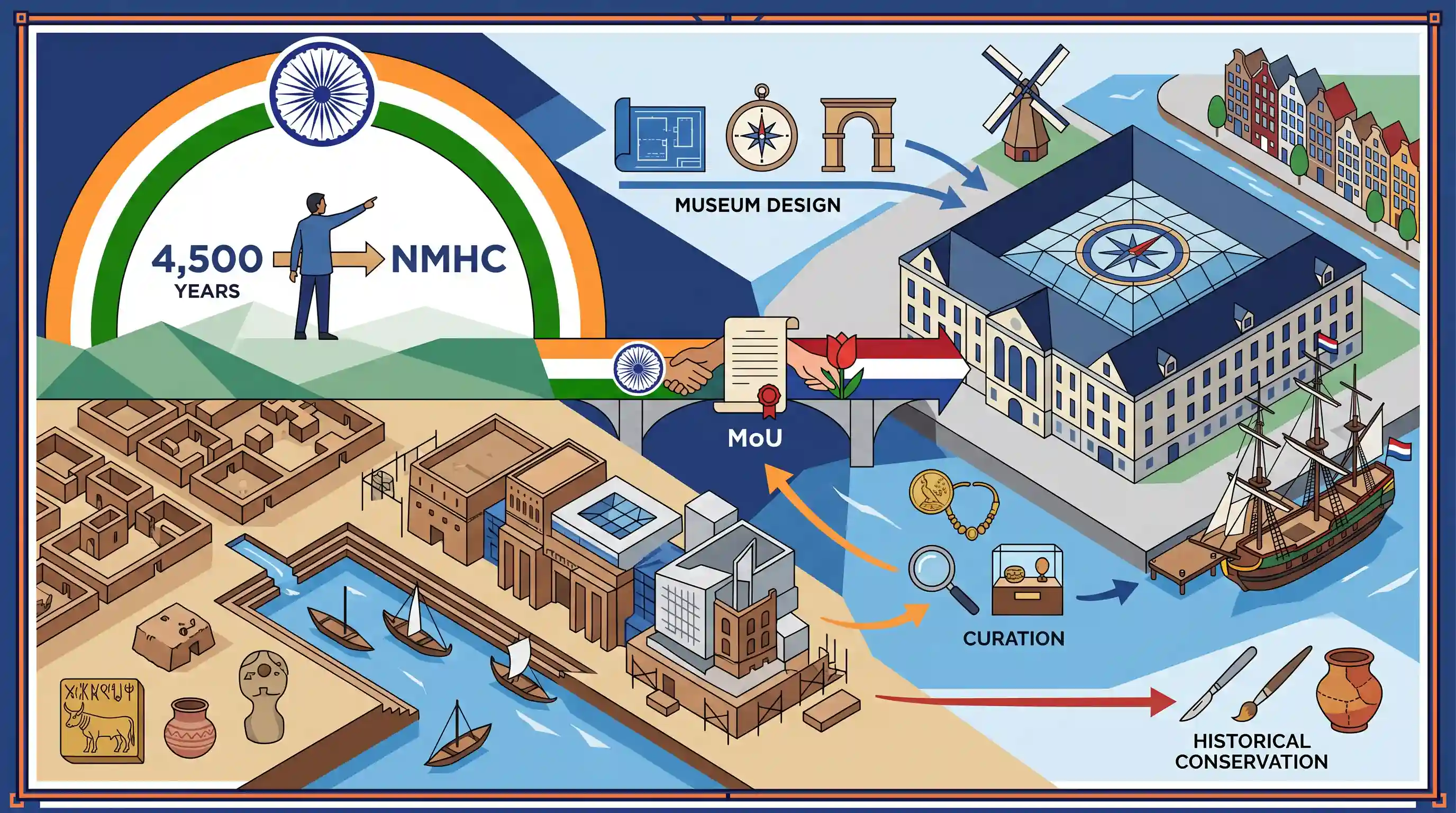
India and the Netherlands have signed a Memorandum of Understanding (MoU) to enhance bilateral cooperation in preserving and showcasing maritime heritage. This agreement marks a pivotal step in developing the National Maritime Heritage Complex (NMHC) at Lothal, Gujarat, a project spearheaded by the Ministry of Ports, Shipping and Waterways. The collaboration links the NMHC with the National Maritime Museum in Amsterdam, enabling the exchange of expertise, knowledge, and best practices in museum design, curation, and historical conservation. The NMHC is envisioned to display India's 4,500-year-old maritime legacy, starting from the ancient Indus Valley Civilization port city of Lothal.
Key Points
- India and the Netherlands signed an MoU to strengthen cooperation in the field of maritime heritage.
- The agreement will significantly boost the development of the National Maritime Heritage Complex (NMHC) at Lothal, Gujarat.
- The MoU facilitates collaboration between NMHC and the National Maritime Museum in Amsterdam for knowledge exchange, curation, and conservation practices.
- The NMHC is being developed under the aegis of the Ministry of Ports, Shipping and Waterways.
- The complex will showcase India's rich 4,500-year-old maritime legacy, tracing back to the Harappan port city of Lothal.
Important Terms
National Maritime Heritage Complex (NMHC)

A ₹4,500-crore world-class facility at Lothal, Gujarat, showcasing India's 4,500-year maritime legacy through museums, heritage parks, and research centers.
UPSC context
GS Paper I (Art & Culture) and GS Paper III (Infrastructure); tests major cultural projects and heritage tourism.
Lothal
An ancient Indus Valley Civilization port city in Gujarat, significant for housing the world's earliest known artificial dockyard and serving as a global trade hub.
UPSC context
GS Paper I (Ancient History); critical for understanding Harappan urban planning, maritime trade, and archaeological findings.
Indus Valley Civilization (IVC)
One of the world's earliest urban civilizations (c. 3300–1300 BCE), characterized by advanced urban design, standardized weights, and extensive seafaring trade.
UPSC context
GS Paper I (Ancient History); a core topic testing socio-economic structures and ancient global connectivity.
Sagarmala Programme
A flagship Union Government initiative aimed at port-led development, enhancing maritime logistics, and boosting coastal community economic growth.
UPSC context
GS Paper III (Infrastructure/Economy); tests knowledge of national logistics frameworks and maritime sector modernization.
Cultural Diplomacy
The use of cultural exchanges—including art, history, and heritage—to strengthen bilateral ties and project a nation's "soft power" internationally.
UPSC context
GS Paper II (International Relations); evaluates understanding of non-traditional diplomacy and bilateral cultural cooperation.
National Maritime Museum (NMM), Amsterdam
A premier Dutch institution providing technical expertise in museum curation, design, and conservation for the development of India's NMHC project.
UPSC context
GS Paper II (International Relations); relevant for India-Netherlands bilateral cooperation in the field of heritage.
Prelims Trap
"The National Maritime Heritage Complex at Lothal is developed by the Ministry of Culture."
Aspirants instinctively link heritage complexes to the Ministry of Culture or ASI. The NMHC is uniquely developed by MoPSW under the Sagarmala Programme.
Static Concepts Connected
What are the unique archaeological discoveries at the Lothal IVC site?
- Artificial Dockyard: Features the world's earliest known artificial dockyard, strategically connected to the Sabarmati river to facilitate trade.
- Mesopotamian Trade: Findings of Persian Gulf seals and terracotta ship models provide clear evidence of maritime trade with Mesopotamia.
- Burials & Crafts: Unique presence of 'double burials' (male and female buried together), fire altars, and a thriving bead-making industry.
How does the Sagarmala Programme relate to heritage and tourism?
- Core Mandate: While primarily focused on port-led development to reduce logistics costs, it includes a key pillar for 'Coastal Community Development'.
- Coastal Tourism: Under this pillar, the MoPSW funds projects like the NMHC and oceanic museums to boost coastal tourism and generate local employment.
Cross-Topic Patterns
Sagarmala meets Cultural Diplomacy
The NMHC integrates the Ministry of Ports' Sagarmala infrastructure framework with international soft power, partnering with the Netherlands to build coastal tourism assets.
IVC trade & modern maritime corridors
Lothal’s ancient links to Mesopotamia are being revived narratively through modern geopolitical and maritime heritage initiatives, paralleling the historic framing of the modern IMEC corridor.

Expect a multi-statement Prelims question mixing Lothal’s static IVC features (dockyard, double burials) with MoPSW's NMHC project.
Linked PYQs · 3
Linked PYQs · 3
- 2020PrelimsGS1
With reference to the period of Gupta dynasty in ancient India, the towns Ghantasala, Kadura and Chaul were well known as
- 2023PrelimsGS1
With reference to ancient South India, Korkai, Poompuhar and Muchiri were well known as
- 2018MainsGS1
Safeguarding the Indian art heritage is the need of the moment. Discuss.
