Maharashtra Legislative Council elections announced for graduate seats
Source:The Hindu ↗
Why It Matters
Important for understanding the composition and election process of state Legislative Councils (Vidhan Parishad), particularly regarding graduate and teacher constituencies under Article 171.
Summary
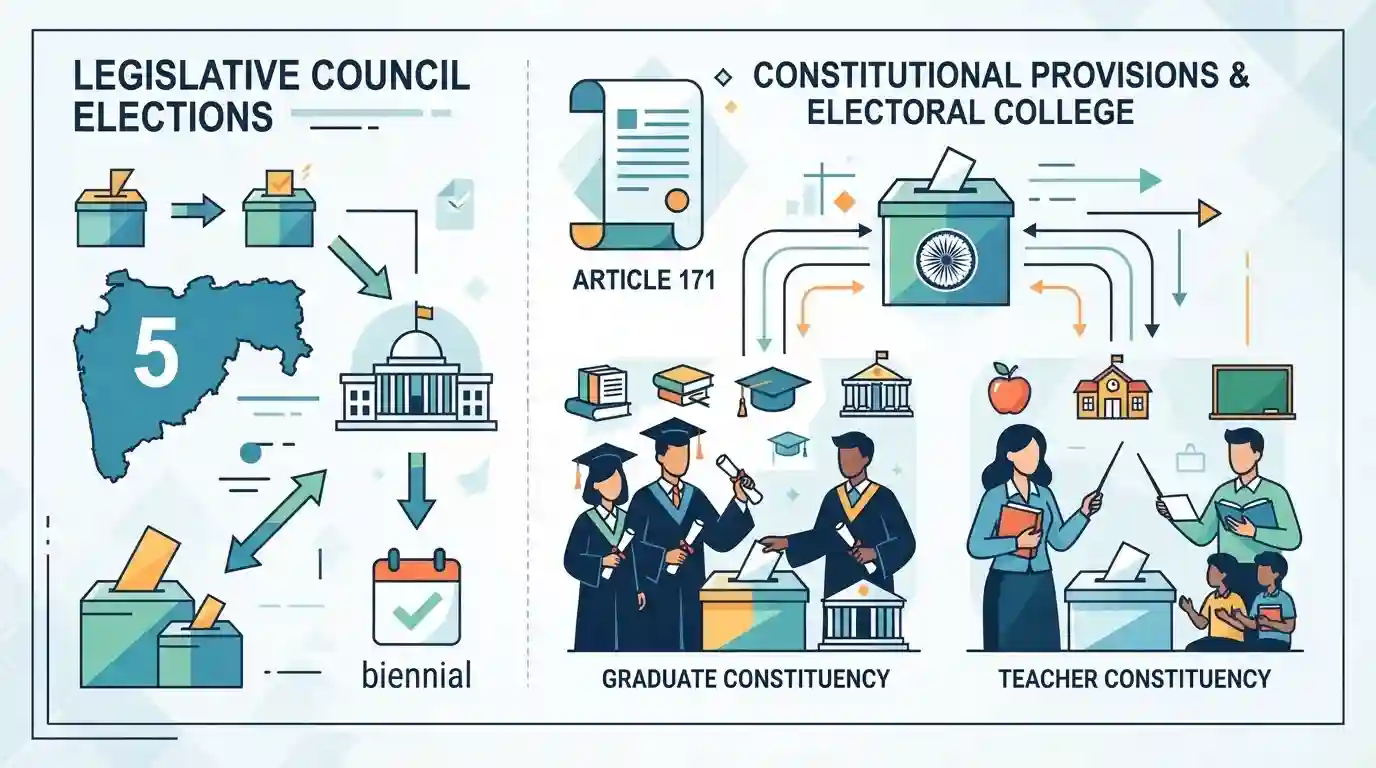
The Election Commission announced biennial elections for five seats in the Maharashtra Legislative Council (MLC) representing graduate and teacher constituencies. These elections highlight the unique electoral college provisions under Article 171 of the Indian Constitution, where registered graduates and teachers participate in electing members to the upper house of the state legislature.
Key Points
- Biennial elections announced for five MLC seats from graduate and teacher constituencies in Maharashtra.
- Article 171 of the Indian Constitution governs the composition of the State Legislative Council, including constituencies for graduates and teachers.
- Elections to the Legislative Council utilize specific electorates comprising eligible graduates and teachers rather than general adult suffrage.
Important Terms
Article 171 of the Constitution

A constitutional provision defining the composition and size limits of State Legislative Councils (Vidhan Parishads), including specialized electorates for graduates, teachers, local bodies, and gubernatorial nominations.
UPSC context
MPSC Polity & Governance: Tests knowledge of the bicameral legislature framework, upper house composition, and unique functional constituencies.
Maharashtra Legislative Council
The upper house of the Maharashtra state legislature, comprising 78 members where one-third of the members retire biennially and seats are filled via unique functional electorates.
UPSC context
MPSC Maharashtra Specific Polity: Evaluates structural understanding of the state's Vidhan Parishad, graduate-teacher constituencies, and local political representation.
Election Commission
An autonomous constitutional authority responsible for administering election processes in India, including parliamentary, state legislative, and biennial MLC polls.
UPSC context
MPSC Polity: Important for questions on constitutional bodies, electoral administration, code of conduct, and democratic decentralization.
Static Concepts Connected
What are the constitutional provisions and composition criteria for State Legislative Councils under Article 171?
- Size Limit: Total strength of a Legislative Council cannot exceed one-third of the total strength of the State Legislative Assembly, and cannot be less than 40 members.
- Electorate Breakdown: One-third members are elected by local bodies, one-twelfth by graduates, one-twelfth by teachers, one-third by MLAs, and the remaining one-sixth are nominated by the Governor.
Cross-Topic Patterns
Vidhan Parishad + RP Act 1950 Linkages
State Legislative Council elections test both Article 171 composition norms and the Representation of the People Act, 1950, bridging constitutional provisions and electoral statutes.

MPSC loves combining Article 171 composition rules with specific RP Act, 1950 criteria for graduates and teachers in a single statement question.
Linked PYQs · 1
Linked PYQs · 1
- 2019MPSC_PRELIMSGS1
Consider the following statements : a. Odisha Legislative Assembly passed resolution for creation of Legislative Council recently. b. Currently, five States have Legislative Councils. c. Proposals to create Legislative Councils in Kerala and Gujarat are pending in Parliament. d. ¹⁄₁₂ members of Legislative Council are elected by registered graduates. Which of the above statements are correct ? Answer Options :
