Bhutan Queen Mother award in Assam for humanitarian diplomacy
Source:The Hindu ↗
Why It Matters
Provides a concrete example of people-to-people ties and soft power diplomacy between India (specifically the Northeast) and Bhutan. It also highlights the role of civil society organizations (like the Tarayana Foundation and UNB Trust) in fostering inclusive development and peace-building.
Summary
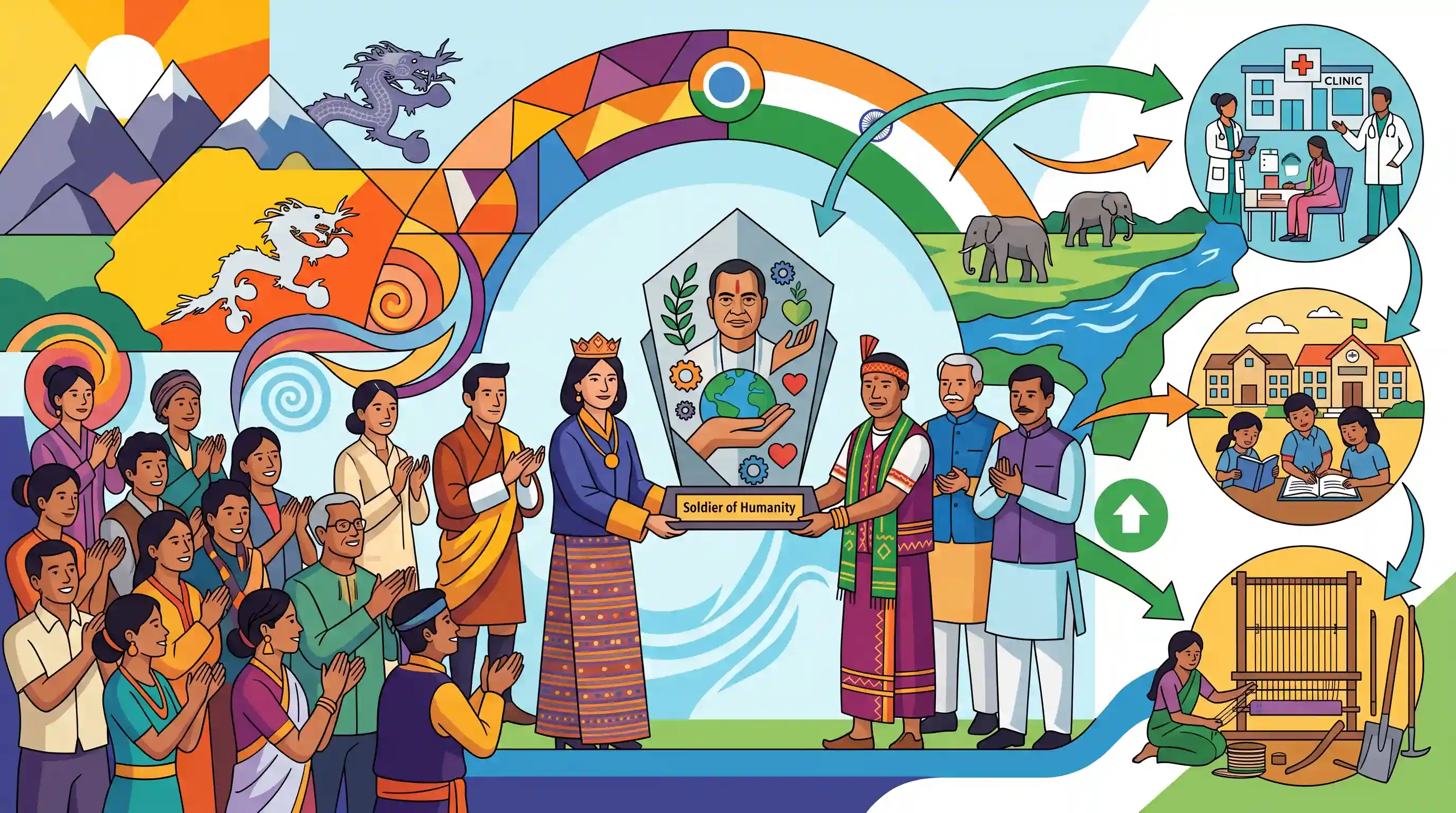
Bhutan's Queen Mother, Gyalyum Ashi Dorji Wangmo Wangchuck, was honored with the 22nd Upendra Nath Brahma 'Soldier of Humanity' Award in Assam for her philanthropic work via the Tarayana Foundation. Named after revered Bodo leader Upendra Nath Brahma, the award reflects strengthening regional ties, soft power diplomacy, and civil society cooperation between Bhutan and India's Bodoland Territorial Region.
Key Points
- Bhutan's Queen Mother Gyalyum Ashi Dorji Wangmo Wangchuck received the 22nd Upendra Nath Brahma 'Soldier of Humanity' Award, 2025 in Kokrajhar, Assam.
- The award was instituted by the Upendra Nath Brahma Trust in honor of Bodofa Upendra Nath Brahma, a prominent Bodo leader.
- The Queen Mother was recognized for her philanthropic efforts through the Tarayana Foundation, focusing on rural development, poverty alleviation, healthcare, and education in Bhutan.
- The event underscores growing people-to-people and civil society ties between Bhutan and India's Northeast, highlighting cultural and humanitarian diplomacy.
Important Terms
Soldier of Humanity Award

A prestigious recognition instituted by the UNBT to honor individuals for exceptional humanitarian service, social development, and inclusive growth, particularly for marginalized communities.
UPSC context
GS-II: International Relations/Awards; highlights soft power diplomacy and people-to-people ties between India and Bhutan.
Upendra Nath Brahma
A revered Bodo leader and former President of the All Bodo Students Union (ABSU), known as 'Bodofa' (Father of the Bodos), who led the non-violent Bodoland movement.
UPSC context
GS-I/V: Post-independence India/Assam History; relevant for ethnic movements and leaders who shaped regional autonomy in the Northeast.
Tarayana Foundation
A Bhutanese non-profit organization founded by Queen Mother Gyalyum Ashi Dorji Wangmo Wangchuck in 2003, focusing on rural development, poverty alleviation, and cultural preservation.
UPSC context
GS-II: Role of NGOs and Civil Society; demonstrates the impact of non-state actors in cross-border regional cooperation.
Bodoland Territorial Council (BTC)
An autonomous administrative body in Assam established under the Sixth Schedule of the Indian Constitution to govern the Bodoland Territorial Region (BTR).
UPSC context
GS-II: Polity/Governance; tests knowledge of autonomous councils, Sixth Schedule provisions, and decentralization in tribal areas.
Sixth Schedule
Provisions in the Indian Constitution (Articles 244(2) and 275(1)) that provide for autonomous districts and councils to protect the rights of tribal populations in Northeast India.
UPSC context
GS-II: Indian Constitution; a core topic regarding federalism and the administration of scheduled and tribal areas.
Upendra Nath Brahma Trust (UNBT)
A public charitable trust established in 1999 to preserve the legacy of Upendra Nath Brahma and promote humanitarian, educational, and cultural activities in the Bodoland region.
UPSC context
GS-II/V: Role of institutions in community development and cultural diplomacy within the Bodoland Territorial Region.
Prelims Trap
Bhutan shares an international border with the Indian states of Meghalaya, Assam, and Arunachal Pradesh.
Bhutan only borders Assam, Arunachal Pradesh, West Bengal, and Sikkim. UPSC often sets boundary traps including Meghalaya due to its proximity.
Static Concepts Connected
What is the Constitutional basis for the Bodoland Territorial Council?
- Sixth Schedule: It is established under the Sixth Schedule, which covers tribal areas in Assam, Meghalaya, Tripura, and Mizoram (AMTM).
- Legislative Powers: Autonomous District Councils (ADCs) have power to make laws on specific subjects like land, forests, and social customs.
- Governor's Role: The Governor holds the power to create, reorganize, alter boundaries, or dissolve these autonomous districts.
What is Paradiplomacy in India's International Relations?
- Core Meaning: The direct involvement of state governments, local bodies, or sub-national units in international relations and foreign policy.
- Union Supremacy: Despite paradiplomacy, foreign affairs remains exclusively a Union subject under Schedule VII (Article 246) of the Constitution.
- Scope of Engagement: States primarily engage in economic agreements, cultural exchanges, border haats, and diaspora welfare rather than hard security.
Cross-Topic Patterns
Sub-national diplomacy in Neighbourhood First
Border states are increasingly driving regional ties. Assam's cultural outreach to Bhutan's royalty mirrors Tripura's engagement with Bangladesh, acting as crucial soft-power force multipliers for India.
Internal Security + Border Management
The successful Bodo peace accords stabilized the volatile Bhutan-Assam frontier, historically exploited by insurgent groups like the NDFB who previously used dense Bhutanese forests for sanctuary.

Paradiplomacy + Sixth Schedule areas acting as foreign policy bridges (e.g., Assam-Bhutan) is ripe for a Mains GS2 question.
Linked PYQs · 4
Linked PYQs · 4
- 2015MainsGS2
Terrorist activities and mutual distrust have clouded India-Pakistan relations. To what extent the use of soft power like sports and cultural exchanges could help generate goodwill between the two countries? Discuss with suitable examples.
- 2024MainsGS2
Public charitable trusts have the potential to make India's development more inclusive as they relate to certain vital public issues. Comment.
- 2023MainsGS2
Discuss the contribution of civil society groups for women's effective and meaningful participation and representation in state legislatures in India.
- 2015PrelimsGS1
The provisions in Fifth Schedule and Sixth Schedule in the Constitution of India are made in order to
