Gujarat Chief Minister Undertakes Official Visit To United States
Source:businesstoday ↗
Why It Matters
The article underscores Gujarat's proactive approach to sub-national economic diplomacy and securing Foreign Direct Investment. The history and objectives of the Vibrant Gujarat Global Summit, as well as FDI trends in the state, are highly relevant to the GPSC Economy syllabus, while the CM's international outreach touches upon the practical aspects of State Executive powers.
Summary
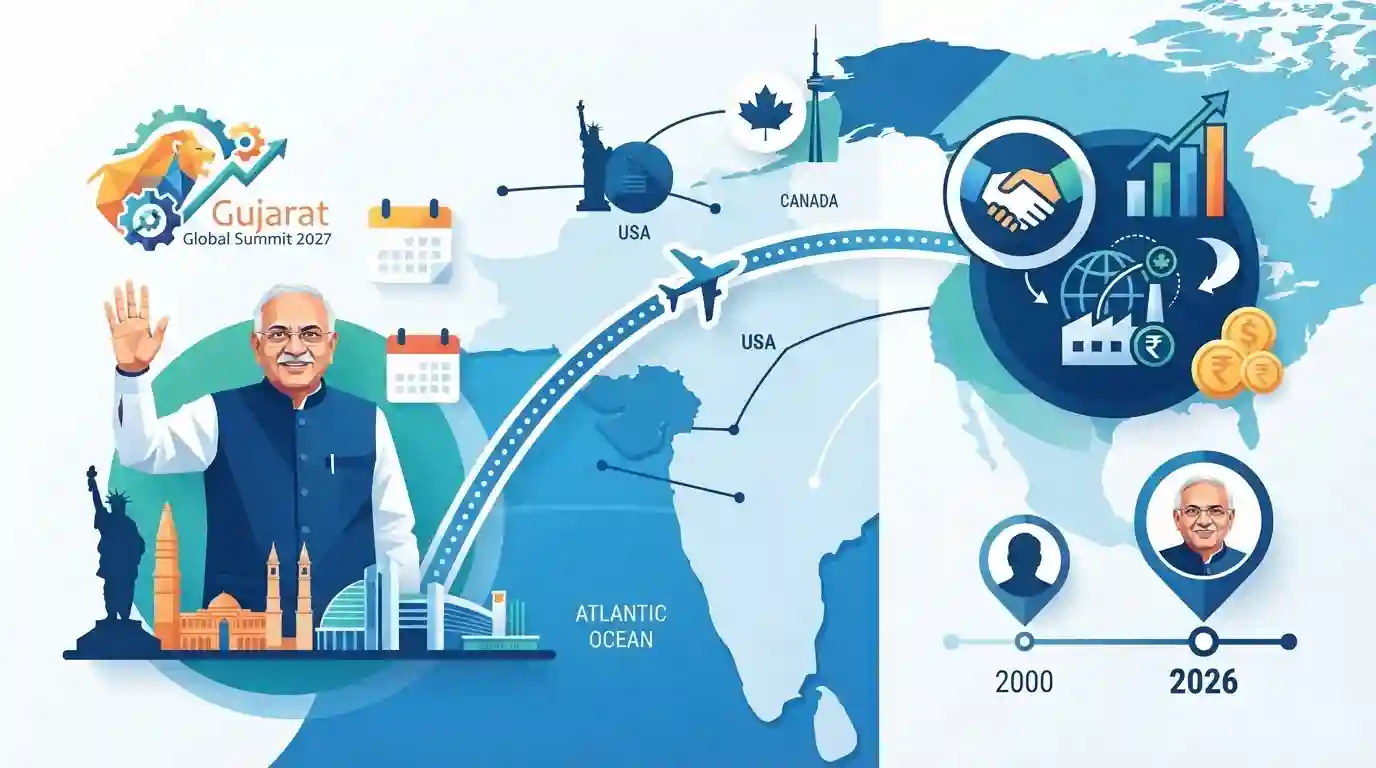
Gujarat Chief Minister Bhupendra Patel will undertake a week-long official visit to the United States and Canada in August 2026 to promote the Vibrant Gujarat Global Summit 2027. This marks a significant milestone in sub-national diplomacy, as he becomes the first sitting Gujarat CM in 25 years to officially visit the US, with the last being Keshubhai Patel in 2000. The visit highlights the state government's continuous efforts to attract Foreign Direct Investment and strengthen economic ties globally.
Key Points
- Gujarat Chief Minister Bhupendra Patel is scheduled for an official visit to the US and Canada in August 2026, marking the first such trip by a sitting Gujarat CM in 25 years.
- The last sitting Gujarat CM to officially visit the US was Keshubhai Patel, who made trips in 1995 and 2000.
- The primary objective of the delegation is to invite industrialists, tech leaders, and investors to the upcoming Vibrant Gujarat Global Summit 2027 to boost Foreign Direct Investment (FDI) in the state.
- The Vibrant Gujarat Global Summit was initiated in 2003 by then-Chief Minister Narendra Modi to position Gujarat as a prime global investment destination.
Important Terms
Vibrant Gujarat Global Summit

A biennial investors' global business event launched in 2003 by the Gujarat government. It serves as a premier economic forum to attract investment, foster strategic partnerships, and promote the state globally.
UPSC context
Relevant to GS Paper 3 (Economic Development). Illustrates state-led economic initiatives, ease of doing business, and investment promotion strategies.
Sub-national Diplomacy
The direct engagement of state or provincial governments in international relations. In India, Chief Ministers increasingly use this paradiplomacy to attract foreign investment, promote local industries, and forge global partnerships.
UPSC context
Vital for GS Paper 2 (International Relations/Polity). Highlights the evolving role of states in India's foreign policy and federal structure.
Foreign Direct Investment (FDI)
An investment made by a foreign entity into business interests in another country, establishing long-term interest and operational control. In India, it is typically defined as an equity stake of 10% or more.
UPSC context
Crucial for GS Paper 3 (Economy). Tests understanding of investment models, foreign capital inflows, regulatory routes, and macroeconomic growth.
Competitive Federalism
A governance model where states actively compete against one another to attract investment, improve ease of doing business, and boost economic growth, acting as autonomous economic players.
UPSC context
Relevant to GS Paper 2 (Polity). Demonstrates the dynamics of modern federalism and how regional competition drives national economic progress.
Prelims Trap
State governments possess constitutional authority to independently negotiate and sign binding FDI treaties with foreign nations.
Foreign affairs, international treaties, and foreign trade are exclusive Union subjects (Entries 10, 14, 41). States engage in 'paradiplomacy' but cannot sign sovereign treaties.
Static Concepts Connected
What clearances are required for a Chief Minister's official foreign visit?
- Political Clearance: Mandatory approval from the Ministry of External Affairs (MEA) assessing the political suitability and diplomatic timing of the visit.
- FCRA Clearance: Required from the Ministry of Home Affairs (MHA) under the Foreign Contribution (Regulation) Act if the CM accepts any foreign hospitality.
- Constitutional Alignment: Under Article 257, the executive power of every state must not impede the Union's executive power, ensuring alignment with national interests.
How does 'Paradiplomacy' function within India's constitutional framework?
- Definition: The direct engagement of sub-national entities (like states or cities) with international actors, primarily focusing on trade, investment, and cultural exchange.
- Union List Constraints: Operates strictly under Union oversight, as Foreign Affairs and Foreign Trade are under the Union List (Seventh Schedule).
- Competitive Federalism: Acts as an extension of competitive federalism, driving states to host summits (e.g., Vibrant Gujarat) to outcompete peers for global capital.
Cross-Topic Patterns
Paradiplomacy & Centre-State friction
Denials of MEA clearance for official CM visits abroad frequently trigger constitutional debates over the exact limits of state paradiplomacy and Centre-State relations.
FDI Trends & Competitive Federalism
State-led global summits decentralize economic diplomacy, showcasing competitive federalism by empowering industrial states like Gujarat and Maharashtra to directly attract FDI.

Expect a GS2 Mains question evaluating 'Paradiplomacy'—how states bypass the Centre to court FDI while bound by the Union List.
Linked PYQs · 2
Linked PYQs · 2
- 2025GPSC_PRELIMSGS1
Which of the following statements is/are correct regarding Foreign Direct Investment (FDI) in Gujarat? (A) Gujarat secured the first position in the country in terms of FDI equity inflows with 16.43% contribution in FDI during FY 2023-24. (B) USA, Mauritius, Singapore, UAE and Cayman Islands are among the top five countries attracting FDI Equity Inflow in Gujarat.
- 2021GPSC_PRELIMSGS1
Consider the following statements: Statement 1: The executive power of every State shall be so exercised as not to impede or prejudice the exercise of the executive power of the Union Statement 2: The executive power of the Union shall extend to the giving of such directions to a State as may appear to the Government of India to be necessary for that purpose.
