Girls education scheme donation and sustainable goals in Ahmedabad
Source:indianmasterminds ↗
આ શા માટે મહત્વનું છે
The article encapsulates key state government priorities including girls' education schemes, sustainable environmental practices (Mission LiFE), green technology adoption, and regional infrastructure milestones (Narmada water in Kutch), which are highly relevant for GPSC questions on state welfare schemes and sustainable development.
સારાંશ
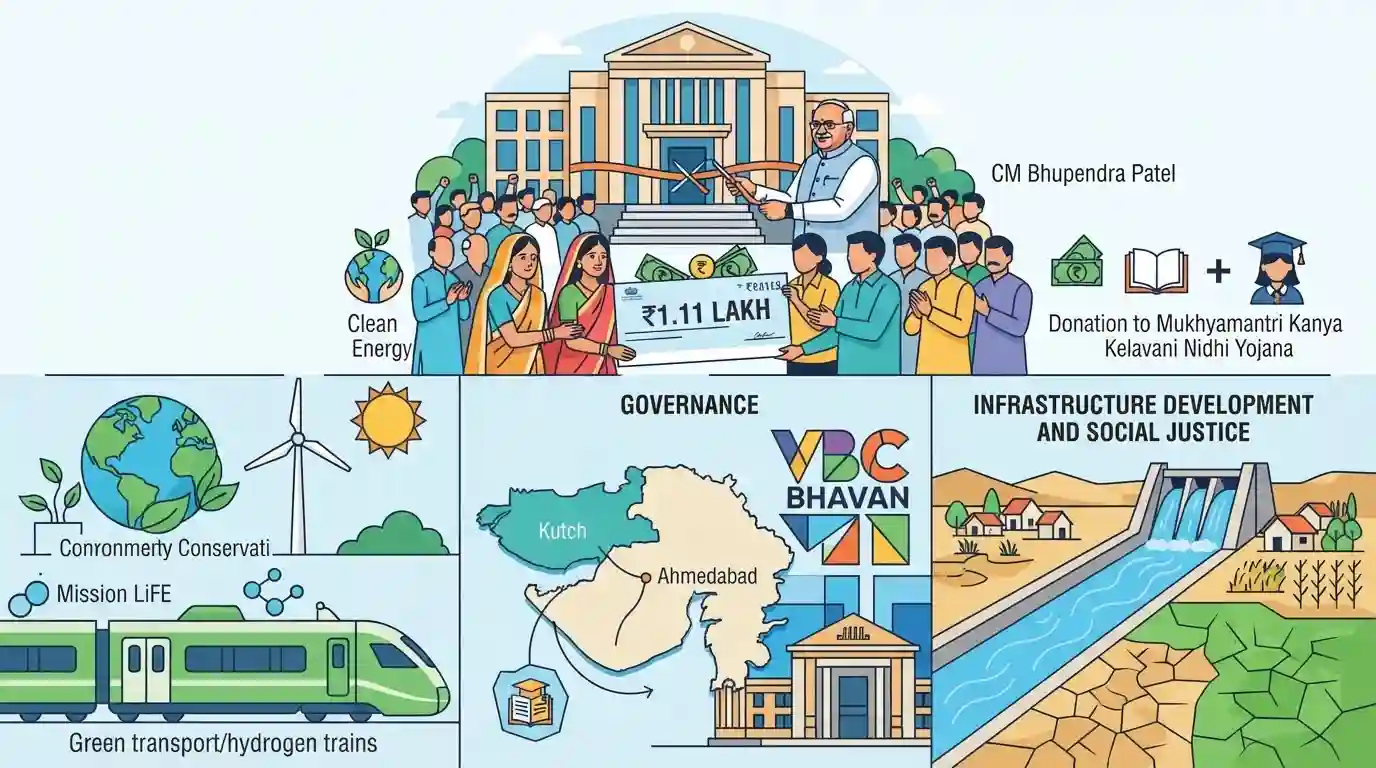
Gujarat CM Bhupendra Patel inaugurated the VBC Bhavan in Ahmedabad, where the VBC Samaj donated ₹1.11 lakh to the Mukhyamantri Kanya Kelavani Nidhi Yojana for girls' education. The event highlighted Gujarat's focus on sustainable development through Mission LiFE, green transport like hydrogen trains, and resolving water scarcity in the Kutch region via Narmada waters.
મુખ્ય મુદ્દા
- Gujarat Chief Minister Bhupendra Patel inaugurated the Matrushri Maniben Mavjibhai Swaroopchand Vora VBC Bhavan in Ahmedabad, constructed by the VBC Samaj.
- The VBC Samaj donated ₹1.11 lakh to the state's 'Mukhyamantri Kanya Kelavani Nidhi Yojana' to promote girls' education.
- The Chief Minister urged citizens to adopt Mission LiFE principles for environmental sustainability by saving water, electricity, and fuel.
- He highlighted national green initiatives like the launch of hydrogen train services and the overarching goal of achieving a Viksit Bharat by 2047.
- The CM also reflected on the successful delivery of Narmada river waters to the arid Kutch and Vagad regions, solving historical water scarcity.
મહત્વપૂર્ણ શબ્દો
Mukhyamantri Kanya Kelavani Nidhi Yojana

A Gujarat government scholarship scheme providing financial assistance to deserving and meritorious girl students, specifically helping fund expensive higher education such as medical (MBBS) degrees.
UPSC context
Highly relevant for GS-2 (Welfare Schemes, Women Empowerment, Education) as a state-level best practice for bridging gender gaps in professional education.
Mission LiFE (Lifestyle for Environment)
An India-led global mass movement launched at COP26 that nudges individuals and communities to adopt sustainable, eco-friendly lifestyles and replace mindless consumption with mindful resource utilization.
UPSC context
Vital for GS-3 (Environment) and GS-4 (Ethics). Serves as India's primary behavioral-change framework in its climate change and NDC commitments.
Viksit Bharat 2047
The Government of India's strategic vision to transform the country into a fully developed, prosperous, and self-reliant nation by 2047, marking 100 years of independence.
UPSC context
Crucial for GS-2 (Governance) and GS-3 (Economic Development). It frames the overarching policy objectives across all sectors of the Indian economy.
Hydrogen-Powered Trains
Locomotives that generate onboard electricity using hydrogen fuel cells, emitting only water vapor. India recently launched its first indigenous hydrogen train to decarbonize its railway network.
UPSC context
Important for GS-3 (Science & Technology, Infrastructure, Environmental Pollution). Showcases India's transition to green mobility and Net-Zero goals.
પ્રિલિમ્સ ટ્રેપ
Mission LiFE is a legally binding UNFCCC treaty with mandatory, country-specific targets and penalties for non-compliance.
Mission LiFE is an India-led global mass movement based on voluntary individual actions and circular economy principles, not a binding UNFCCC treaty.
સંલગ્ન સ્થિર ખ્યાલો
How do hydrogen fuel cells generate electricity and what are their emissions?
- Electrochemical process: Combines hydrogen and oxygen electrochemically to generate electricity directly, bypassing combustion for higher efficiency.
- Zero-emission output: Emits only water vapor and heat, ensuring zero tailpipe carbon emissions or particulate matter.
What are the three core strategic phases of the global 'Mission LiFE' initiative?
- Demand-side shift: Focuses on nudging individuals worldwide to practice simple, eco-friendly behaviors in their daily lives.
- Supply-side change: Encourages industries and markets to adapt and scale up sustainable production matching the eco-friendly demand.
- Policy-level transition: Aims to influence government policies to support and institutionalize sustainable consumption and circular economies.
આંતર-વિષય પેટર્ન
Behavioral nudges + Climate action
Translating global climate commitments into citizen-led actions using behavioral economics, mirroring successful public health and sanitation movements like Swachh Bharat.
Heritage preservation + Green transport
Deploying hydrogen-powered trains on heritage routes balances micro-regional ecological conservation in eco-sensitive zones with national clean mobility targets.

Expect a multi-statement Prelims question testing the chemical byproducts of hydrogen fuel cells alongside the three phases of Mission LiFE.
સંલગ્ન PYQ · 4
સંલગ્ન PYQ · 4
- 2025GPSC_PRELIMSGS1
Which of the following statements is/are correct regarding the G-SAFAL scheme?
- 2018GPSC_PRELIMSGS1
The first female graduate of Gujarat is _________________.
- 2022GPSC_PRELIMSGS1
What is "A Step Towards a Sustainable Future (STAT)" Scheme?
- 2025GPSC_PRELIMSGS1
What are Banni, Rabari and Bavalia in Gujarat?
