Wildlife Conservation and Grassland Restoration Review in Gujarat
Source:ddindia ↗
Why It Matters
Important for tracking national and state-level wildlife conservation initiatives, endangered species protection programs like GIB and Project Cheetah, and grassland ecosystem management in Gujarat.
Summary
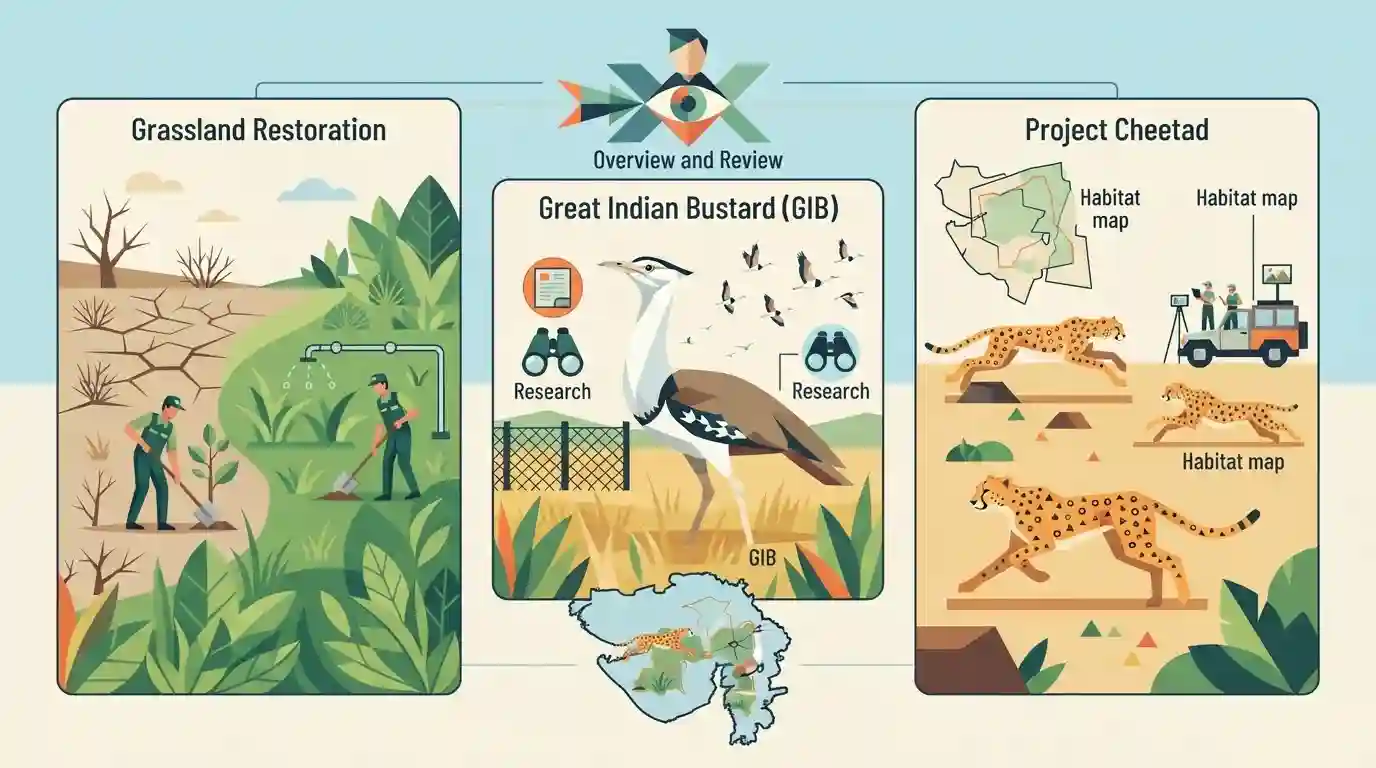
Union Minister for Environment, Forest and Climate Change Bhupender Yadav reviewed wildlife conservation projects in Gujarat, focusing on Great Indian Bustard (GIB) preservation, grassland restoration, and Project Cheetah preparations.
Key Points
- Union Environment Minister Bhupender Yadav reviewed conservation efforts for the Great Indian Bustard (GIB) in Gujarat.
- Discussions included grassland restoration initiatives, particularly in arid and semi-arid regions like Kutch.
- Progress on Project Cheetah and habitat management strategies were evaluated to ensure ecological security for reintroduced species.
Important Terms
Project Cheetah

An ambitious Indian wildlife conservation initiative aimed at reintroducing the cheetah after its extinction in 1952, involving intercontinental translocation from Africa and habitat restoration in grassland ecosystems.
UPSC context
Important for GPSC Mains (Environment and Wildlife Conservation) and Prelims, testing knowledge of species reintroduction, national parks, and ecological restoration.
Ministry of Environment, Forest and Climate Change
The apex central government ministry in India responsible for planning, promoting, and coordinating environmental and forestry policies, wildlife protection programs, and biodiversity conservation initiatives.
UPSC context
Crucial for GPSC governance and environmental administration topics, testing administrative mandates, statutory bodies, and national conservation frameworks.
Prelims Trap
Project Cheetah is exclusively implemented within Madhya Pradesh's Kuno National Park.
Aspirants often assume Project Cheetah is restricted only to Kuno National Park in Madhya Pradesh; however, Banni grasslands in Gujarat are being actively developed as an additional release/secondary site.
Static Concepts Connected
What are the key conservation statuses, threats, and protected areas for the Great Indian Bustard (GIB) in India?
- Status & Protection: Critically Endangered on the IUCN Red List and listed under Schedule I of the Wild Life (Protection) Act, 1972.
- Key Habitats: Found primarily in Rajasthan and Gujarat (Kutch); isolated pockets exist in Maharashtra, Karnataka, and Andhra Pradesh.
- Primary Threat: High-tension overhead power transmission lines are the leading cause of mortality for adult GIBs due to poor frontal vision.
- Sanctuaries: Desert National Park (Rajasthan) and Lala-Bustard Sanctuary (Kutch, Gujarat) are premier dedicated habitats.
Cross-Topic Patterns
Grassland Restoration: GIB meets Project Cheetah
Banni grassland restoration in Kutch serves as a dual-purpose model for both critically endangered avian conservation (GIB) and mammalian reintroduction (Cheetah).
Wildlife Act & Habitat Governance Frameworks
Integrating regional wildlife initiatives with national species recovery plans tests inter-state and intra-state coordination under the Wildlife Protection Act.

Project Cheetah sites (Kuno vs Banni) and GIB critical habitats (Rajasthan vs Gujarat) are high-yield comparative Prelims traps.
Linked PYQs · 1
Linked PYQs · 1
- 2026GPSC_PRELIMSGS1
The 'Great Indian Bustard (GIB)' (Ghorad) is frequently seen in the news in the context of wildlife conservation efforts in western India. Consider the following statements regarding this species: 1. Currently, the highest surviving wild population of the Great Indian Bustard in India is located in the semi-arid grasslands of Gujarat. 2. It is a long-distance migratory bird that travels from Central Asia to the Indian subcontinent to escape harsh winters. Which of the above statement(s) is/are correct?
