Bhopal Initiates Free Passenger Trials For Electric Buses
Source:ians ↗
Why It Matters
Demonstrates the practical state-level implementation of the PM-eBus Sewa scheme, marking a critical transition toward green energy, sustainable public infrastructure, and accessible urban transport in Madhya Pradesh.
Summary
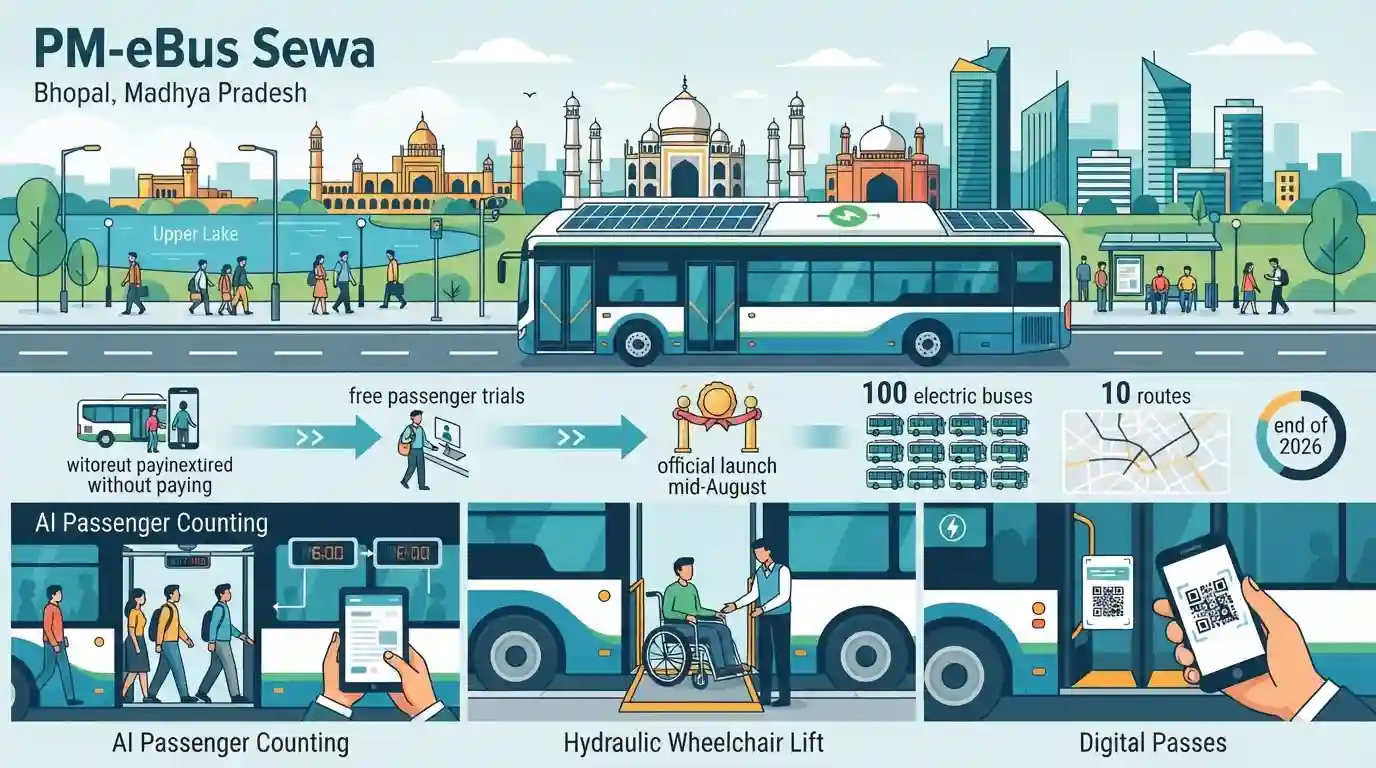
Bhopal is set to begin free passenger trials for its new electric bus fleet under the central government's PM-eBus Sewa initiative. With an official launch expected by mid-August, the city plans to deploy 100 technology-equipped electric buses on 10 routes by the end of 2026. The transition highlights modern, inclusive, and sustainable urban mobility with features like AI passenger counting, hydraulic wheelchair lifts, and digital passes.
Key Points
- Bhopal is initiating free passenger trials of electric buses starting July 27, 2026, under the PM-eBus Sewa scheme.
- The official launch of the electric bus service is anticipated around Independence Day (August 15).
- By the end of 2026, a total of 100 electric buses are planned to operate across 10 routes in Bhopal.
- The electric buses are equipped with modern amenities like digital ticketing, mobile app passes, AI-based passenger counting, CCTV cameras, panic buttons, and automatic hydraulic wheelchair lifts.
- A central hub with multiple chargers and a dedicated 2000 kVA transformer is being established at Board Office Square for the fleet.
Important Terms
PM-eBus Sewa

A central government scheme to deploy 10,000 electric buses across Indian cities on a Public-Private Partnership (PPP) model, aiming to reduce greenhouse gas emissions and enhance urban mobility infrastructure.
UPSC context
GS Paper 2 & 3 (Govt Schemes, Infrastructure). Tests knowledge of sustainable public transport, EV adoption, and environmental conservation strategies.
Bhopal City Link Limited (BCLL)
A state-owned Special Purpose Vehicle (SPV) established by the Bhopal Municipal Corporation and Development Authority to operate and manage the city's public bus transportation network.
UPSC context
GS Paper 2 (Governance). Relevant as a case study for urban local bodies managing public transit via special purpose vehicles.
Gross Cost Contract (GCC) Model
A Public-Private Partnership model where the government pays a private operator a fixed sum per kilometer to run transport services, while the government retains fare revenue and route control.
UPSC context
GS Paper 3 (Investment Models). Tests understanding of public-private partnership structures in urban service delivery and infrastructure procurement.
Green Urban Mobility Initiatives (GUMI)
A segment of the PM-eBus Sewa scheme focused on developing sustainable transport infrastructure, including NCMC-based automated fare collection, bus priority lanes, and EV charging facilities.
UPSC context
GS Paper 3 (Environment, Infrastructure). Highlights national efforts toward multimodal integration and reducing urban carbon footprints.
Prelims Trap
PM-eBus Sewa deploys 10,000 electric buses primarily in major metropolitan and megacities to combat severe vehicular air pollution.
PM-eBus Sewa specifically targets Tier-2/Tier-3 cities (population 3 lakh to 40 lakh), explicitly prioritizing cities that currently lack organized public bus services.
Static Concepts Connected
What is the role of a Payment Security Mechanism (PSM) in PPP mobility projects?
- Risk Mitigation: It serves as a financial safeguard for private bus operators against payment delays or defaults by state Public Transport Authorities.
- CESL Management: Under PM-eBus Sewa, Convergence Energy Services Limited (CESL) manages the PSM fund to ensure investor confidence.
- Financial Viability: By lowering payment risk, the PSM reduces the cost of capital, making the PPP model financially viable.
What are the core mandates of the Accessible India Campaign (Sugamya Bharat Abhiyan)?
- Transport Pillar: Mandates making public transport fully accessible for Persons with Disabilities (PwDs), including retrofitting buses with wheelchair lifts.
- Built Environment: Focuses on providing accessible ramps, designated parking, and tactile paths in government and public buildings.
- ICT Ecosystem: Ensures government websites and public documents are structurally accessible to the visually and hearing impaired.
Cross-Topic Patterns
Green Mobility + Accessible India
The inclusion of hydraulic wheelchair lifts in e-buses merges climate initiatives with the Rights of Persons with Disabilities Act, ensuring India's green transition remains socially inclusive.
FAME vs PM E-DRIVE transition
UPSC tracks scheme evolution. FAME II transitioned into the PM E-DRIVE Scheme, which now heavily prioritizes commercial fleets, e-buses, and charging networks over private four-wheeler subsidies.

Expect a multi-statement Prelims question contrasting PM-eBus Sewa's tier-2/3 focus against PM E-DRIVE's broader EV infrastructure goals.
Linked PYQs · 2
Linked PYQs · 2
- 2024MPPSC_PRELIMSGS1
UNNATI (Agri-GISl project of Madhya Pradesh Government is for :
- 2023MPPSC_PRELIMSGS1
Which of the following is not an E–procurement portal?
