Bhoj Wetland Eviction Drive Stalled Due To Police Personnel Shortage
Source:free-press-journal ↗
Why It Matters
The issue highlights the governance challenges in implementing environmental protection orders and the conflict between urban commercial encroachment and wetland conservation. Bhoj Wetland is a significant Ramsar site in Madhya Pradesh, making its preservation crucial for the region's ecology.
Summary
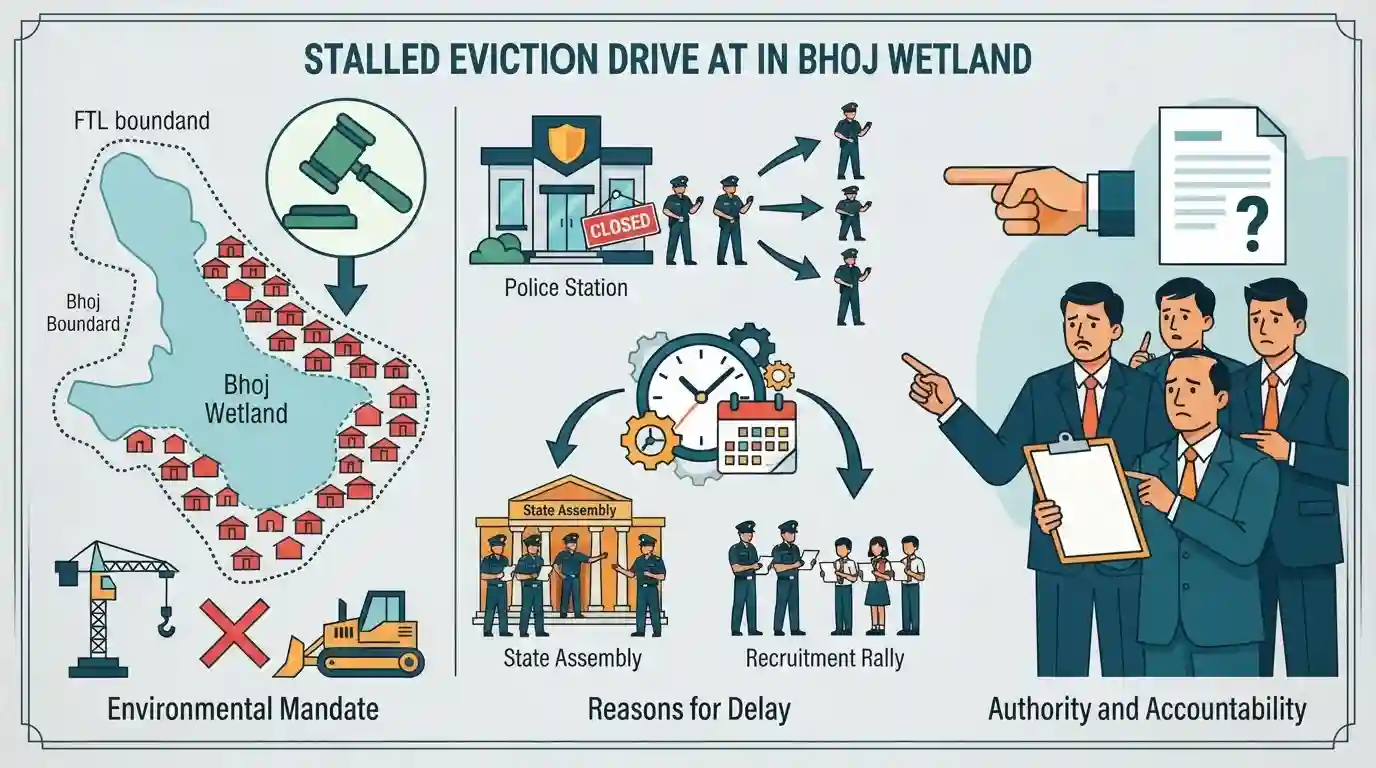
An eviction drive to remove 36 encroaching establishments from the Full Tank Level (FTL) and buffer zone of the Bhoj Wetland, as mandated by the National Green Tribunal (NGT), has been stalled. The Bhopal district administration attributes the delay to an acute shortage of police personnel, who are currently deployed for the state Assembly session and the Indian Army's Agniveer recruitment rally. The NGT recently criticized the Bhopal Municipal Corporation and local authorities for failing to clear the encroachments over the last six years and ordered a fresh compliance report.
Key Points
- The National Green Tribunal (NGT) mandated the removal of encroachments from the Full Tank Level (FTL) and buffer zone of Bhopal's Bhoj Wetland.
- 36 establishments, including restaurants and BMC's Kachra Cafe near the Boat Club, have been identified for eviction.
- The eviction drive is stalled due to a shortage of police personnel, who are occupied with the state Assembly session and an Agniveer recruitment rally.
- The NGT has criticized the local administration and the Bhopal Municipal Corporation for their failure to clear the wetland encroachments over the past six years.
Important Terms
National Green Tribunal (NGT)

A specialized statutory body established under the NGT Act, 2010, for the expeditious disposal of environmental disputes. Guided by principles of natural justice, it enforces key environmental laws and mandates case resolutions within six months.
UPSC context
GS Paper 2 & 3 (Statutory Bodies, Environment). Tests knowledge of environmental governance, its jurisdiction, and role in fast-tracking ecological justice.
Agniveer Scheme
A 2022 central government initiative to recruit youth aged 17.5 to 21 into the armed forces for a four-year term. It aims to modernize the military, retaining 25% of recruits for permanent service.
UPSC context
GS Paper 2 & 3 (Government Policies, Security). Tests understanding of defense reforms, military modernization, and human resource management.
Bhopal Municipal Corporation (BMC)
The urban local governing body in Bhopal responsible for civic infrastructure and municipal administration. It is tasked with executing NGT-mandated anti-encroachment drives in sensitive ecological zones like the Bhoj Wetland's buffer area.
UPSC context
GS Paper 2 (Local Self-Government). Relevant for understanding the functions, challenges, and enforcement capacities of Urban Local Bodies under the 74th Amendment.
Indian Army
The land-based branch of the Indian Armed Forces responsible for national security. It relies on massive recruitment rallies, such as those under the Agniveer Scheme, to induct personnel and maintain a future-ready defense force.
UPSC context
GS Paper 3 (Security Forces). Tests knowledge of India's defense architecture, border management, and structural modernizations like short-term recruitment initiatives.
Bhopal Police
The law enforcement agency for Bhopal, responsible for public order. Personnel shortages due to concurrent deployments for assembly sessions and military rallies directly hampered local administrative capacity to execute NGT environmental eviction orders.
UPSC context
GS Paper 2 & 3 (Governance, Internal Security). Highlights state capacity constraints and how overstretched police forces affect civic law enforcement and environmental compliance.
Prelims Trap
"Bhoj Wetland is a naturally formed lake complex located in Central India."
Bhoj Wetland is actually a man-made reservoir created in the 11th century by Paramara King Raja Bhoja. UPSC frequently tests the natural vs. man-made distinction.
Static Concepts Connected
What is the regulatory framework for wetlands under the 2017 Rules?
- Decentralization: Shifted the primary responsibility of wetland management and notification from the Central Government to State Wetland Authorities (SWAs).
- Prohibited Activities: Strictly bans encroachment, solid waste dumping, and setting up permanent industries within the wetland and its demarcated buffer zone.
- Wise Use Principle: Mandates management based on the 'wise use' principle, integrating wetland ecological conservation with sustainable development.
What are the enforcement powers and practical limitations of the NGT?
- Civil Court Powers: Under Section 25 of the NGT Act, 2010, the Tribunal's orders are executable as a decree of a civil court.
- Executive Dependency: The NGT does not have an independent enforcement agency. It relies entirely on local district administration and police, often leading to severe execution delays.
- Suo Motu Jurisdiction: The Supreme Court of India has explicitly upheld the NGT's power to take suo motu cognizance of environmental degradation.
Cross-Topic Patterns
NGT limitations vs. State Capacity constraints
Highlights the governance gap where specialized environmental tribunals lack independent enforcement wings, making compliance heavily dependent on over-stretched local police facing competing law-and-order priorities.
Urbanization choking designated Ramsar sites
Bhoj Wetland's encroachment by municipal bodies mirrors issues at East Kolkata Wetlands and Pallikaranai, showing a pan-India pattern of state-led degradation of urban wetlands.

Expect a 2026 question blending man-made vs natural status of Ramsar sites with the specific prohibitions under the Wetland Rules 2017.
Linked PYQs · 2
Linked PYQs · 2
- 2018MPPSC_PRELIMSGS1
What is the full form of NGT?
- 2023MPPSC_PRELIMSGS1
National Green Tribunal's (NGT) headquarters is situated at:
