Bhopal Master Plan considers relief for commercial traders
Source:freepressjournal ↗
Why It Matters
Understanding the mechanisms of urban planning, zoning regulations, and the roles of municipal bodies and state departments is crucial for the MPPSC Prelims, particularly within the context of state geography, urban local self-government (74th Amendment), and public administration.
Summary
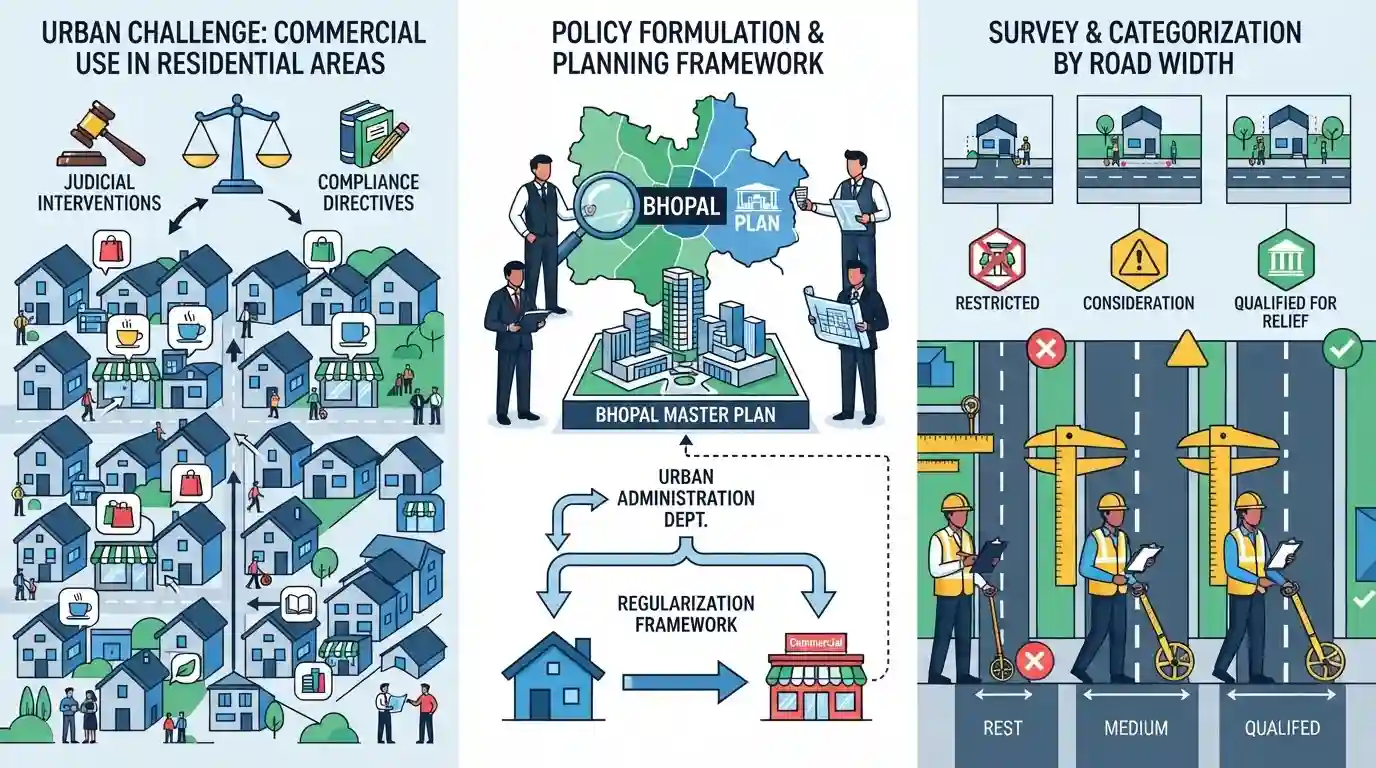
The Madhya Pradesh government is planning interventions, notably through the Bhopal Master Plan, to provide relief to traders running commercial ventures from residential plots in Bhopal. Prompted by a Supreme Court directive, the state's Urban Administration Department is considering a compounding framework that would allow legal conversion of residential plots into commercial ones. To facilitate this, the Bhopal Municipal Corporation is surveying commercial activities, categorizing them according to the widths of adjacent roads to determine eligibility for relief measures.
Key Points
- The Madhya Pradesh government is drafting policies, including the potential implementation of the Bhopal Master Plan, to address commercial activities operating from residential plots.
- This move follows a Supreme Court order mandating action regarding the misuse of residential plots for commercial purposes.
- The Urban Administration Department is exploring 'compounding' to officially allow certain properties to be converted to commercial status upon payment of a fee.
- The Bhopal Municipal Corporation is conducting surveys to classify commercial establishments based on location and road width (12m, 18m, 24m) to guide the new policies.
Important Terms
Bhopal Master Plan

A statutory urban planning document guiding long-term spatial development, zoning, and land use. The absence of an updated plan in Bhopal has fueled unregulated commercial expansion in residential zones.
UPSC context
GS-1 (Urbanization). Highlights challenges of unplanned urban expansion and the critical need for updated statutory zoning frameworks.
Compounding Framework
A legal mechanism allowing civic authorities to regularize unauthorized construction or land-use violations—such as operating commercial ventures from residential plots—by levying prescribed penalties or fees instead of ordering demolition.
UPSC context
GS-2 (Governance). Relevant to urban local body regulations, administrative flexibility, and enforcing the rule of law in civic administration.
Bhopal Municipal Corporation
The urban local body responsible for civic administration and enforcing zoning rules in Bhopal. It is currently surveying road widths to categorize and regulate illegal commercial activities under state directives.
UPSC context
GS-2 (Local Self-Government). Tests the enforcement challenges and administrative mandate of municipal corporations empowered under the 74th Constitutional Amendment.
Urban Administration Department
The Madhya Pradesh state department overseeing urban local bodies, formulating city development policies, and devising legal interventions—like compounding frameworks—to resolve zoning disputes and unauthorized commercial activities.
UPSC context
GS-2 (Governance). Demonstrates the executive's role in urban policy formulation, state-municipal relations, and implementing judicial directives.
Prelims Trap
"The 74th Amendment automatically transfers exclusive power over urban land-use and town planning to Municipal Corporations."
Under Article 243W, devolving the 18 subjects in the 12th Schedule is discretionary for State Legislatures, not automatic. States often retain control via parastatal bodies.
Static Concepts Connected
How does the 74th Amendment address urban land use and town planning?
- Article 243W: It empowers State Legislatures to endow Urban Local Bodies (ULBs) with the authority to function as institutions of self-government.
- 12th Schedule: It lists 18 functional items, explicitly including "Urban planning including town planning" and "Regulation of land-use and construction of buildings."
- Devolution gap: In practice, state governments often assign these functions to unelected parastatal agencies (like Development Authorities) rather than elected municipal bodies.
What is 'compounding' in the context of municipal urban land-use regulation?
- Definition: A regulatory mechanism to legally regularize unauthorized construction or land-use violations (e.g., running a shop in a residential zone).
- Mechanism: It involves paying a penalty or impact fee to the municipal authority instead of facing punitive sealing or demolition.
- Rationale: It is used to balance the economic reality of mixed land use with the enforcement of municipal master plan carrying capacities.
Cross-Topic Patterns
Judicial intervention in urban planning
The SC's directive in Bhopal mirrors the M.C. Mehta case in Delhi, highlighting how courts frequently enforce municipal laws when local bodies fail to curb unauthorized commercialization.
Parastatals vs. Elected ULBs
State-level Urban Administration departments often bypass elected Municipal Corporations in drafting Master Plans, reflecting the incomplete democratic decentralization under the 74th Constitutional Amendment Act.

Expect a multi-statement question on the 12th Schedule testing if land-use regulation is a mandatory or discretionary devolution under Art 243W.
Linked PYQs · 1
Linked PYQs · 1
- 2022MPPSC_PRELIMSGS1
When did the Madhya Pradesh State Election Commission come into existence?
