Madhya Pradesh Ranks Third Nationally in Vegetable Production Output
Source:newindianexpress ↗
Why It Matters
MPPSC Prelims consistently features questions on Madhya Pradesh's position in agricultural and crop production (e.g., vegetable and tomato production ranks) and Rajya Sabha political representation/elections from the state.
Summary
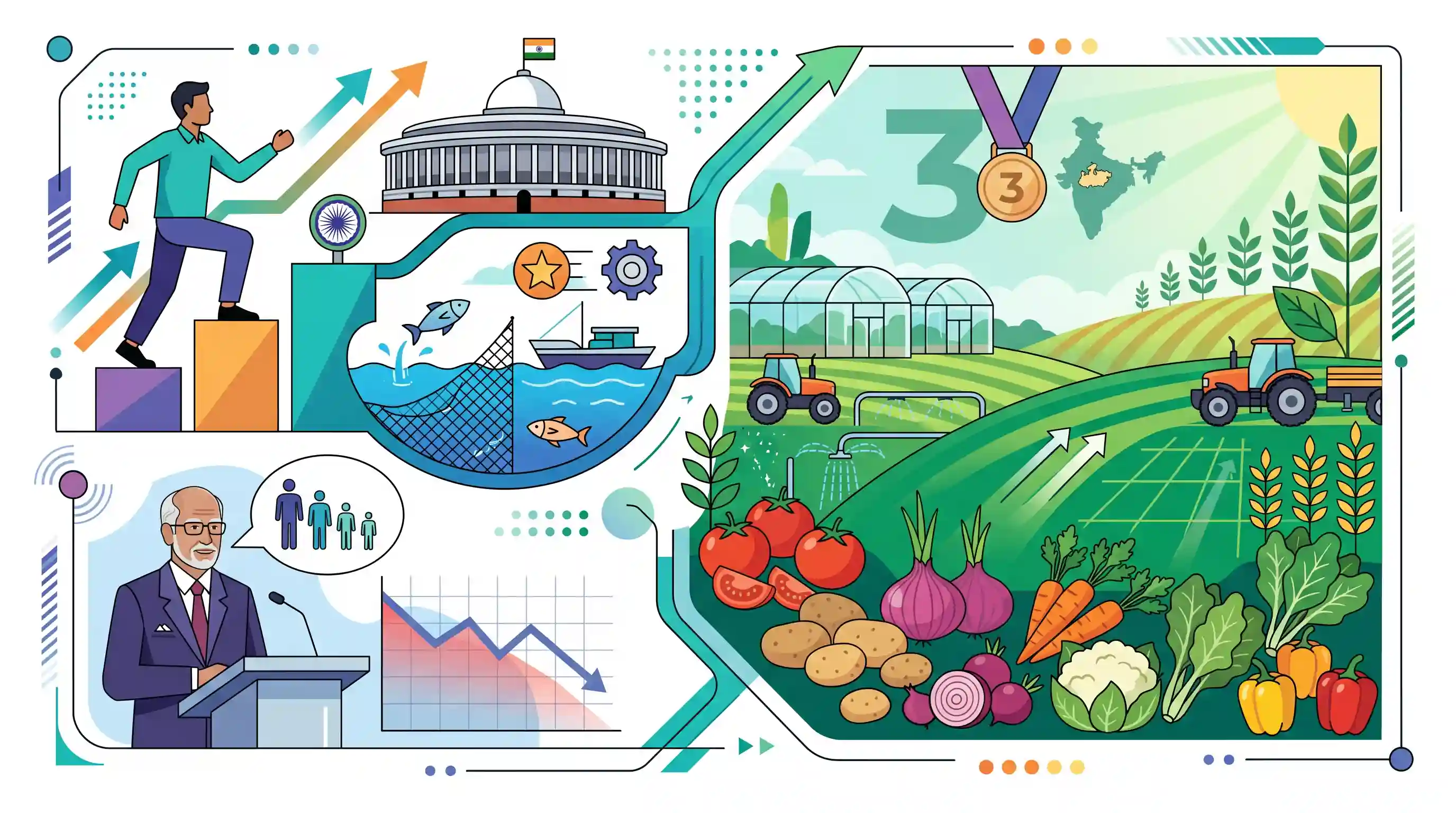
This news brief outlines critical updates from Madhya Pradesh, including the political rise of Mahesh Kewat (elected unopposed to the Rajya Sabha and appointed head of the MP Fishermen Welfare Board), MP's 3rd rank in vegetable production in India with new horticulture expansion plans, and a controversial population control pitch by retired bureaucrat Niyaz Khan.
Key Points
- Mahesh Kewat, a prominent Kewat caste organizational leader from the Bundelkhand region of MP, was elected unopposed to the Rajya Sabha on June 11, 2026, alongside BJP candidates Tarun Chugh and Rajneesh Agrawal.
- In April 2026, Kewat was appointed as the head of the MP Fishermen Welfare Board, and political analysts speculate his potential induction into the Union Cabinet (Team Modi 3.0) as a Minister of State (MoS).
- Madhya Pradesh ranks 3rd in India in vegetable production, with an annual output of nearly 259 lakh metric tonnes after an increase of 21.58 lakh metric tonnes over the last four years.
- The MP Department of Horticulture and Food Processing has introduced an action plan to expand vegetable cultivation across 54,000 hectares, with 13,300 hectares reserved specifically for potato cultivation.
- Retired Madhya Pradesh IAS officer Niyaz Khan publicly advocated for forced sterilization to curb population explosion.
Important Terms
Rajya Sabha

The upper house of India's bicameral Parliament representing states and union territories. It acts as a permanent body with staggered six-year terms, safeguarding federalism and checking hasty legislation.
UPSC context
GS Paper II (Polity). Tests parliamentary processes, federal representation, and the legislative role of the upper house.
Department of Horticulture and Food Processing (Madhya Pradesh)
A state government department that plans and implements policies for crop diversification, food processing infrastructure, and boosting horticultural production to enhance farmers' incomes.
UPSC context
GS Paper III (Agriculture). Tests state-level agricultural strategies, allied sectors, and food processing value chain initiatives.
Population Stabilization
The demographic stage where a population ceases to grow, achieved primarily when fertility rates reach replacement level (TFR of 2.1) through voluntary family planning and gender empowerment.
UPSC context
GS Paper I (Social Issues). Tests concepts of demographic transition, population policies, and reproductive healthcare.
Madhya Pradesh Fishermen Welfare Board
A state board dedicated to executing social welfare schemes, promoting modern fisheries, and elevating the socio-economic status of marginalized riverine and fishing communities.
UPSC context
GS Paper II (Welfare Schemes). Tests developmental policies and targeted interventions for vulnerable and marginalized communities.
Prelims Trap
Any alteration in Rajya Sabha seat allocation for states requires a constitutional amendment under Article 368.
Changes to the Fourth Schedule due to state creation (Articles 3 and 4) are passed by a simple majority, not a formal Article 368 amendment.
Static Concepts Connected
How are Rajya Sabha seats allocated and adjusted during state reorganization?
- Fourth Schedule: Governed by the Fourth Schedule of the Constitution, which allocates seats to states based on their population.
- Legislative Power: Under Articles 3 and 4, Parliament can adjust seat distribution through simple legislation during state bifurcation without an Article 368 amendment.
- Election System: Elected indirectly by elected MLAs of the respective state using proportional representation by means of a single transferable vote.
What are the structural features of India's horticulture sector?
- Production Status: India is the second-largest global producer of fruits and vegetables, led by states like Uttar Pradesh, West Bengal, and Madhya Pradesh.
- Nodal Schemes: Supported by the Mission for Integrated Development of Horticulture (MIDH), a centrally sponsored scheme targeting holistic sector growth.
- Economic Impact: Offers higher per-unit area returns and climate resilience compared to water-intensive cereal crops, promoting agricultural diversification.
Cross-Topic Patterns
State Reorganization & Parliamentary Representation
Explores how bifurcation of states under Article 3 alters Rajya Sabha allocations (Fourth Schedule) without requiring a formal constitutional amendment under Article 368.
Horticulture Diversification vs Grain Procurement
Examines how states like MP shifting to intensive vegetable cultivation balances against the ecological and procurement demands of traditional MSP crops like wheat and paddy.

Expect a multi-statement question linking state reorganization seat adjustment rules (Art 3/4) with domestic horticulture ranking trends.
Linked PYQs · 2
Linked PYQs · 2
- 2018MPPSC_PRELIMSGS1
Who among the following women won the by-edition in 2017 for the one Rajya Sabha seat from Madhya Pradesh?
- 2025MPPSC_PRELIMSGS1
In Madhya Pradesh, which vegetable recorded the highest productivity in 2023-24?
