Bhopal Begins Trial Runs for PM eBus Sewa Scheme
Source:free-press-journal ↗
Why It Matters
This development is highly relevant for MPPSC Prelims under state-specific urban infrastructure, sustainable development goals (SDG 11 & 13), and environment-friendly public initiatives. Transitioning public transit to electric fleets under the PM eBus Sewa Scheme reflects Madhya Pradesh's progress in green infrastructure and sustainable transport systems.
Summary
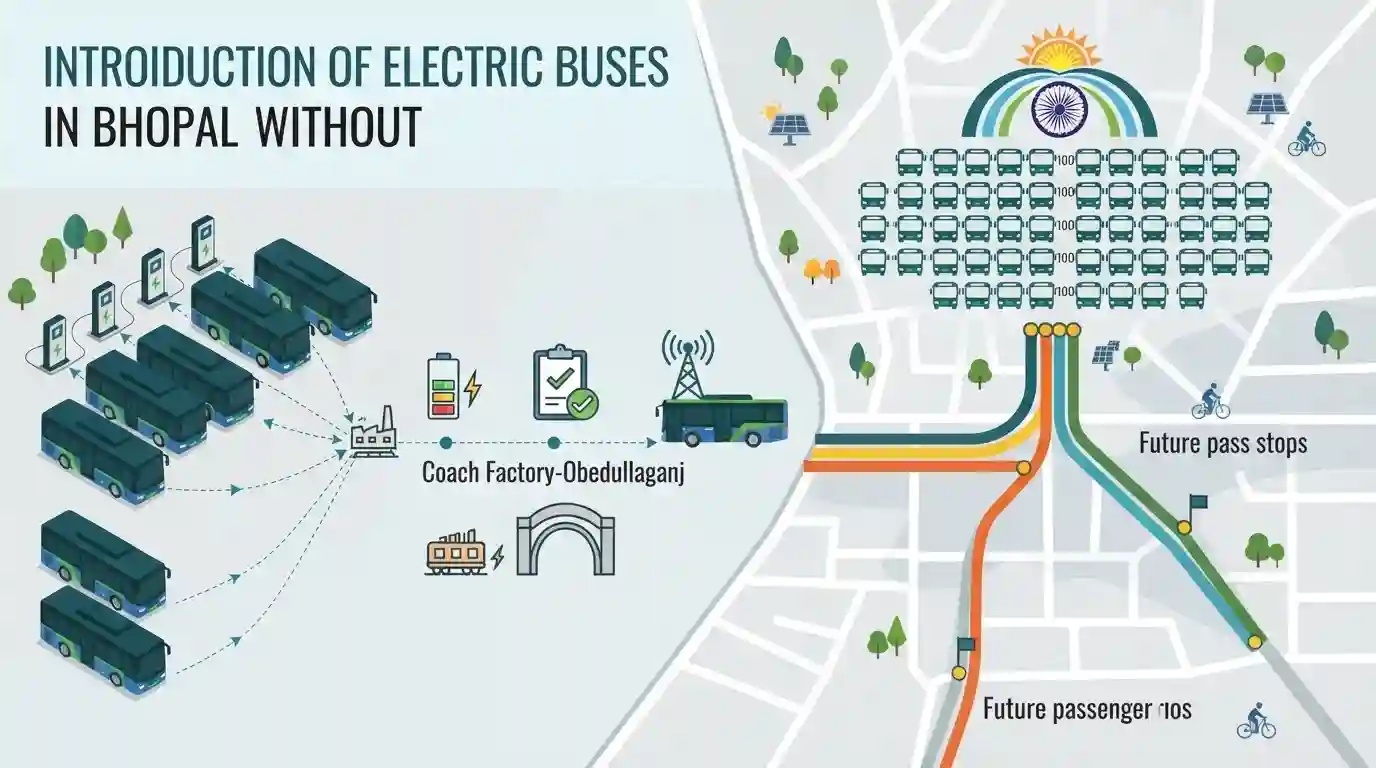
Bhopal has initiated technical trial runs of 10 newly arrived electric buses under the PM eBus Sewa Scheme on the Coach Factory-Obedullaganj route. These trials aim to assess operational feasibility, charging intervals, and tech integration before starting passenger runs on three designated routes. Bhopal is slated to receive a total of 100 eco-friendly, fully air-conditioned e-buses under the scheme to bolster sustainable urban public transport in Madhya Pradesh.
Key Points
- Bhopal has officially started the technical and operational trial runs of 10 electric buses under the central government's PM eBus Sewa Scheme.
- In the initial five-day trial phase, the e-buses are operating without passengers on the Coach Factory-Obedullaganj route to assess technical feasibility, braking performance, and charging intervals.
- Prior to the official trials, six of these electric buses were deployed to transport Madhya Pradesh Cabinet ministers and senior administrative officials to and from a council meeting in Jagdishpur.
- Passenger trials will follow on three key routes: Coach Factory to Obedullaganj, Phanda to Mandideep, and Bairagarh to Katara Hills.
- Under the PM eBus Sewa Scheme, Bhopal is slated to receive a total of 100 electric buses, of which 21 have already arrived.
- Each air-conditioned bus is equipped with a 25-passenger seating capacity, an operational range of 180 km on a single charge, GPS tracking, CCTV surveillance, panic buttons, digital ticketing, and hydraulic platforms for persons with disabilities.
Important Terms
PM eBus Sewa Scheme

A centrally sponsored scheme targeting the deployment of 10,000 electric buses on a Public-Private Partnership model to augment city bus operations and promote green mobility across Indian cities.
UPSC context
GS Paper III (Infrastructure); tests eco-mobility, urban transit schemes, and public-private models.
Bhopal Municipal Corporation (BMC)
An urban local self-government body responsible for administering civic services and infrastructure in Bhopal, constituted under Article 243Q of the 74th Constitutional Amendment Act, 1992.
UPSC context
GS Paper II (Polity); tests urban local bodies (ULBs) and the 74th Constitutional Amendment.
Madhya Pradesh Council of Ministers
The constitutional state executive body headed by the Chief Minister, responsible for aiding and advising the Governor of Madhya Pradesh under Articles 163 and 164 of the Indian Constitution.
UPSC context
GS Paper II (Polity); tests state executive structures, collective responsibility, and ministerial limits.
Prelims Trap
The PM e-Bus Sewa scheme is a 100% centrally funded sector scheme covering the full capital cost of procuring e-buses for all cities.
It operates on a PPP model (Opex) with a ₹20,000 crore central subsidy supporting a ₹57,613 crore project, rather than being 100% centrally funded.
Static Concepts Connected
What is the Public-Private Partnership (PPP) Opex model used in public transport?
- Opex Model: Private concessionaires procure, operate, and maintain buses, while the contracting authority pays a predetermined per-kilometer rate, minimizing government up-front capital expenditure.
- Risk Allocation: Operational risks (maintenance, electricity costs) are borne by the private operator, while transit demand and fare collection risks generally remain with the municipal authority.
- Central Support: The central government provides viability gap funding or operational subsidies to make the PPP route financially attractive to private concessionaires.
What are the key public transit mandates under the RPwD Act, 2016?
- Section 41: Mandates the government to design and promote accessible public transport, including retrofitting existing transport systems to make them disabled-friendly.
- Sugamya Bharat: Part of the Accessible India Campaign, requiring all public carriers to feature low-floors, hydraulic lifts, and audio-visual aids.
- Standards Formulation: Requires the Ministry of Road Transport to formulate and enforce harmonised accessibility guidelines for all public bus body designs.
Cross-Topic Patterns
Municipal Bonds + Urban Mobility
To finance charging infrastructure under GUMI, financially stressed ULBs are leveraging green municipal bonds, linking urban local government reforms to clean energy targets.
SDG 11 + Inclusive Infrastructure
Integrating hydraulic platforms in e-buses shows how climate mitigation (e-buses) must align with social inclusion (RPwD compliance) to achieve universal access targets.

PM-eBus Sewa's PPP operational model, GUMI components, and statutory accessibility under RPwD Act 2016 likely to feature in UPSC 2026.
Linked PYQs · 2
Linked PYQs · 2
- 2015MPPSC_PRELIMSGS1
The base of sustainable development is
- 2025MPPSC_PRELIMSGS1
What was Madhya Pradesh's composite SDG (Sustainable Development Goals) score in the SDG India Index 3.0 in 2020?
