Bhojshala Dispute: Supreme Court Directs Land Allotment for Namaz
Source:thehindu ↗
Why It Matters
The Bhojshala dispute is highly relevant for MPPSC as it directly touches upon the history of the Paramara dynasty (Raja Bhoj and his capital Dhar), the role of the Archaeological Survey of India (ASI), and the constitutional aspects of secularism and religious rights.
Summary
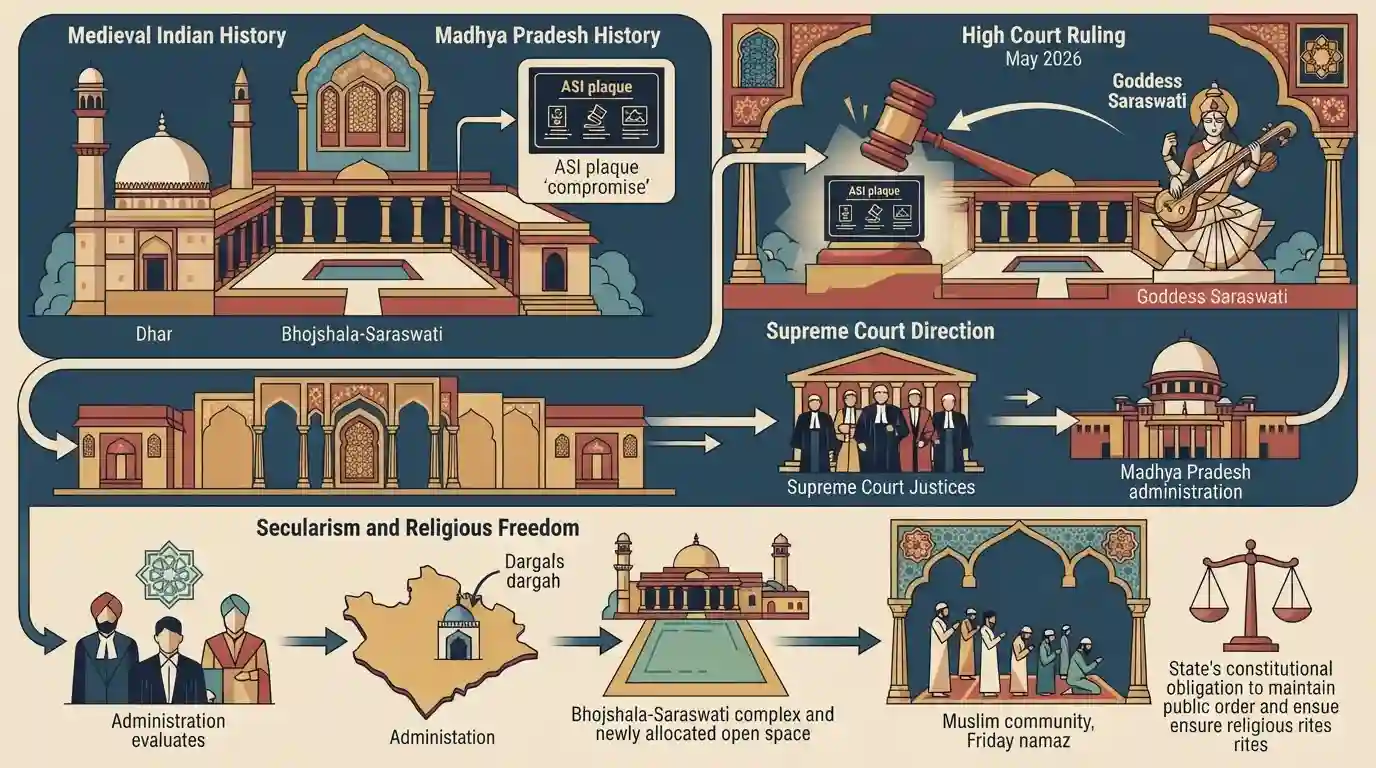
The Supreme Court of India directed the Madhya Pradesh administration to evaluate allocating a designated space near a dargah for the Muslim community to perform Friday namaz. This follows a May 2026 High Court ruling that declared the disputed Bhojshala-Kamal Maula mosque complex in Dhar as a temple dedicated to Goddess Saraswati, invalidating an earlier ASI compromise. The Supreme Court underscored the state's constitutional obligation to ensure the peaceful exercise of religious rites while maintaining public order, bringing issues of secularism, medieval history, and heritage management to the forefront.
Key Points
- The Supreme Court has asked the Madhya Pradesh government to consider allocating land near a dargah for Muslims to offer Friday namaz amidst the ongoing Bhojshala-Kamal Maula mosque dispute.
- In May 2026, the MP High Court ruled that the disputed complex in Dhar was fundamentally a temple dedicated to Goddess Saraswati, quashing a decades-old ASI arrangement that permitted Friday prayers.
- The dispute is deeply rooted in the history of Dhar, the medieval capital of the Paramara dynasty, notably King Bhoja, who was a great patron of learning and built the original structure.
- The Supreme Court emphasized the constitutional duty of the state to guarantee religious freedom for all communities while strictly maintaining law and order.
Important Terms
Bhojshala-Kamal Maula Mosque Complex

An 11th-century ASI-protected monument in Dhar, Madhya Pradesh. Hindus revere it as a Saraswati temple built by Paramara ruler Raja Bhoj, while Muslims consider it a mosque, leading to ongoing historical and legal disputes.
UPSC context
Crucial for GS Paper 1 (Medieval Indian History, Paramara dynasty architecture, and heritage management).
Archaeological Survey of India (ASI)
A statutory body responsible for archaeological research and the conservation of cultural monuments. In the Bhojshala dispute, its decades-old order regulating community worship was recently quashed by the High Court.
UPSC context
Relevant for GS Paper 1 (Art and Culture) and Prelims questions on statutory bodies.
Madhya Pradesh High Court
The state's highest judicial authority, whose May 2026 judgment controversially declared the disputed Bhojshala-Kamal Maula complex a Hindu temple, prompting subsequent Supreme Court intervention regarding minority worship rights.
UPSC context
Significant for GS Paper 2 (Judiciary's role in historical claims and religious freedom).
Supreme Court of India
India's apex judicial body. In this dispute, it underscored the state's constitutional obligation to allocate suitable spaces for religious rites (namaz) to balance religious freedom with public order.
UPSC context
Tests GS Paper 2 (Polity - fundamental rights, right to freedom of religion, and judicial interventions).
Secularism
A core constitutional principle ensuring equal treatment of all religions. The Bhojshala case highlights the state's delicate role in facilitating minority religious practices while managing historical majoritarian claims.
UPSC context
Core concept for GS Paper 1 (Indian Society) and GS Paper 2 (Polity - Basic Structure).
Prelims Trap
The Places of Worship Act, 1991 protects the religious character of ASI-protected monuments like Bhojshala.
The Places of Worship Act, 1991 explicitly exempts ancient and historical monuments covered by the AMASR Act, 1958. This exemption allows the religious character of sites like Bhojshala to be legally contested.
Static Concepts Connected
What are the key cultural and literary contributions of Paramara ruler King Bhoja?
- Patron of Learning: Established the Bhojshala in his capital Dhar, creating a prominent center for Sanskrit studies and the worship of Goddess Vagdevi (Saraswati).
- Literary Works: Authored 'Samarangana Sutradhara' (a treatise on architecture and engineering) and 'Saraswatikanthabharana' (a work on Sanskrit grammar and poetics).
- Temple Architecture: Commissioned the Bhojeshwar Temple at Bhojpur, an unfinished Shiva temple featuring one of India's largest stone Lingas.
How does the AMASR Act regulate religious practices at protected monuments?
- Customary Practice: Section 16 of the AMASR Act, 1958 protects the customary religious practices that were actively taking place at the time the monument was brought under ASI protection.
- Exemption from 1991 Act: Historical monuments and archaeological sites protected under the AMASR Act are explicitly exempt from the status-quo provisions of the Places of Worship (Special Provisions) Act, 1991.
Cross-Topic Patterns
AMASR Act vs. Places of Worship Act
Disputes like Bhojshala and Gyanvapi repeatedly test the legal exemption of ASI-protected historical monuments under the Places of Worship Act, blending medieval history with modern constitutional law.
Article 25 and "Public Order" restrictions
The SC's emphasis on balancing religious rights with public order mirrors recent controversies over hijab bans and religious processions, making Article 25 restrictions a critical focus area.

Expect a multi-statement question combining King Bhoja’s literary works (Samarangana Sutradhara) with AMASR Act exemptions for monuments.
Linked PYQs · 3
Linked PYQs · 3
- 2010MPPSC_PRELIMSGS1
King Bhoj ruled over:
- 2019MPPSC_PRELIMSGS1
Who among the following built 'Tribhuvan Narayan Temple' of Chittour ?
- 2023MPPSC_PRELIMSGS1
By which Constitutional Amendment was the term 'Socialist' included in the Preamble?
