Bhavnagar Spurious Liquor Crisis and Health Emergency Response
Source:india-today ↗
Why It Matters
This event is highly relevant for aspirants as it bridges Science (toxicology of methanol and emergency medical response like dialysis) with Polity and Governance (the practical challenges of enforcing state prohibition policies derived from DPSP Article 47, and disaster management protocols).
Summary
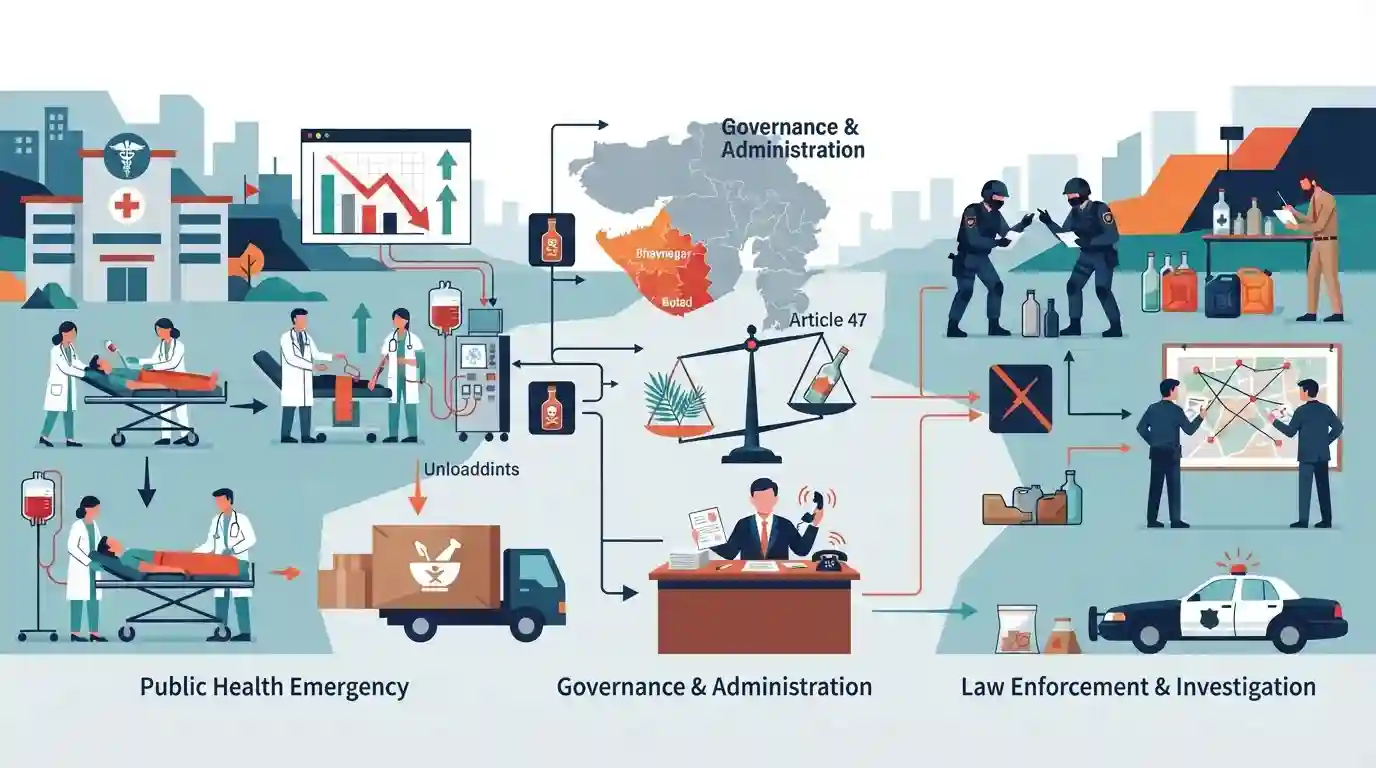
In response to a severe spurious liquor tragedy involving methanol poisoning in the Bhavnagar and Botad districts, the Gujarat government rapidly escalated its healthcare and administrative response. At least 13 people died and dozens were hospitalized. Health authorities reopened closed dialysis and ICU units at Sir T Hospital and sourced critical antidotes from Maharashtra. Simultaneously, the state's Anti-Terrorism Squad and State Monitoring Cell launched investigations into the illicit alcohol network. The incident highlights critical overlaps between public health emergency management and the governance challenges of enforcing total liquor prohibition in a dry state.
Key Points
- At least 13 people died and 63 were hospitalized after consuming spurious liquor laced with highly toxic methanol in Gujarat's Botad and Bhavnagar districts.
- The Gujarat Health Department initiated emergency medical protocols, reopening previously closed dialysis and ICU units at Sir T Hospital to treat acute organ failure caused by methanol toxicity.
- Specialized antidotes and medical teams were immediately procured from Ahmedabad and neighboring Maharashtra to manage the crisis.
- The state's Anti-Terrorism Squad (ATS) and the State Monitoring Cell (SMC) were mobilized to investigate the distribution network of the toxic brew.
- The tragedy exposes significant administrative and law enforcement challenges in maintaining prohibition in Gujarat, a dry state guided by Article 47 of the DPSP.
Important Terms
Directive Principles of State Policy (Article 47)

A constitutional provision urging states to raise nutrition and public health standards. It explicitly directs the state to endeavor to prohibit the consumption of intoxicating drinks and health-injurious drugs.
UPSC context
Vital for GPSC Paper 4 (Polity) to evaluate the constitutional basis, rationale, and governance challenges of Gujarat's strict liquor prohibition policy.
State Monitoring Cell (SMC)
A specialized branch within the Gujarat Police established to track and crack down on illicit statewide activities. It primarily focuses on enforcing the Prohibition Act by dismantling bootlegging and gambling networks.
UPSC context
Critical for GPSC Paper 5 (Public Administration) when discussing state law enforcement mechanisms and the administrative challenges of enforcing complete prohibition.
Anti-Terrorism Squad (ATS)
A specialized Gujarat Police unit mandated to conduct counter-terrorism operations, gather intelligence, and dismantle major organized crime syndicates. It frequently intervenes in complex, cross-border illicit networks like toxic liquor smuggling.
UPSC context
Important for GPSC Paper 6 (Internal Security) to illustrate the role of specialized forces in countering organized crime and internal security threats.
Sir T Hospital
Sir Takhatsinhji Hospital is a major public medical facility in Bhavnagar, Gujarat. Built in the 1880s, it serves as the region's crucial public health infrastructure for emergency care during crises like mass poisoning.
UPSC context
Relevant for GPSC Paper 5 (Public Health Governance) as a real-world case study of district-level emergency medical response and disaster healthcare capacity.
Health Department of Gujarat
The state authority responsible for overseeing medical infrastructure, public health policies, and healthcare administration. It manages critical emergency responses, such as procuring life-saving antidotes during mass casualty events.
UPSC context
Tests knowledge in GPSC Paper 5 (Governance) regarding state capacity in disaster healthcare, inter-state coordination, and managing public health emergencies.
Prelims Trap
Spurious liquor toxicity is primarily caused by an overdose of highly concentrated ethanol.
Hooch toxicity is caused by Methanol (methyl alcohol), not Ethanol. Methanol metabolizes into lethal formic acid. Paradoxically, pharmaceutical-grade Ethanol is used as an antidote to stop this metabolic process.
Static Concepts Connected
How does the Constitution approach the prohibition of alcohol?
- Article 47: Directs the State to improve public health and endeavor to prohibit intoxicating drinks and drugs.
- State List: Intoxicating liquors fall under the State List (Entry 8, List II), allowing individual states to formulate their own prohibition policies.
- Non-Justiciable: As a DPSP (Part IV), the prohibition mandate is non-justiciable and cannot be legally enforced by the courts.
What is the biochemical mechanism of methanol poisoning?
- Toxic Breakdown: The liver enzyme alcohol dehydrogenase (ADH) metabolizes methanol into highly toxic formaldehyde and formic acid.
- Clinical Impact: Formic acid causes severe metabolic acidosis, damage to the optic nerve leading to blindness, and multi-organ failure.
- Competitive Inhibition: Antidotes like Ethanol or Fomepizole act as competitive inhibitors. They bind to ADH, preventing methanol breakdown while it is excreted.
Cross-Topic Patterns
Prohibition & Black Market Dynamics
Strict prohibition policies under Article 47 often spawn illicit supply networks. This shifts state challenges from excise collection to law enforcement and acute public health emergency management.
Industrial vs. Potable Alcohol Regulation
The regulatory gap between industrial solvents (methanol) and potable alcohol (ethanol) creates an economic arbitrage, incentivizing bootleggers to use highly toxic industrial chemicals as cheap adulterants.

Expect a hybrid GS-Polity and Science question testing Article 47 alongside the metabolic difference between ethanol and methanol.
Linked PYQs · 2
Linked PYQs · 2
- 2024GPSC_PRELIMSGS1
The Directive Principles are non-justiciable in nature. This implies that 1. A citizen cannot move the Hon. court if the government fails to legally enforce the Directive Principles or even violate them in some instances. 2. The government cannot enact laws to implement Directive Principles. Select the correct answer code:
- 2025GPSC_PRELIMSGS1
Which of the following statements accurately reflect/(s) the provisions of the Indian Constitution? Statements: 1. The Directive Principles of State Policy (DPSP) are enforceable by the courts. 2. The Indian Constitution provides a federal system with unitary features. 3. The Fundamental Rights can be amended by the Parliament without any restrictions. Which of the statement/statements given above is/are correct?
