Bharatgpt Creator on Indigenous Artificial Intelligence Prospects
Source:Indian Express ↗
Why It Matters
The article is highly relevant for UPSC GS3 (Science and Technology) and GS2 (Human Resources/Education). It challenges the narrative that fundamental research deficits prevent India from becoming an AI powerhouse, offering a pragmatic view on applied AI and engineering as key drivers for indigenous technologies like BharatGPT.
Summary
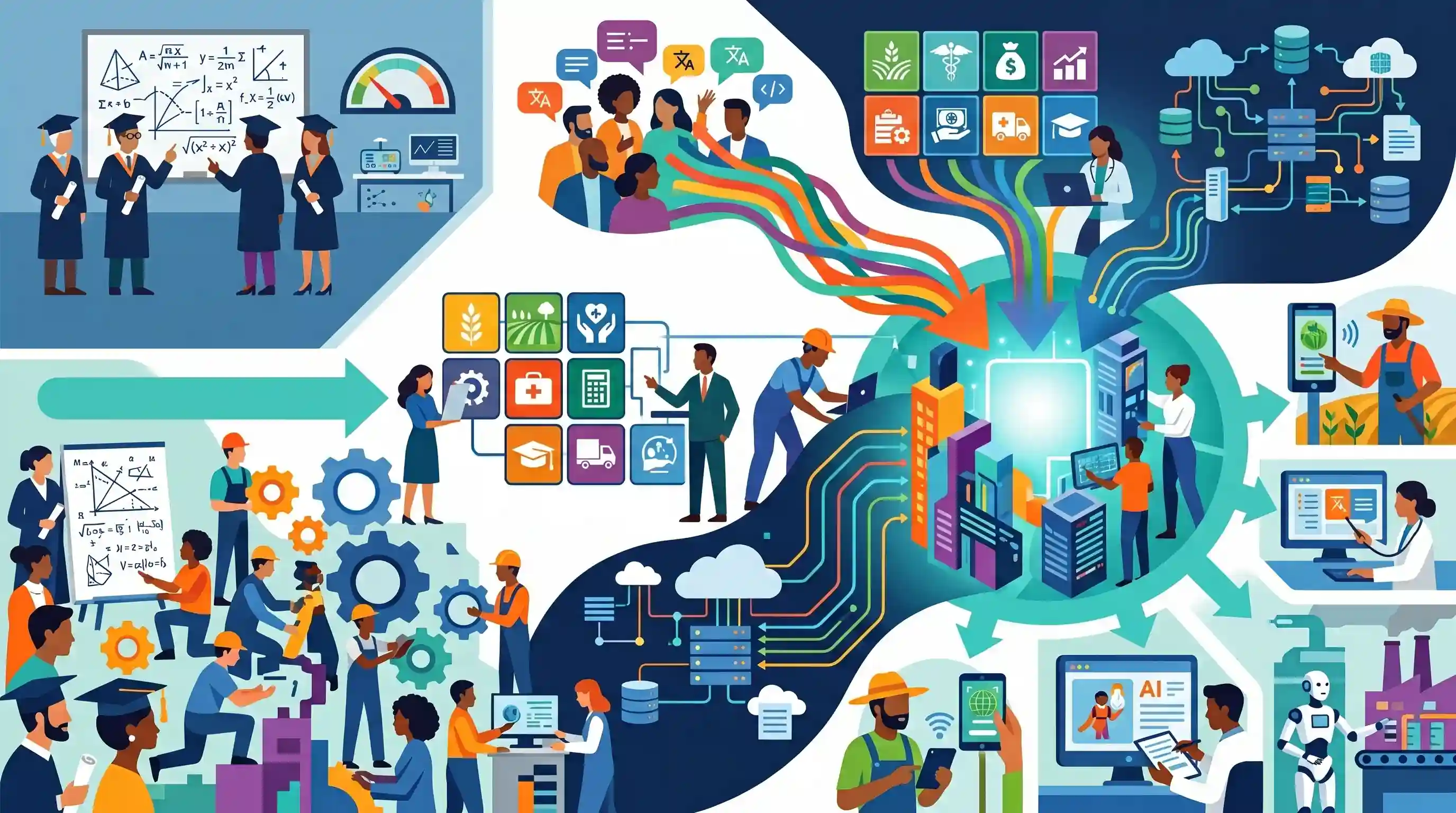
The creator of BharatGPT highlights that while India's lack of Mathematics PhDs is a genuine structural issue for foundational research, it is not a critical barrier to building practical AI solutions. The development of Large Language Models and AI applications heavily depends on applied engineering, domain-specific knowledge, and dataset integration. India can effectively harness its vast engineering workforce and linguistic diversity to create localized AI tools, emphasizing applied problem-solving over purely theoretical algorithmic development.
Key Points
- While India faces a genuine shortage of PhD scholars in Mathematics, this deficit is not the primary bottleneck for developing effective AI solutions.
- The creation of AI solutions and Large Language Models (LLMs) like BharatGPT relies heavily on applied engineering, domain expertise, and the integration of diverse datasets, rather than exclusively on foundational mathematical research.
- India has a strong opportunity to leverage its massive engineering talent and linguistic diversity to build localized AI models that solve real-world, grassroots problems.
- The discussion underscores the need to differentiate between foundational algorithm research (which requires advanced theoretical mathematics) and the practical architecture of AI applications.
Important Terms
BharatGPT

An indigenous, sovereign AI foundational model developed by CoRover.ai supporting 12+ Indian languages. It focuses on data localization and Indian cultural context for enterprise and public use.
UPSC context
GS III: S&T; tests awareness of indigenous technological advancements and digital sovereignty in the AI sector.
IndiaAI Mission
A ₹10,372 crore government initiative to build a sovereign AI ecosystem, including high-end compute infrastructure, indigenous models, and a unified datasets platform for startups and researchers.
UPSC context
GS III: Economy/S&T; relevant for industrial policy, digital infrastructure, and India's global competitiveness in emerging technologies.
Large Language Model (LLM)
A deep-learning algorithm trained on vast text data to recognize and generate human-like content. They serve as foundational architectures for generative AI tools like ChatGPT or Hanooman.
UPSC context
GS III: S&T; essential for understanding the underlying technology of Generative AI and its societal/economic implications.
Sovereign AI
A nation's capacity to build, own, and regulate AI technology independently. It aims to ensure data privacy, strategic autonomy, and development aligned with national values.
UPSC context
GS II/III: Governance and Security; tests understanding of digital colonization, data protection, and strategic technological independence.
Applied Engineering
The practical application of AI models to solve specific domain-related problems, emphasizing integration and usability over theoretical algorithmic or mathematical research breakthroughs.
UPSC context
GS III: S&T/Education; relevant for debates on India’s R&D focus and the shift from services to product-led growth.
Bhashini
The National Language Technology Mission aimed at breaking language barriers using AI. It provides open-source data and tools for real-time translation in major Indian languages.
UPSC context
GS II: Governance; tests knowledge of digital inclusion initiatives and the use of technology to bridge the linguistic divide.
Prelims Trap
Developing indigenous LLMs like BharatGPT requires primarily foundational algorithmic breakthroughs in mathematics.
Building practical AI/LLMs depends heavily on applied engineering, high compute, and dataset curation, not primarily on new theoretical mathematical breakthroughs.
Static Concepts Connected
What is Sovereign AI and why is it critical for India?
- Data sovereignty: Developing domestic foundational models to retain control over national data, ensuring privacy and strategic security.
- Cultural alignment: Training models on localized, vernacular datasets (like India's 22 scheduled languages) to prevent Western cultural bias in AI outputs.
- DPI integration: Layering indigenous AI models over existing Digital Public Infrastructure (Aadhaar, UPI) to improve grassroots administrative and welfare delivery.
How do Large Language Models (LLMs) conceptually function?
- Deep learning architecture: They utilize deep neural networks with billions of parameters, trained on massive datasets to understand and generate human language.
- Probabilistic generation: They do not 'think', but use complex probabilistic models to predict the most likely next word or token in a sequence.
- Fine-tuning: Adapting pre-trained open-source foundational models using highly specific, local datasets to perform specialized tasks accurately.
Cross-Topic Patterns
Vernacular AI + Inclusive Governance
AI trained on India's linguistic diversity (like the Bhashini project) directly links tech advancement to inclusive governance, breaking language barriers in Digital Public Infrastructure (DPI) adoption.
R&D Deficit vs Demographic Dividend
India's structural deficit in fundamental STEM research (low math/stat PhDs) is uniquely offset by its massive demographic dividend in applied software engineering, reshaping how emerging economies approach tech sovereignty.

Expect a multi-statement question contrasting foundational AI research with applied Sovereign AI, linking LLMs to India's DPI and Bhashini.
Linked PYQs · 3
Linked PYQs · 3
- 2023MainsGS3
Introduce the concept of Artificial Intelligence (AI). How does Al help clinical diagnosis? Do you perceive any threat to privacy of the individual in the use of Al in healthcare?
- 2020PrelimsGS1
With the present state of development, Artificial Intelligence can effectively do which of the following? 1. Bring down electricity consumption in industrial units 2. Create meaningful short stories and songs 3. Disease diagnosis 4. Text-to-Speech Conversion 5. Wireless transmission of electrical energy Select the correct answer using the code given below:
- 2023MainsGS2
The crucial aspect of development process has been the inadequate attention paid to Human Resource Development in India. Suggest measures that can address this inadequacy.
