Bharat NCAP 2.0 and Enhanced Vehicle Pedestrian Safety Norms
Source:Indian Express ↗
Why It Matters
Road safety is a critical governance and infrastructure issue, given India's high accident fatality rate. Bharat NCAP represents a shift towards indigenous technical standards and proactive regulation in the automotive sector, directly relevant to GS-3 (Infrastructure and Technology) and GS-2 (Government Policies).
Summary
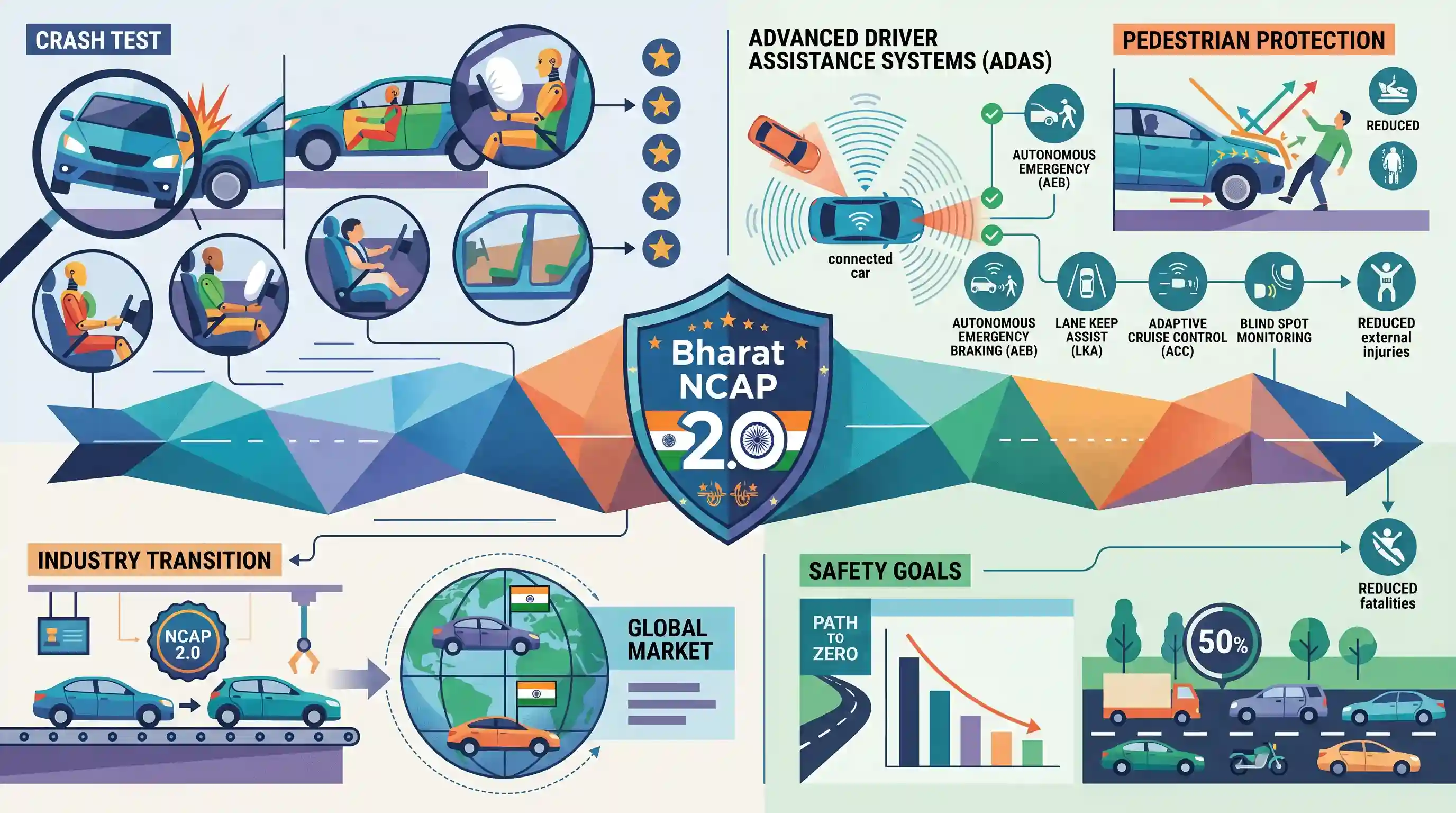
The Ministry of Road Transport and Highways is advancing road safety with the anticipated rollout of Bharat NCAP 2.0, the updated indigenous crash-test and safety rating program. The revised norms aim to holistically enhance road safety by not only upgrading occupant protection protocols but also integrating stringent pedestrian safety evaluations to minimize external injuries during impacts. The transition emphasizes the integration of modern safety technologies, such as Advanced Driver Assistance Systems (ADAS), pushing automakers to manufacture globally competitive, safer vehicles. This proactive regulatory push supports India's ambitious targets to halve road fatalities and strengthens the domestic automotive manufacturing ecosystem.
Key Points
- Bharat NCAP 2.0 introduces stricter crash-test protocols and safety benchmarks for the Indian automobile market, significantly upgrading vehicle assessment parameters.
- The new rules will place a heightened emphasis on pedestrian safety, assessing vehicle front-end structures to minimize injuries to pedestrians in the event of collisions.
- Advanced Driver Assistance Systems (ADAS) and active safety features are expected to play a more prominent role in securing higher star ratings for vehicles.
- The initiative aligns with India's commitments under the Brasilia Declaration to reduce road accidents and fatalities by half, driving automakers to prioritize robust engineering and road safety over cost-cutting.
Important Terms
Bharat New Car Assessment Programme (Bharat NCAP)

India's indigenous star-rating system (1-5) for vehicle safety based on crash tests. Version 2.0, effective October 2027, introduces holistic pillars including pedestrian safety and electronic driver aids.
UPSC context
GS-3 (Infrastructure/Safety). Tests understanding of domestic safety regulations and their impact on automotive manufacturing competitiveness.
Brasilia Declaration on Road Safety
A 2015 global commitment signed in Brazil aiming to halve road traffic deaths. India, a signatory, has recalibrated its target to achieve this 50% reduction by 2030.
UPSC context
GS-2 (International Agreements) and GS-3 (Road Safety). Tests knowledge of international frameworks influencing India's social and safety policies.
Motor Vehicles (Amendment) Act, 2019
A transformative law that increased penalties for traffic violations, established a National Road Safety Board, introduced vehicle recall provisions for safety defects, and protected 'Good Samaritans'.
UPSC context
GS-2 (Government Policies). Evaluates awareness of legislative reforms in the transport sector and public safety governance.
Advanced Driver Assistance Systems (ADAS)
Electronic systems using sensors and cameras to assist drivers in avoiding collisions through functions like automatic emergency braking, lane-keeping, and adaptive cruise control.
UPSC context
GS-3 (Science & Technology). Tests understanding of emerging automotive technologies and their application in reducing human error in accidents.
Global NCAP
An international non-profit promoting vehicle safety benchmarks. Its 'Safer Cars for India' campaign was the primary benchmark for Indian car safety before the launch of Bharat NCAP.
UPSC context
GS-3 (Standards/Safety). Tests knowledge of international NGOs and benchmarks that drive domestic industrial policy changes.
Vulnerable Road Users (VRUs)
Road users at the highest risk in traffic, primarily pedestrians, cyclists, and two-wheeler riders. Bharat NCAP 2.0 specifically includes a scoring pillar to evaluate external safety for these groups.
UPSC context
GS-3 (Infrastructure/Safety). Tests awareness of inclusive safety planning and strategies to reduce fatalities among non-car occupants.
Prelims Trap
Bharat NCAP safety ratings are now mandatory for all new passenger vehicles sold in India.
Bharat NCAP is a voluntary testing regime, not mandatory. Automakers voluntarily nominate vehicle models for crash testing, though consumer preference is driving adoption.
Static Concepts Connected
What is the Brasilia Declaration on Road Safety?
- UN-backed target: Adopted in 2015 at a WHO co-sponsored conference, it is a global agreement committing nations to halve road traffic deaths and injuries.
- India's commitment: India is a signatory and has committed to halving road fatalities, aligning with Sustainable Development Goal (SDG) Target 3.6.
How does the Motor Vehicles (Amendment) Act 2019 target vehicle safety?
- Vehicle Recalls: Empowers the Central Government to mandate recalls for motor vehicles if a defect harms the environment, driver, or other road users.
- National Board: Provides statutory backing for the creation of the National Road Safety Board to advise on traffic management and motor vehicle standards.
Cross-Topic Patterns
ADAS sensors: LiDAR vs RADAR in S&T
ADAS relies on sensor fusion. Prelims often tests the difference between LiDAR (light pulses, high resolution) and RADAR (radio waves, better in fog/rain) under GS3 Science & Tech.
Road crashes as a GS3 economic drain
Mains GS3 often links road safety to economic impact. India loses roughly 3% of its GDP annually to road accidents, shifting NCAP from a consumer issue to a macroeconomic imperative.

Expect a composite Prelims question testing Bharat NCAP's voluntary nature alongside ADAS sensor tech (LiDAR vs RADAR) and Brasilia pact.
Linked PYQs · 4
Linked PYQs · 4
- 2025PrelimsGS1
With reference to India, consider the following pairs : Organization Union Ministry I. The National Automotive Board : Ministry of Commerce and Industry II. The Coir Board : Ministry of Heavy Industries III. The National Centre for Trade Information : Ministry of Micro, Small and Medium Enterprises How many of the above pairs are correctly matched?
- 2017PrelimsGS1
Consider the following statements: 1. The Standard Mark of Bureau of Indian Standards (BIS) is mandatory for automotive tyres and tubes. 2. AGMARK is a quality Certification Mark issued by the Food and Agriculture Organisation (FAO). Which of the statements given above is/are correct?
- 2025PrelimsGS1
Consider the following types of vehicles : I. Full battery electric vehicles II. Hydrogen fuel cell vehicles III. Fuel cell-electric hybrid vehicles How many of the above are considered as alternative powertrain vehicles?
- 2021MainsGS3
“Investment in infrastructure is essential for more rapid and inclusive economic growth.” Discuss in the light of India's experience.
