Bharat Maritime Insurance Pool for Supply Chain Resilience
Source:Indian Express ↗
Why It Matters
The establishment of a domestic maritime insurance pool highlights the direct impact of global geopolitical conflicts on India's supply chains and trade viability. It underscores the strategic necessity for self-reliance in the financial and insurance sectors to safeguard national trade interests, ensure sanctions resilience, and maintain sovereignty in the face of international market volatility.
Summary
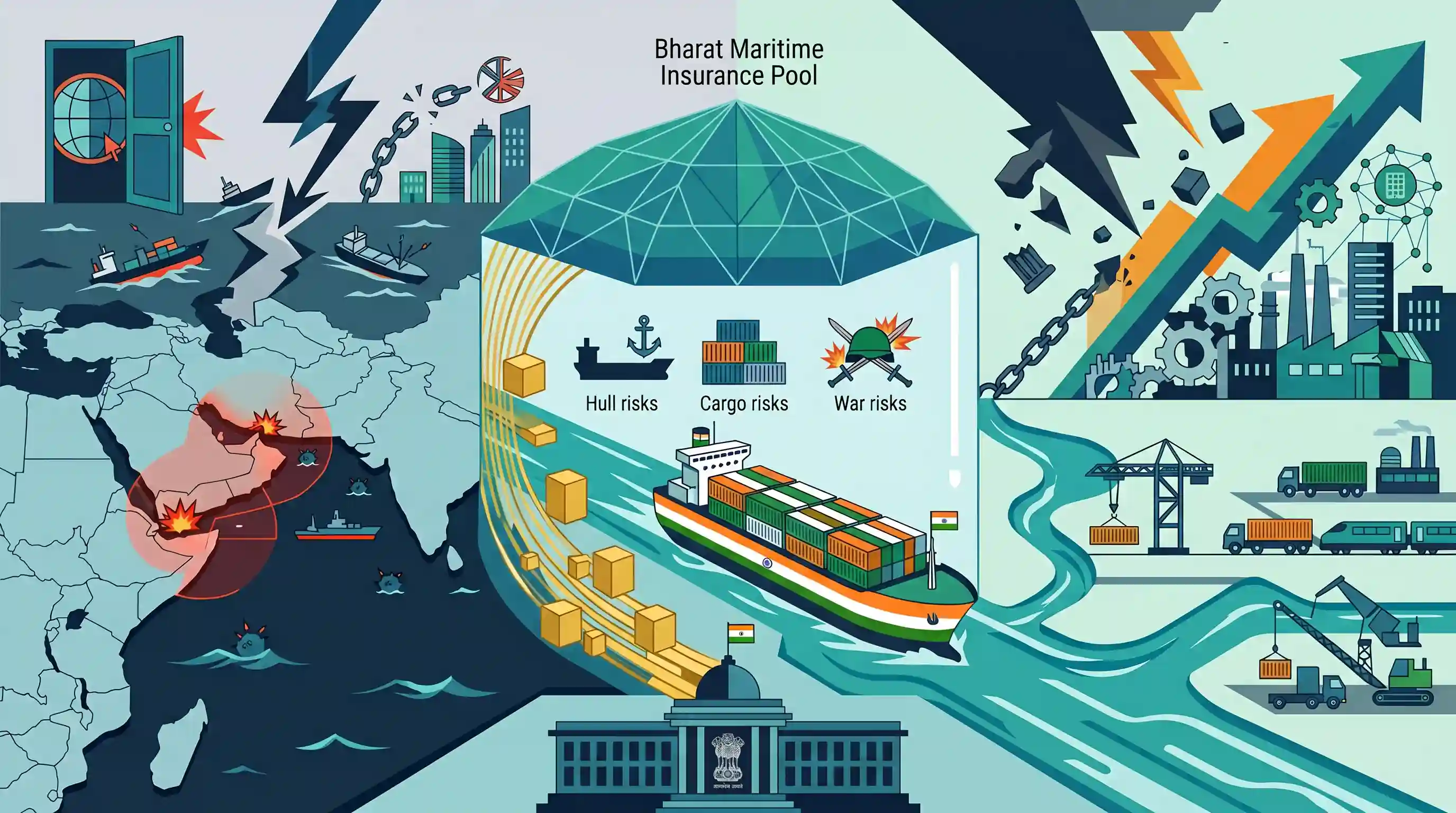
The Indian government has approved the creation of the Rs 12,980-crore 'Bharat Maritime Insurance Pool' (BMI pool), backed by a sovereign guarantee, to provide continuous insurance coverage for Indian vessels traversing volatile maritime corridors like the Strait of Hormuz and Gulf of Aden. Triggered by global shipping disruptions and the withdrawal of foreign reinsurers amidst the West Asia conflict, the pool covers hull, cargo, and war risks. This strategic move aims to reduce reliance on foreign entities like the IGP&I Club, fortify supply chain resilience, ensure uninterrupted maritime trade, and enhance India's economic self-reliance against geopolitical shocks and sanctions.
Key Points
- The Union Cabinet approved the Rs 12,980-crore 'Bharat Maritime Insurance Pool' (BMI pool) backed by a sovereign guarantee to cover maritime risks for Indian vessels.
- The pool covers hull, machinery, cargo, protection and indemnity (P&I), and war risks.
- The initiative responds to global shipping disruptions and the withdrawal of foreign reinsurers due to the ongoing West Asia conflict and tensions in the Strait of Hormuz and Gulf of Aden.
- It aims to reduce India's heavy reliance on the International Group of Protection and Indemnity (IGP&I) Club for third-party maritime liabilities.
- The creation of the BMI pool strengthens self-reliance, sanctions resilience, and ensures continuity of vital maritime trade despite geopolitical instability.
Important Terms
Bharat Maritime Insurance Pool (BMI pool)

A Rs 12,980-crore government-backed domestic risk-sharing mechanism providing hull, cargo, P&I, and war-risk coverage for Indian-flagged or India-bound vessels.
UPSC context
GS-3: Economy (Infrastructure/Trade); GS-2: International Relations. Tests strategies for trade security and 'Atmanirbhar Bharat'.
International Group of Protection and Indemnity (IGP&I) Club
A London-based association of 12-13 mutual clubs providing liability cover for 90% of global ocean-going ships, on which India currently relies for maritime insurance.
UPSC context
GS-2: Global Groupings. Tests understanding of global maritime governance and dependencies in international trade.
Sovereign Guarantee
A government's legally binding promise to honor a debt or obligation if a borrower (or insurance pool) defaults; provides financial stability to large-scale risk pools.
UPSC context
GS-3: Indian Economy. Tests knowledge of fiscal tools used to support strategic sectors and manage financial risk.
GIC Re (General Insurance Corporation of India)
India's sole domestic public-sector reinsurer; it serves as the administrator and lead contributor to the BMI pool.
UPSC context
GS-3: Indian Economy. Tests the role of PSUs in ensuring economic resilience and financial market stability.
Protection and Indemnity (P&I) Insurance
Specialized maritime insurance covering third-party liabilities like oil pollution, wreck removal, crew injury, and legal liabilities not covered by standard hull insurance.
UPSC context
GS-3: Infrastructure (Shipping). Tests technical understanding of maritime trade risks and international environmental liabilities.
General Insurance Council
A statutory body established under the Insurance Act, 1938, representing all non-life insurers in India to advise regulators and coordinate industry practices.
UPSC context
GS-3: Regulatory Bodies. Tests knowledge of institutional frameworks governing the Indian financial and insurance sectors.
Prelims Trap
The BMI Pool is a purely private insurance consortium functioning without government financial backing.
The BMI pool is not purely private; it is explicitly backed by a Rs 12,980-crore sovereign guarantee, meaning the Indian government acts as the ultimate financial backstop.
Static Concepts Connected
What is a Sovereign Guarantee in public finance?
- Contingent Liability: It is a government's promise to discharge the liability of a third party if they default, recorded as a contingent liability rather than immediate direct public debt.
- FRBM Limits: Under the FRBM framework, the central government caps the quantum of incremental guarantees issued in a financial year (typically 0.5% of GDP) to ensure fiscal discipline.
What are the critical maritime chokepoints in West Asia?
- Strait of Hormuz: Connects the Persian Gulf to the Gulf of Oman and Arabian Sea. It is the world's most critical oil transit chokepoint.
- Gulf of Aden: Connects the Red Sea to the Arabian Sea via the Bab-el-Mandeb strait. It is vital for Suez Canal traffic but highly vulnerable to regional conflicts.
Cross-Topic Patterns
Weaponization of Insurance & Sanctions
Western sanctions on Russian oil highlighted how global insurance monopolies (like the IGP&I Club) can be weaponized. Domestic pools are India's strategic countermeasure to bypass such extraterritorial sanctions.
IMEC and Supply Chain Resilience
Disruptions in the Red Sea and Gulf of Aden underscore the necessity for both financial safeguards (BMI Pool) and alternative physical logistics routes like the India-Middle East-Europe Economic Corridor (IMEC).

Expect a 2026 multi-statement question combining West Asian chokepoints (Hormuz/Aden) with India's strategic mechanisms (BMI, Op Sankalp).
Linked PYQs · 4
Linked PYQs · 4
- 2024MainsGS2
Discuss the geopolitical and geostrategic importance of Maldives for India with a focus on global trade and energy flows. Further also discuss how this relationship affects India's maritime security and regional stability amidst international competition ?
- 2014MainsGS2
With respect to the South China sea, maritime territorial disputes and rising tension affirm the need for safeguarding maritime security to ensure freedom of navigation and over flight throughout the region. In this context, discuss the bilateral issues between India and China.
- 2025MainsGS3
Why is maritime security vital to protect India's sea trade? Discuss maritime and coastal security challenges and the way forward.
- 2022MainsGS3
What are the maritime security challenges in India ? Discuss the organisational, technical and procedural initiatives taken to improve the maritime security.
