Nationwide general strike against labour codes and policies
Source:Indian Express ↗
Why It Matters
The massive scale of the Bharat Bandh underscores the ongoing friction between the government's structural reform agenda (such as the Labour Codes and NEP 2020) and the concerns of organized labour, agricultural workers, and public servants. It highlights the challenges of building consensus for economic and administrative reforms in India's complex socio-political landscape.
Summary
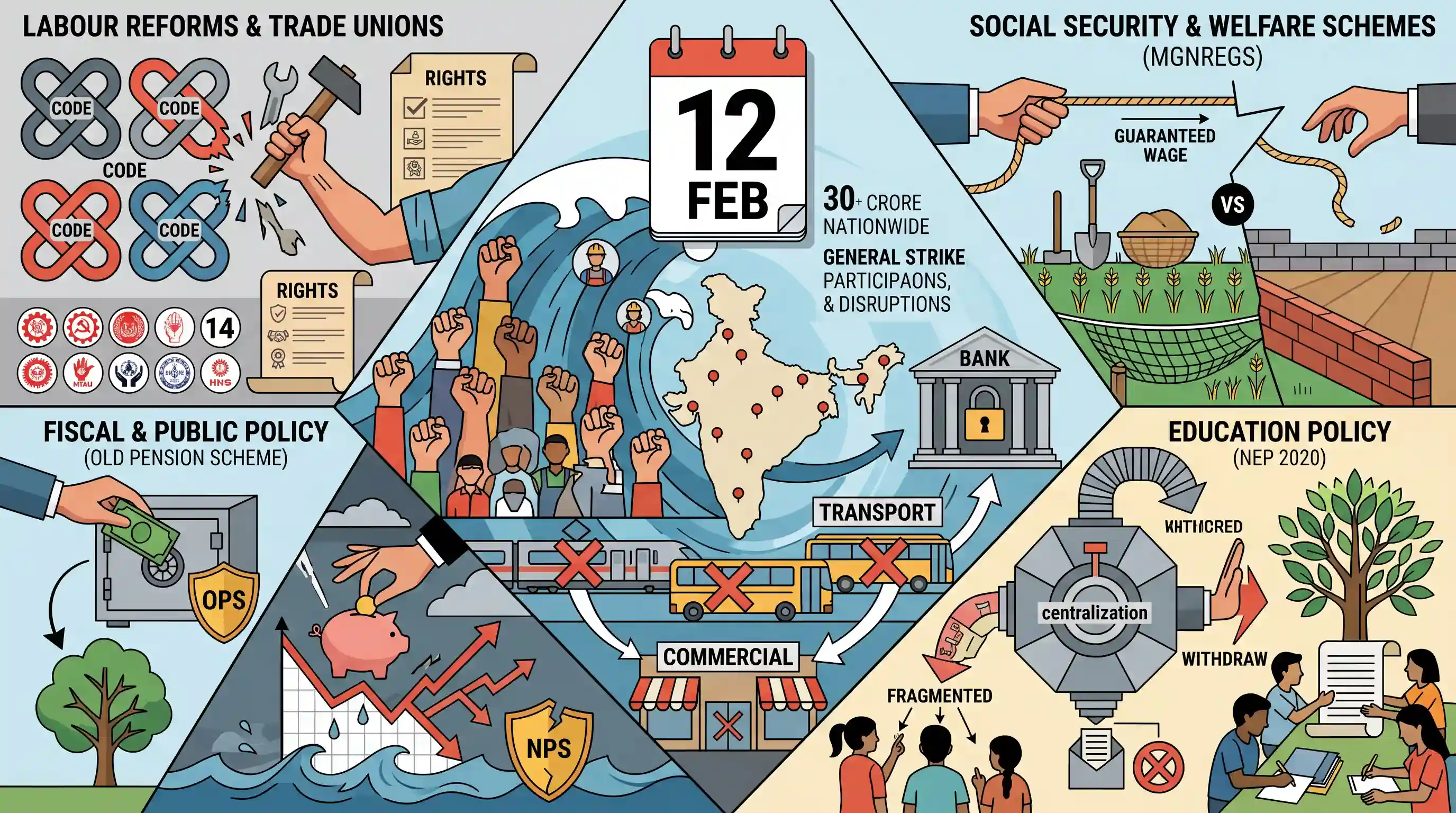
A nationwide general strike, or Bharat Bandh, has been called on February 12, 2026, by 14 national trade unions along with various farmers', civil service, and informal workers' organizations. Protesters are demanding the repeal of the four Labour Codes, the reinstatement of the Old Pension Scheme, the restoration of the Mahatma Gandhi National Rural Employment Guarantee Scheme (MGNREGS), and the withdrawal of the National Education Policy (NEP) 2020. The strike, expected to mobilize over 30 crore participants, reflects mounting opposition to recent structural reforms and is poised to disrupt banking, transport, and commercial operations across hundreds of districts.
Key Points
- A nationwide general strike (Bharat Bandh) called by 14 national trade unions is scheduled for February 12, 2026, with an estimated participation of 30 crore workers.
- The central demands of the strike include the repeal of the four Labour Codes, restoration of MGNREGS, withdrawal of NEP 2020, and the reinstatement of the old pension scheme.
- Farmers' organizations such as the Samyukta Kisan Morcha (SKM) are participating to voice concerns against the India-US interim trade framework.
- The strike is expected to severely impact banking operations, public transport, and government offices in over 600 districts, particularly in states like Odisha, Assam, Kerala, and West Bengal.
Important Terms
Labour Codes

A set of four legislative frameworks (Wages, Industrial Relations, Social Security, and Occupational Safety) that consolidate 29 central labor laws to simplify compliance and modernize labor regulations.
UPSC context
GS III (Economy); tests labor reforms, ease of doing business, and balancing worker welfare with economic flexibility.
Mahatma Gandhi National Rural Employment Guarantee Scheme (MGNREGS)
A demand-driven social security scheme providing at least 100 days of guaranteed unskilled manual work annually to every rural household to enhance livelihood security and reduce poverty.
UPSC context
GS II & III (Welfare/Economy); tests rights-based legislation and rural development strategies.
National Education Policy (NEP) 2020
A comprehensive framework for school and higher education aimed at universalizing education, replacing the 10+2 system with a 5+3+3+4 structure and emphasizing multidisciplinary learning.
UPSC context
GS II (Social Justice/Education); tests structural reforms and alignment with Sustainable Development Goal 4.
Samyukta Kisan Morcha (SKM)
A coalition of over 400 Indian farmers' unions established in 2020 to coordinate protests against agrarian reforms and advocate for legal Minimum Support Price (MSP) guarantees.
UPSC context
GS II (Governance/Polity); tests the role of pressure groups and agrarian mobilization in policy influence.
All India Trade Union Congress (AITUC)
Founded in 1920 with Lala Lajpat Rai as its first president, it is India’s oldest central trade union representing workers' rights in national and international forums.
UPSC context
GS I (History) & GS II (Pressure Groups); tests knowledge of the labor movement and its historical significance.
India-US interim trade framework
A proposed trade arrangement between India and the United States aimed at increasing market access; it is currently opposed by domestic farmer groups fearing agricultural disruption.
UPSC context
GS II (International Relations); tests bilateral trade diplomacy and its impact on the domestic primary sector.
Prelims Trap
The Right to Strike is a Fundamental Right guaranteed under Article 19(1)(c).
Forming trade unions is a fundamental right under Article 19, but the right to strike is only a statutory right regulated by the Industrial Disputes Act, not a fundamental right.
Static Concepts Connected
What is the Constitutional basis and statutory regulation of strikes in India?
- No Fundamental Right: Forming trade unions is protected under Art 19(1)(c), but the Supreme Court ruled there is no fundamental right to strike (e.g., T.K. Rangarajan case).
- Statutory Right: Striking is a statutory right legally recognized but heavily restricted and regulated under the Industrial Disputes Act, 1947.
- Public Utilities Notice: Workers in public utility services cannot go on strike without giving advance notice to the employer within six weeks before striking.
What are the structural pillars of the four new Labour Codes?
- Consolidation: They subsume 29 central labour laws into four unified codes covering Wages, Industrial Relations, Social Security, and Occupational Safety, Health and Working Conditions.
- Industrial Relations: The Industrial Relations Code raises the threshold for requiring government permission for retrenchment, lay-offs, or closure from 100 workers to 300 workers.
- Gig Economy Recognition: The Code on Social Security legally recognizes gig and platform workers for the first time in India, mandating the creation of dedicated social security funds.
Cross-Topic Patterns
OPS demands vs Fiscal Prudence
Reverting to the unfunded, pay-as-you-go Old Pension Scheme (OPS) directly clashes with FRBM Act goals, linking trade union demands to state-level debt traps and macroeconomy in GS-3.
Farmers targeting bilateral trade deals
SKM’s protest against the India-US interim trade framework demonstrates how agrarian lobbies now actively contest FTA and WTO negotiations, linking GS-3 Agriculture with GS-2 International Relations.

Expect a multi-statement Prelims question linking the legal nature of strikes (Art 19) with the Industrial Relations Code notice provisions.
Linked PYQs · 5
Linked PYQs · 5
- 2024MainsGS3
Discuss the merits and demerits of the four 'Labour Codes' in the context of labour market reforms in India. What has been the progress so far in this regard?
- 2017PrelimsGS1
The Trade Disputes Act of 1929 provided for
- 2022PrelimsGS1
In India, which one of the following compiles information on industrial disputes, closures, retrenchments and lay-offs in factories employing workers ?
- 2017PrelimsGS1
Consider the following statements: 1. The Factories Act, 1881 was passed with a view to fix the wages of industrial workers and to allow the workers to form trade unions. 2. N.M. Lokhande was a pioneer in organizing the labour movement in British India. Which of the above statements is/are correct?
- 2020MainsGS2
National Education Policy 2020 is in conformity with the Sustainable Development Goal-4 (2030). It intends to restructure and reorient education system in India. Critically examine the statement.
