Viksit Rajasthan roadmap and Rs 91000 crore water scheme announced
Source:telangana-today ↗
Why It Matters
Major state government announcements, particularly large-scale infrastructure projects like the Rs 91,000-crore drinking water scheme and developmental initiatives in the Shekhawati region, are highly relevant for RPSC RAS Prelims. Questions frequently test knowledge of state policies, budget allocations, and regional geography (such as Shekhawati and border districts).
Summary
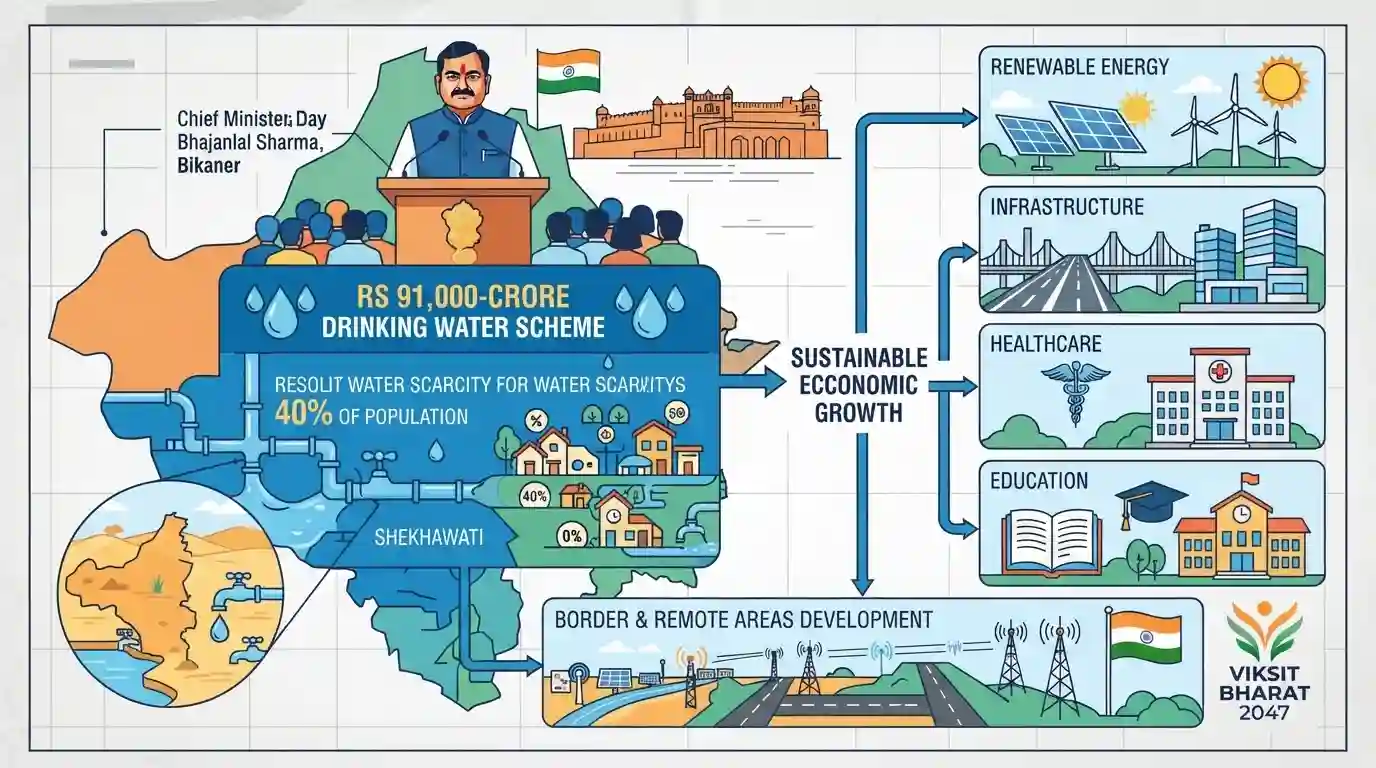
Rajasthan Chief Minister Bhajanlal Sharma outlined the roadmap for 'Viksit Rajasthan' during his Independence Day address at Bikaner. The cornerstone of his announcements was a massive Rs 91,000-crore drinking water scheme aimed at resolving water scarcity for 40% of the state's population, particularly addressing the historic water shortages in the Shekhawati region. The Chief Minister also emphasized a comprehensive development strategy focusing on solar energy, infrastructure, healthcare, and education to ensure sustainable economic growth. The strategic development of border and remote areas was highlighted as a priority to align the state's progress with the national vision of 'Viksit Bharat' by 2047.
Key Points
- Chief Minister Bhajanlal Sharma unveiled a roadmap for 'Viksit Rajasthan' during the state-level Independence Day function in Bikaner.
- Announced a Rs 91,000-crore scheme to provide reliable drinking water to 40% of Rajasthan's population, targeting critical areas like the Shekhawati region.
- Highlighted strategic focus on sectors like infrastructure, solar energy, healthcare, and education to drive long-term state development.
- Emphasized specific attention towards the progress of border and remote districts, including Bikaner, ensuring equitable development.
- Aligned the state's socio-economic goals with the broader national vision of 'Viksit Bharat' by 2047.
Important Terms
Viksit Rajasthan

A strategic development roadmap introduced by the Rajasthan government, prioritizing infrastructure, healthcare, education, solar energy, and water security to ensure sustainable economic growth and regional equity.
UPSC context
Crucial for RAS Mains Paper III (Rajasthan Economy). Tests knowledge of current state development strategies and welfare policies.
Viksit Bharat 2047
The Government of India's strategic vision to transform India into a fully developed, economically robust, socially inclusive, and technologically advanced nation by the 100th anniversary of its independence in 2047.
UPSC context
Relevant for RAS/UPSC Mains Paper II and III (Governance and Economy). Tests knowledge of long-term national policy goals.
Shekhawati Region
A semi-arid historical region in northeastern Rajasthan, including Sikar, Jhunjhunu, and Churu. It faces acute groundwater depletion and is the target of major state water infrastructure and inter-state pipeline projects.
UPSC context
Essential for RAS Mains Paper II (Rajasthan Geography). Tests knowledge of regional environmental challenges and water management.
Prelims Trap
Rajasthan ranks first nationally in overall renewable energy capacity.
Rajasthan leads the nation specifically in installed solar capacity, but holds the second rank nationally in overall renewable energy capacity.
Static Concepts Connected
What are the constitutional provisions regarding a Uniform Civil Code (UCC) at the State level?
- Article 44: DPSP guiding state policy to secure a uniform civil code for all citizens.
- Concurrent List: Personal laws (marriage, succession) fall under Entry 5 of the Concurrent List, enabling states to legislate.
- Presidential Assent: Under Article 254(2), a state law on concurrent subjects repugnant to central law requires Presidential assent.
What are the geographical and water resources characteristics of the Shekhawati region?
- Inland Drainage: Comprising Sikar, Jhunjhunu, Churu, and Neem Ka Thana, the region falls largely under the inland drainage basin.
- River System: The seasonal Kantli River is the primary drainage channel, which originates in the Aravalis (Khandela hills).
- Aquifer Stress: The region suffers from severe groundwater depletion, with almost all blocks declared as 'Over-exploited' or 'Dark Zones'.
Cross-Topic Patterns
Border Area Development + National Security
Aligning the development of border districts like Bikaner with the Border Area Development Programme (BADP) to enhance strategic infrastructure and check rural-to-urban migration.
Fiscal Federalism + Capex Outlays
Analyzing how a massive Rs 91,000-crore water allocation impacts the state's fiscal deficit targets under the Rajasthan FRBM Act.

Expect a multi-statement question combining the Rs 91k-cr water scheme details with Rajasthan's national rank in solar versus overall RE.
Linked PYQs · 4
Linked PYQs · 4
- 2021RPSC_PRELIMSGS1
In which year was the Rajasthan Solar Energy Policy announced?
- 2012RPSC_PRELIMSGS1
The first solar energy policy was announced by the Government of Rajasthan in -
- 2023RPSC_PRELIMSGS1
Which agency has been given the responsibility of implementing the PM-KUSUM scheme (Component A) in Rajasthan, which involves the establishment of solar power plants with a capacity of 0.5 MW to 2 MW?
- 2025RPSC_PRELIMSGS1
Consider the following statements: A. Luni Basin and Shekhawati region are sub-regions of Bhangar in Rajasthan. B. The Ghaggar plain is mostly spread in Hanumangarh and Ganganagar districts. C. Nagaur Uplands have saline lakes and internal drainage. D. The Aravalli ranges are rich in all types of minerals. Select the correct answer from the code given below: Code:
