Bhagat Singh birth anniversary commemorated with socialist ideals
Source:The Hindu ↗
Why It Matters
The article bridges the historical ideology of Bhagat Singh with contemporary socio-economic challenges in India. It is highly relevant for GS1 (Modern History - Revolutionary Nationalism and Ideologies; Impact of the Russian Revolution) and GS2 (Social Justice - privatization of healthcare/education and youth issues). Understanding the evolution of socialist ideals in India is crucial for the Mains examination.
Summary
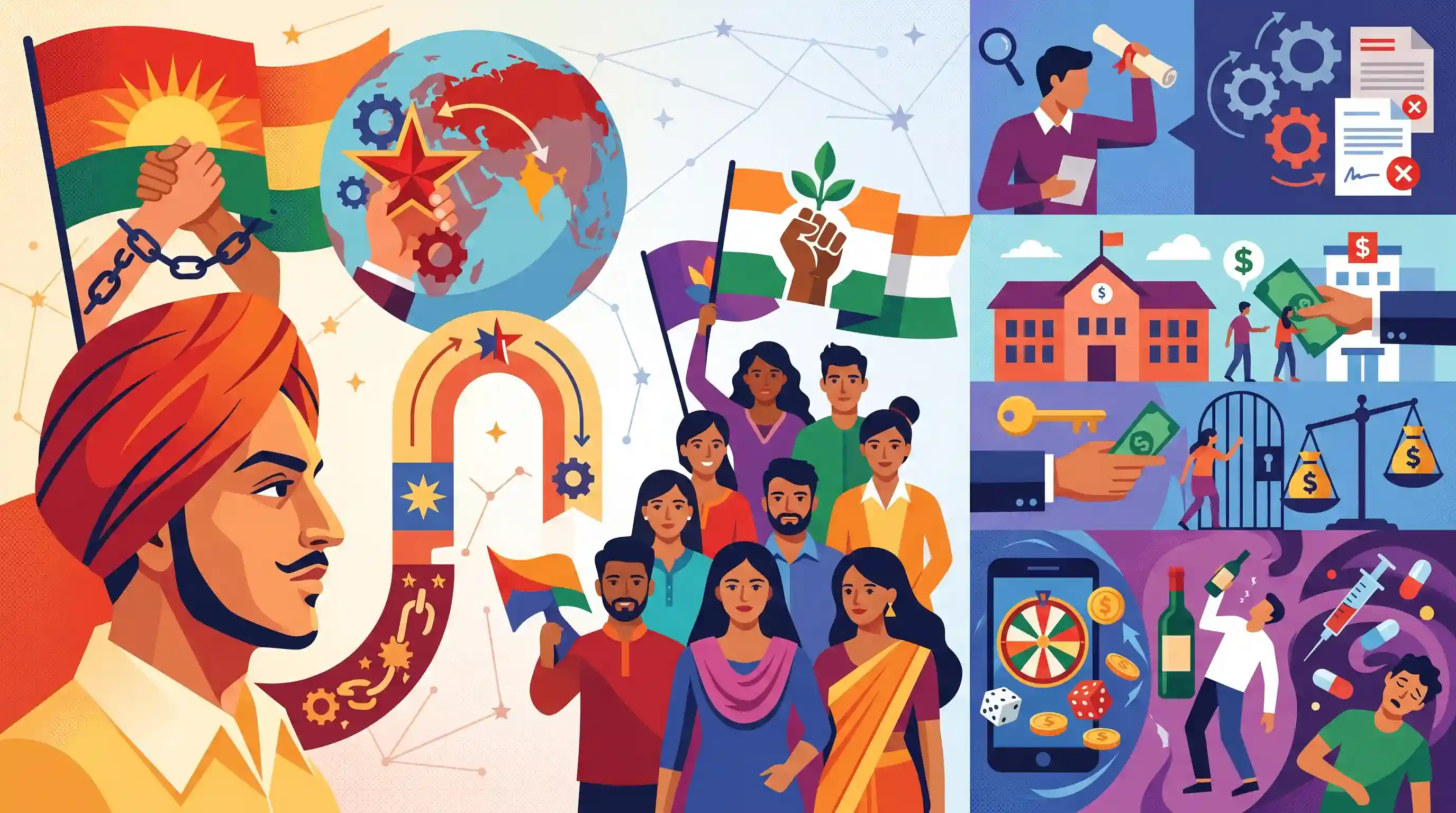
The birth anniversary of revolutionary freedom fighter Bhagat Singh was celebrated in Dharwad by the All India Democratic Youth Organisation (AIDYO). Participants highlighted his ideological commitment to establishing an exploitation-free socialist society, a vision deeply influenced by the 1917 Russian Revolution. Speakers drew parallels between Bhagat Singh's struggles against colonial exploitation and the contemporary challenges faced by Indian youth, including rising unemployment, the privatization of public education and healthcare, and the pervasive spread of social vices like online gambling, alcoholism, and drug abuse. The event underscored the need for the youth to adopt Bhagat Singh's ideals to address ongoing socio-economic inequalities and societal degradation.
Key Points
- Bhagat Singh's birth anniversary was commemorated in Dharwad by the All India Democratic Youth Organisation (AIDYO) to reflect on his life, struggle, and ideology.
- Speakers emphasized Bhagat Singh's vision of a socialist society inspired by the 1917 Russian Revolution, aimed at ending exploitation and ensuring education, healthcare, and social security.
- The contemporary relevance of his ideals was highlighted in the context of rising capitalism, privatization of essential services like education and healthcare, unemployment, and price rises.
- Concerns were raised regarding modern vices such as online gaming, betting, alcoholism, and drug abuse, which are distracting the youth from constructive nation-building.
Important Terms
Bhagat Singh

An iconic revolutionary socialist who founded the Naujawan Bharat Sabha and transformed the HSRA into a body dedicated to ending all forms of human exploitation.
UPSC context
GS Paper I (Modern History); tests understanding of revolutionary movements and ideological evolution in the independence struggle.
Hindustan Socialist Republican Association (HSRA)
A revolutionary party reorganized in 1928 to formally adopt socialism, aiming to replace British rule with a socialist republic led by workers and peasants.
UPSC context
GS Paper I (Modern History); focuses on the radical-revolutionary strand and its vision for post-independence India.
All India Democratic Youth Organisation (AIDYO)
The youth wing of the Socialist Unity Centre of India (Communist), founded in 1966 to mobilize youth against unemployment, communalism, and the commercialization of education.
UPSC context
GS Paper II (Social Justice); examines the role of pressure groups and youth-led social mobilization.
Russian Revolution (1917)
The 1917 Bolshevik uprising that profoundly influenced Indian revolutionaries to pivot from individual heroic actions toward mass-based movements and socialist economic ideals.
UPSC context
GS Paper I (World History); covers the impact of global revolutions on the Indian national movement.
Privatization of Healthcare and Education
The shift toward private-sector-led service delivery in social sectors, often raising concerns regarding out-of-pocket expenditure (OOPE) and inequitable access for vulnerable populations.
UPSC context
GS Paper II (Social Justice) and Paper III (Indian Economy); tests analysis of human capital and welfare policy.
Socialist Society
The socio-economic vision of Bhagat Singh, where wealth is distributed equally and the state is free from class, caste, and religious exploitation.
UPSC context
GS Paper I (Modern History); examines the distinct ideological frameworks adopted by different freedom fighters.
Prelims Trap
Bhagat Singh founded the Hindustan Republican Association (HRA) in 1924.
HRA was founded by Sachindra Nath Sanyal and Ram Prasad Bismil. Bhagat Singh helped reorganize it into the Hindustan Socialist Republican Association (HSRA) in 1928.
Static Concepts Connected
How did the HRA evolve into the HSRA?
- 1924 Formation: The Hindustan Republican Association (HRA) was founded in Kanpur in 1924 by Sachindra Nath Sanyal, Ram Prasad Bismil, and Jogesh Chandra Chatterjee.
- 1928 Reorganization: Following the Kakori train robbery and subsequent arrests, revolutionaries met at Feroz Shah Kotla, Delhi in 1928 to reorganize the HRA into the HSRA.
- Ideological Shift: The addition of 'Socialist' to the name reflected the influence of the Russian Revolution, shifting the group's goal from mere political freedom to ending all socio-economic exploitation.
How does the Constitution regulate gambling and substance abuse?
- Gambling (State List): Entry 34 of the State List (Schedule VII) gives state legislatures the exclusive power to enact laws on betting and gambling, causing fragmented regulations for online gaming.
- Substances (DPSP): Article 47 directs the State to raise the level of nutrition and public health, explicitly obligating it to prohibit intoxicating drinks and drugs injurious to health.
Cross-Topic Patterns
HSRA Ideology + DPSP Welfare State
Bhagat Singh's vision of an exploitation-free society aligns perfectly with Part IV of the Constitution, particularly Articles 38 and 47 regarding the minimization of socio-economic inequalities and improvement of public health.
Russian Revolution + Indian Left Wing
The 1917 Bolshevik revolution did not just inspire the HSRA; it catalyzed the broader Indian socialist movement, including the formation of AITUC (1920) and the Communist Party of India (1925).

Expect a multi-statement question on Bhagat Singh linking the 1928 HSRA reorganization with his secular, socialist writings.
Linked PYQs · 4
Linked PYQs · 4
- 2003PrelimsGS1
With reference to Indian freedom struggle, which one of the following statements is correct?
- 2014MainsGS1
The New Economic Policy – 1921 of Lenin had influenced the policies adopted by India soon after independence. Evaluate.
- 2014MainsGS1
What were the major political, economic and social developments in the world which motivated the anti-colonial struggle in India?
- 2024MainsGS2
In a crucial domain like the public healthcare system the Indian State should play a vital role to contain the adverse impact of marketisation of the system. Suggest some measures through which the State can enhance the reach of public healthcare at the grassroots level.
