Maharashtra BH Series Vehicle Road Tax Enforcement Campaign
Source:businesstoday ↗
Why It Matters
The article highlights the implementation challenges of an ease-of-mobility policy (BH series). It demonstrates the intersection of central rules (Motor Vehicles Rules) and state jurisdiction (road tax collection), illustrating practical governance, compliance gaps, and the enforcement mechanisms used to manage public revenue.
Summary
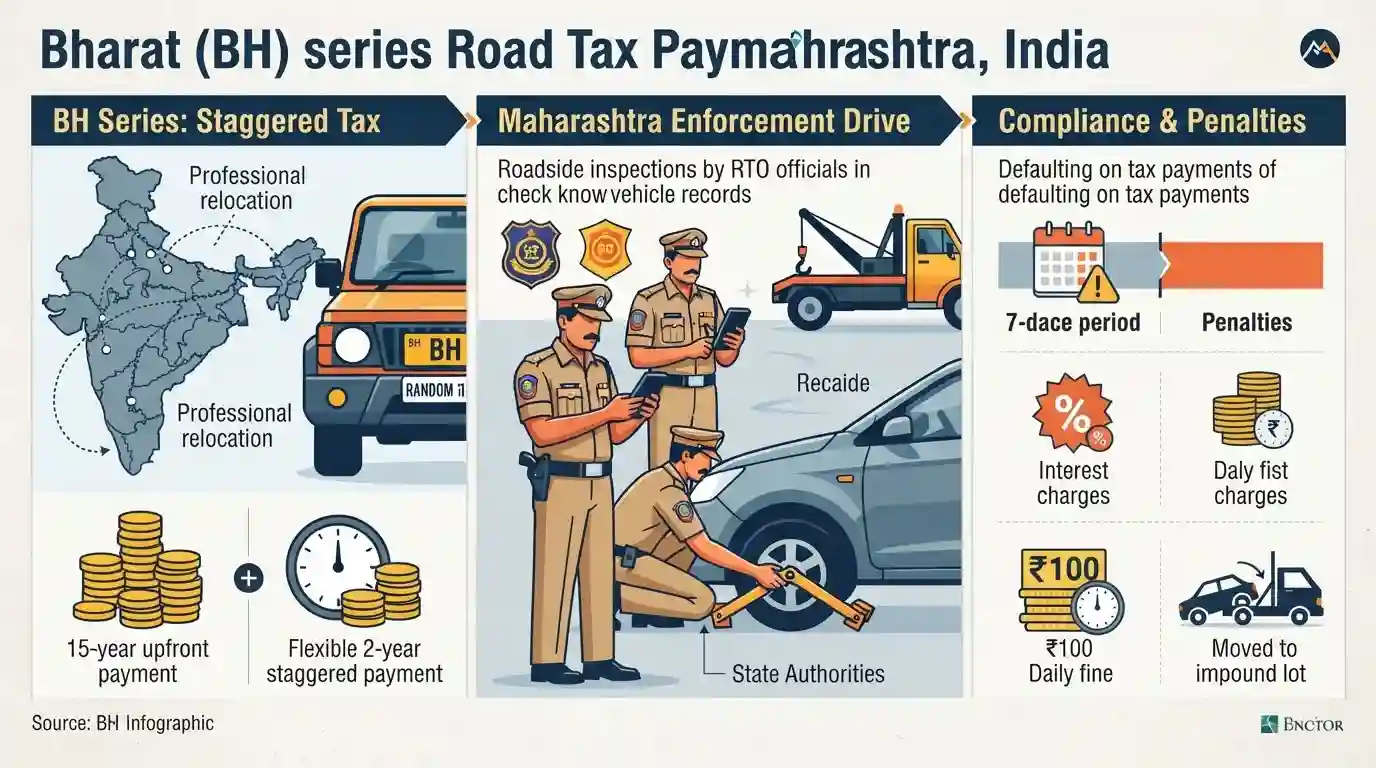
The Maharashtra Transport Department has launched a stringent enforcement campaign targeting owners of Bharat (BH) series vehicles who default on their staggered road tax payments. Regional Transport Offices (RTOs) are authorized to immediately seize such vehicles during roadside inspections. BH series registration, governed by the Central Motor Vehicles Rules, 1989, allows professionals frequently relocating across states to pay road tax in two-year installments rather than a standard 15-year upfront sum. However, widespread defaults have led Maharashtra authorities to implement a seven-day grace period, followed by strict penalties including 2% interest and a ₹100 daily fine. This action underscores the administrative challenges states face in tracking decentralized, staggered tax structures.
Key Points
- The Maharashtra Transport Department has ordered RTOs to seize BH series vehicles on sight if owners default on their road tax installments.
- Under Rule 51B of the Central Motor Vehicles Rules, 1989, the BH series is available to government employees and private employees whose companies have offices in four or more states.
- Unlike conventional vehicle registration requiring a 15-year upfront tax, BH series vehicles pay road tax in two-year installments to facilitate seamless interstate transfers.
- A seven-day grace period is provided for tax payment, after which an interest charge of 2% and a ₹100 daily penalty are imposed.
- The drive aims to curb compliance gaps resulting from the recurring payment structure, exposing challenges in monitoring real-time tax payment records.
Important Terms
Bharat (BH) series

A nationwide vehicle registration mark introduced in 2021 allowing eligible owners to relocate across states without vehicle re-registration or paying standard upfront 15-year road tax, instead paying in two-year staggered blocks.
UPSC context
GS Paper II (Government Policies) & GS III (Infrastructure). Tests governance mechanisms enabling interstate mobility and federal administrative coordination.
Central Motor Vehicles Rules, 1989
A central regulatory framework governing driver licensing, traffic inspections, vehicle registrations, safety standards, and environmental norms in India, enacted under the parent Motor Vehicles Act, 1988.
UPSC context
GS Paper II (Delegated Legislation). Tests statutory enforcement of federal transport guidelines at state levels.
Regional Transport Offices (RTOs)
State-level authorities responsible for executing the provisions of the Motor Vehicles Act, including issuing driver licenses, registering motor vehicles, and collecting road taxes within regional jurisdictions.
UPSC context
GS Paper II (Federalism/Administrative Organs). Tests local execution of concurrent transport and taxation subjects in states.
Prelims Trap
The Central Government has the exclusive legislative power to determine and collect road tax rates for BH-series vehicles.
Under Entry 57 of the State List, states retain exclusive power to levy and collect vehicle taxes. Entry 35 of the Concurrent List only allows the Centre to lay down 'principles' of taxation.
Static Concepts Connected
What is the constitutional division of power regarding motor vehicles and road taxation in India?
- State List (Entry 57): Empowers State Legislatures to levy taxes on vehicles, whether mechanically propelled or not, suitable for use on roads.
- Concurrent List (Entry 35): Allows both Centre and States to legislate on "mechanically propelled vehicles, including the principles on which taxes on such vehicles are to be levied."
- Judicial Interpretation: Courts have clarified that while the Centre can formulate standard taxation principles, it cannot constitutionally set or override the actual tax rates levied by States.
What are the key features and eligibility rules of the Bharat (BH) Series vehicle registration?
- Primary Objective: Introduced by MoRTH in 2021 to facilitate seamless interstate vehicle transfer without the mandatory re-registration after 12 months under the Motor Vehicles Act.
- Staggered Taxation: Instead of paying a 15-year lump-sum road tax upfront, BH-series vehicle owners pay road tax in staggered two-year installments.
- Eligibility Criteria: Defense personnel, Central/State Government employees, PSU staff, and private sector employees whose organizations have offices in 4 or more States/UTs.
Cross-Topic Patterns
Federal Finance + Central Schemes
Friction over BH-series tax collections highlights how centralized transport policies can disrupt state own-tax revenues, stressing Centre-State cooperative federalism.
Digital Public Infrastructure + State Taxes
Tracking decentralized staggered taxes highlights the need for real-time integration between the national VAHAN database and state RTO systems to prevent revenue leakage.

UPSC may test the Seventh Schedule division of powers between Entry 57 (List II) and Entry 35 (List III) via the lens of BH-series disputes.
Linked PYQs · 2
Linked PYQs · 2
- 2025MPSC_PRELIMSGS1
As per the Hazardous Waste (Management, Handling and Transboundary Movement) Rules, 2008, the ________ shall be the nodal Ministry to deal with the transboundary movement of the hazardous wastes and to grant permission for transit of the hazardous wastes through any part of India.
- 2011MPSC_PRELIMSGS1
Which of the following forms of tax does the State Government get in maximum portion from the Central Government ?
