India Diplomatic Outreach and Regional Geopolitics in West Asia
Source:The Hindu ↗
Why It Matters
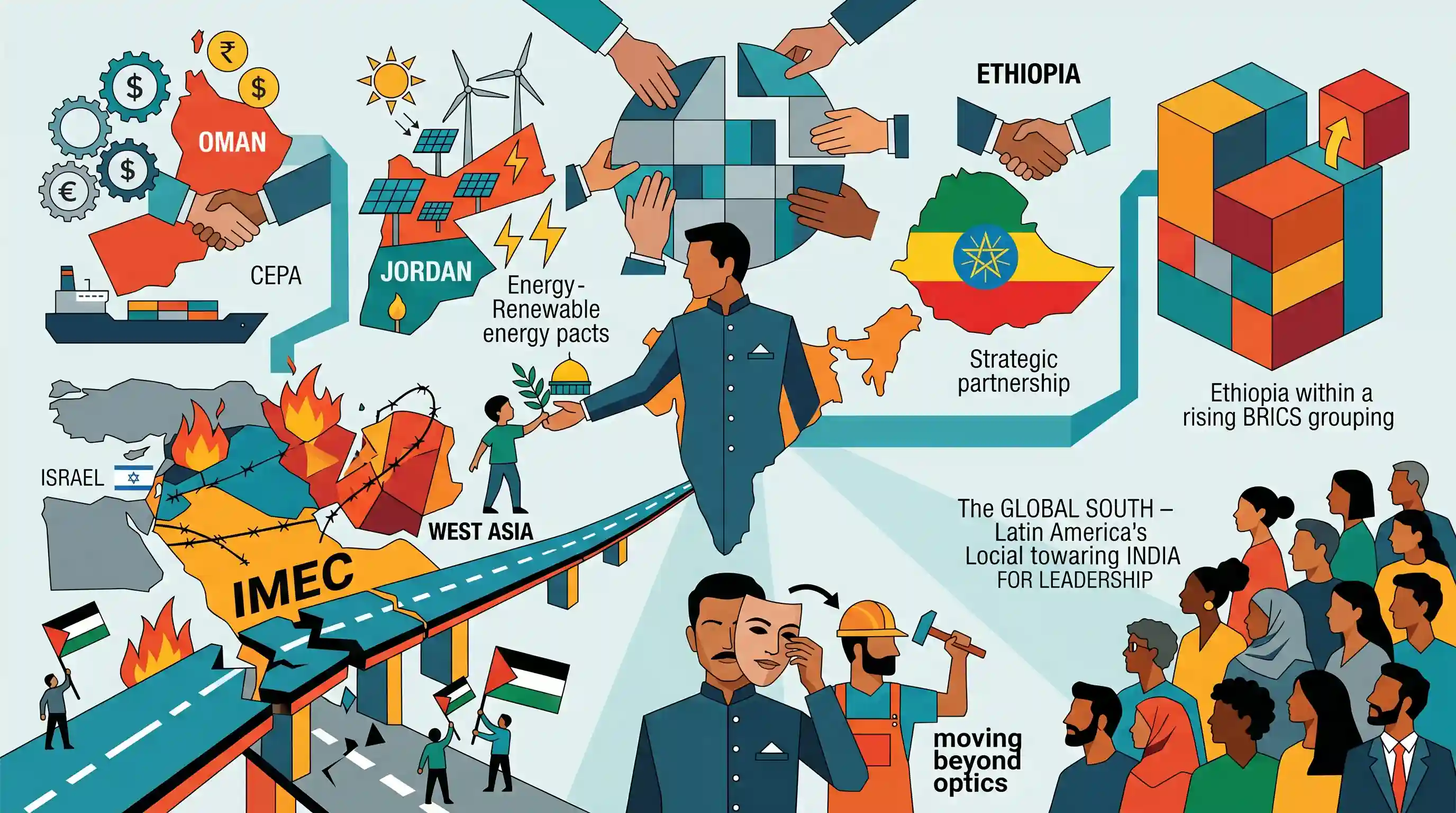
Provides a comprehensive overview of India's current diplomatic balancing act, highlighting economic diplomacy in the Gulf, strategic outreach in Africa, and the geopolitical challenges posed by the Israel-Gaza conflict to initiatives like IMEC. Useful for GS2 answers on India's evolving role in the Global South and West Asia.
Summary
The editorial analyzes Prime Minister Narendra Modi's three-nation diplomatic tour to Oman, Jordan, and Ethiopia, evaluating its implications for India's strategic outreach and advocacy for the Global South. The visits yielded significant economic and strategic agreements, including a CEPA with Oman and renewable energy pacts with Jordan, while cementing a strategic partnership with Ethiopia ahead of its BRICS membership. However, regional geopolitics—notably the Israel-Arab tensions—imperil mega-initiatives like the IMEC. The article emphasizes that while strengthening bilateral ties in Africa and the Gulf is crucial, India must leverage its diplomatic capital to reiterate its principled support for a sovereign Palestinian state to Israel, ensuring its foreign policy moves beyond diplomatic optics to actively shape a shared global order.
Key Points
- PM Modi's visits to Oman, Jordan, and Ethiopia aim to strengthen bilateral ties and reinforce India's leadership role in the Global South.
- A newly signed CEPA with Oman sets the stage for broader GCC free trade agreement talks, emphasizing deepening economic engagement in the Gulf.
- In Jordan, discussions centered on renewable energy, water management, and reiterating traditional Indian support for the Palestinian cause.
- The Israel-Arab conflict has imperilled the proposed India-Middle East-Europe Economic Corridor (IMEC), demanding a strategic response from India.
- The Ethiopia visit launched a strategic partnership and focused on the upcoming Africa-India summit, recognizing Ethiopia's pivotal role in the African Union and as a new BRICS member.
- The editorial suggests India should use its diplomatic capital to convey its stance on Palestinian sovereignty directly to Israel, moving beyond mere diplomatic optics.
Important Terms
India-Middle East-Europe Economic Corridor (IMEC)

A proposed multi-modal economic corridor connecting India to Europe via West Asia. It integrates shipping and rail networks to enhance trade, energy security, and digital connectivity, serving as a strategic alternative to China’s BRI.
UPSC context
GS-2 (IR); tests knowledge of strategic connectivity, India’s role in global supply chains, and the impact of Middle East instability on diplomacy.
Global South
Nations categorized as developing or emerging, often sharing histories of colonialism. India positions itself as a lead advocate for this group, championing their interests in global governance, climate finance, and international trade.
UPSC context
GS-2 (IR); tests India’s leadership in multilateral forums and its ability to act as a bridge between developed and developing nations.
Comprehensive Economic Partnership Agreement (CEPA)
A comprehensive bilateral trade agreement covering goods, services, and investment. It goes beyond tariff reductions to include regulatory standards and intellectual property, exemplified by the 2025 India-Oman pact aimed at deep economic integration.
UPSC context
GS-2/GS-3; tests understanding of bilateral trade mechanisms and India’s strategy to expand its economic footprint in West Asia.
BRICS
An intergovernmental organization of major emerging economies that expanded in 2024 to include nations like Ethiopia. It seeks to reform global governance and challenge Western-dominated financial and political systems.
UPSC context
GS-2 (IR); tests knowledge of multilateral groupings, global governance reform, and the implications of the bloc's recent expansion.
Gulf Cooperation Council (GCC)
A political and economic union of six Arab states (Saudi Arabia, UAE, Qatar, Kuwait, Oman, Bahrain). It is critical for India's energy security, trade, and the welfare of its vast expatriate workforce.
UPSC context
GS-2 (IR); tests strategic partnership dynamics, energy security dependencies, and the significance of the Indian diaspora in the Gulf.
African Union (AU)
A 55-member continental organization promoting unity and development in Africa. India’s strategic partnership with the AU, including supporting its G20 membership, underscores its commitment to South-South cooperation and leadership in the Global South.
UPSC context
GS-2 (IR); tests India-Africa relations, institutional cooperation, and efforts to democratize global decision-making bodies.
Prelims Trap
"India has signed a Comprehensive Economic Partnership Agreement (CEPA) with all members of the Gulf Cooperation Council (GCC)."
India has bilateral CEPAs with the UAE and now Oman. A broader, collective India-GCC Free Trade Agreement is still under negotiation and has not been finalized.
Static Concepts Connected
What are the core components of the India-Middle East-Europe Economic Corridor (IMEC)?
- Two Corridors: The Eastern Corridor connects India to the Arabian Gulf, while the Northern Corridor connects the Gulf to Europe.
- Multi-modal Infrastructure: Comprises a railway transit network, supplemented by undersea electricity cables, a green hydrogen pipeline, and high-speed data cables.
- Geopolitical Alternative: Positioned to counter China's Belt and Road Initiative (BRI) by boosting connectivity, reducing transit times, and integrating markets among allied nations.
How does India's 'De-hyphenation' policy operate in West Asia?
- Independent Bilateralism: India evaluates relationships with rival nations independently, ensuring ties with Israel do not dictate or limit its traditional relations with Palestine.
- Two-State Support: Despite expanding defense and strategic ties with Israel, India officially maintains its principled diplomatic support for a sovereign, independent Palestinian state.
Cross-Topic Patterns
IMEC delays and Red Sea maritime security
The stalling of IMEC due to Israel-Gaza tensions, coupled with Houthi attacks in the Red Sea, exposes India's vulnerability at major maritime chokepoints, stressing the need for diversified trade routes.
BRICS expansion and the Horn of Africa
Ethiopia's inclusion in BRICS significantly amplifies its geopolitical weight. Sited at the African Union HQ, it aligns perfectly with India's push for Global South representation in global governance.

Expect a 2026 Mains question linking the viability of mega-corridors like IMEC to protracted West Asian instability and maritime security.
Linked PYQs · 3
Linked PYQs · 3
- 2018MainsGS2
“India’s relations with Israel have, of late, acquired a depth and diversity, which cannot be rolled back.” Discuss.
- 2017MainsGS2
The question of India's Energy Security constitutes the most important part of India's economic progress. Analyze India's energy policy cooperation with West Asian countries.
- 2021MainsGS2
If the last few decades were of Asia's growth story, the next few are expected to be of Africa's.” In the light of this statement, examine India's influence in Africa in recent years.
