Biodiversity conservation and monoculture threats in Parpoli village
Source:Indian Express ↗
Why It Matters
Highlights the conflict between economic agriculture (monoculture) and biodiversity conservation in fragile ecosystems like the Western Ghats, underscoring the importance of community-led ecotourism as a sustainable solution. Good case study for GS3 environment answers.
Summary
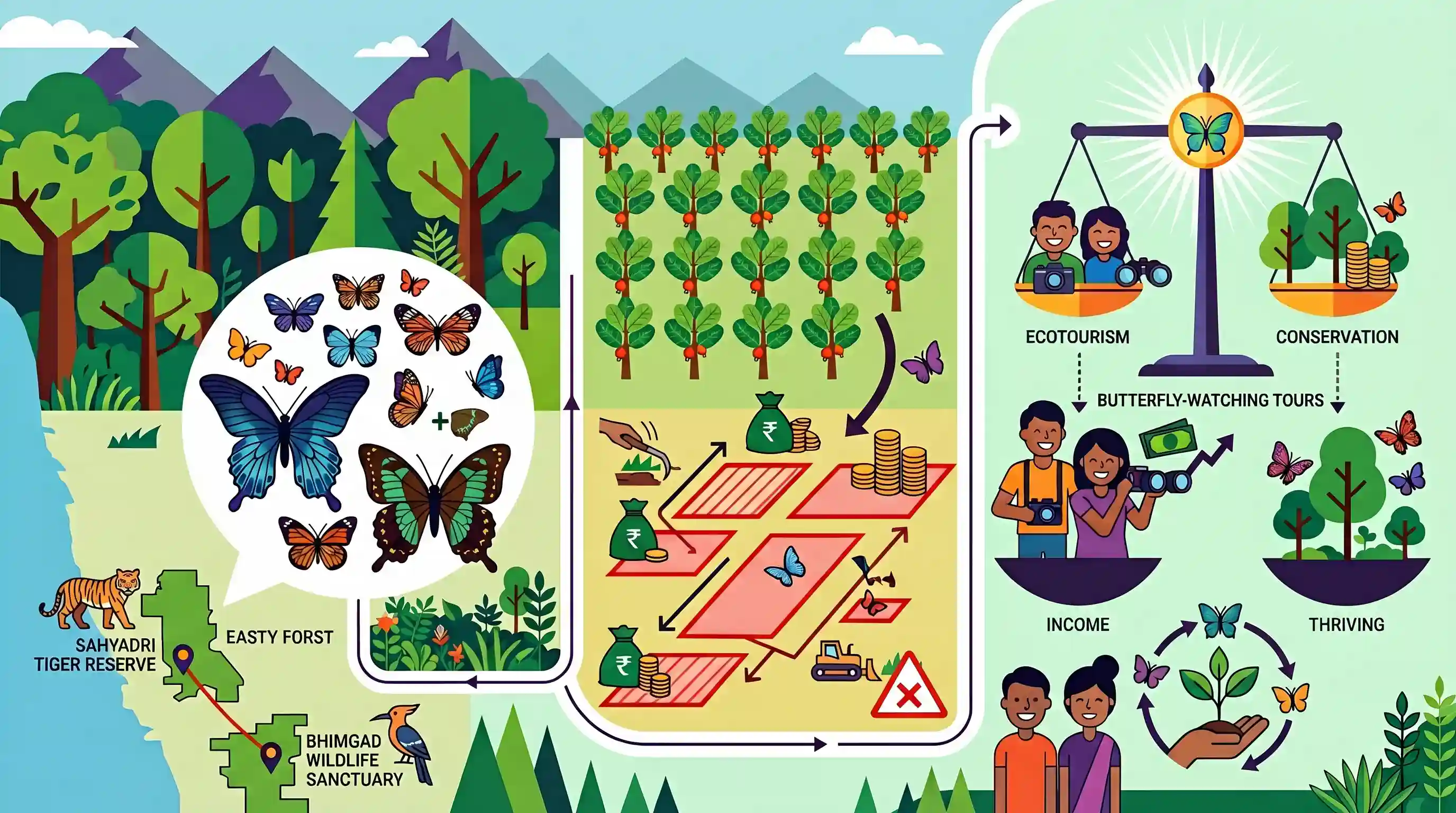
Parpoli, situated in the Amboli ghats within Maharashtra's Sindhudurg district, has been designated as the state's first 'butterfly village'. Home to over 204 butterfly species, including rare ones like the Malabar Banded Peacock and the state butterfly Blue Mormon, the village represents a rich ecological zone in the Western Ghats connecting the Sahyadri Tiger Reserve and Bhimgad Wildlife Sanctuary. However, this unique biodiversity is increasingly threatened by rapid changes in land use, specifically the transition from mixed, nectar-rich forests to monoculture cashew plantations driven by economic incentives. Conservationists emphasize the necessity of balancing rural livelihoods with ecological preservation, suggesting ecotourism—supported by initiatives like the Sindhu Ratna Yojana—as a viable model to safeguard critical butterfly habitats while providing sustainable income for local communities.
Key Points
- Parpoli in Sindhudurg, Maharashtra is declared the state's first 'butterfly village', hosting over 204 species including the state butterfly Blue Mormon and the rare Malabar Banded Peacock.
- The village is an essential wildlife corridor linking the Sahyadri Tiger Reserve and the Bhimgad Wildlife Sanctuary within the globally recognized Western Ghats biodiversity hotspot.
- Deforestation and the spread of monoculture cashew plantations are destroying native nectar and host plants, severely threatening butterfly populations.
- Ecotourism, supported by initiatives like the Sindhu Ratna Yojana, is being promoted to create conservation-linked livelihoods (e.g., homestays, guided trails) and disincentivize ecological degradation.
Important Terms
Sindhu Ratna Yojana

Maharashtra state development scheme for Ratnagiri and Sindhudurg districts; it promotes sustainable livelihoods through ecotourism (e.g., homestays), cashew processing, and infrastructure to boost rural incomes.
UPSC context
GS Paper 2: Government Schemes; GS Paper 3: Regional Development and Sustainable Livelihoods.
Blue Mormon (Papilio polymnestor)
Maharashtra’s state butterfly (India’s first); a large velvet-black swallowtail with blue spots. Found in the Western Ghats, it serves as a bioindicator for healthy, nectar-rich forest ecosystems.
UPSC context
GS Paper 3: Biodiversity; Prelims: State symbols and conservation status of endemic species.
Sahyadri Tiger Reserve
Tiger reserve in Maharashtra’s Western Ghats comprising Koyna Wildlife Sanctuary and Chandoli National Park; it is the northernmost range for tiger dispersal in the Western Ghats landscape.
UPSC context
GS Paper 3: Environment; tests knowledge of protected areas and wildlife corridors.
Bhimgad Wildlife Sanctuary
A protected area in Karnataka’s Belagavi district; crucial for the Sahyadri-Konkan corridor and the only known breeding site for the critically endangered Wroughton’s free-tailed bat.
UPSC context
GS Paper 3: Environment; tests connectivity between protected areas and endemic species habitats.
Malabar Nature Conservation Club (MNCC)
Local NGO in the Amboli-Sindhudurg region; focuses on documenting Western Ghats biodiversity and promoting community-led ecotourism models like the 'Butterfly Village' initiative.
UPSC context
GS Paper 3: Conservation; tests the role of civil society and NGOs in biodiversity protection.
Western Ghats (Sahyadris)
UNESCO World Heritage site and global biodiversity hotspot; its 'Sahyadri-Konkan' corridor is vital for the genetic exchange of species between Maharashtra, Goa, and Karnataka.
UPSC context
GS Paper 1: Geography; GS Paper 3: Biodiversity hotspots and ecological sensitivity.
Prelims Trap
The Malabar Banded Peacock is the officially recognized state butterfly of Maharashtra.
Aspirants may assume this because Parpoli is in Maharashtra. However, the Malabar Banded Peacock is Kerala's state butterfly; Maharashtra's is the Blue Mormon.
Static Concepts Connected
What makes butterflies reliable biological indicators (bio-indicators) in ecology?
- Microclimate sensitivity: They are highly sensitive to microclimatic variations in temperature, humidity, and light, reflecting immediate habitat health.
- Short life cycles: Rapid life cycles allow scientists to observe the generational impacts of environmental changes, toxins, or climate shifts quickly.
- Plant specificity: Larvae rely on specific host plants; a decline in butterfly populations directly signals local flora degradation and habitat loss.
What is the geographical and ecological significance of the Sahyadri-Bhimgad wildlife corridor?
- Landscape Linkage: It forms a crucial landscape linkage connecting the northernmost tiger habitat in the Western Ghats (Sahyadri TR) to Karnataka's reserves.
- Biogeographic Chokepoint: It acts as an essential bridge for the genetic dispersal of tigers and endemic Western Ghats species across state borders.
- Protected Area Network: The corridor connects Sahyadri TR (itself integrating Koyna WLS and Chandoli NP) to Bhimgad WLS, home to the critically endangered Wroughton's free-tailed bat.
Cross-Topic Patterns
Monoculture expansion vs. Micro-habitats
The shift from mixed native forests to cashew plantations in the Western Ghats mirrors ecological degradation seen with palm oil in the North East, destroying vital pollinator networks and host plants.
State Symbols and Regional Endemism
Just as state animals are tested, state butterflies (e.g., Blue Mormon, Kaiser-i-Hind) act as proxies to test an aspirant's knowledge of regional endemism and specific bio-geographic zones.

Mapping the Sahyadri-Bhimgad corridor alongside its endemic fauna (Blue Mormon, Wroughton's bat) is a high-probability 2026 Prelims frame.
Linked PYQs · 4
Linked PYQs · 4
- 2011PrelimsGS1
Three of the following criteria have contributed to the recognition of Western Ghats-Sri Lanka and Indo-Burma regions as hotspots of biodiversity: 1. Species richness 2. Vegetation density 3. Endemism 4. Ethno-botanical importance 5. Threat perception 6. Adaptation of flora and fauna to warm and humid conditions Which three of the above are correct criteria in this context?
- 2010PrelimsGS1
Consider the following statements: 1. Biodiversity hotspots are located only in tropical regions. 2. India has four biodiversity hotspots i.e., Eastern Himalayas, Western Himalayas, Western Ghats and Andaman and Nicobar Islands. Which of the statements given above is/are correct?
- 2021MainsGS3
What are the present challenges before crop diversification? How do emerging technologies provide an opportunity for crop diversification?
- 2017PrelimsGS1
From the ecological point of view, which one of the following assumes importance in being a good link between the Eastern Ghats and the Western Ghats?
