Agricultural Policy Shift from Minimum Support Price to Income Support
Source:Indian Express ↗
Why It Matters
This article addresses core economic debates on agricultural pricing and support systems in India, directly tying into UPSC GS-3 syllabus components concerning farm subsidies, MSP, and structural agrarian reforms.
Summary
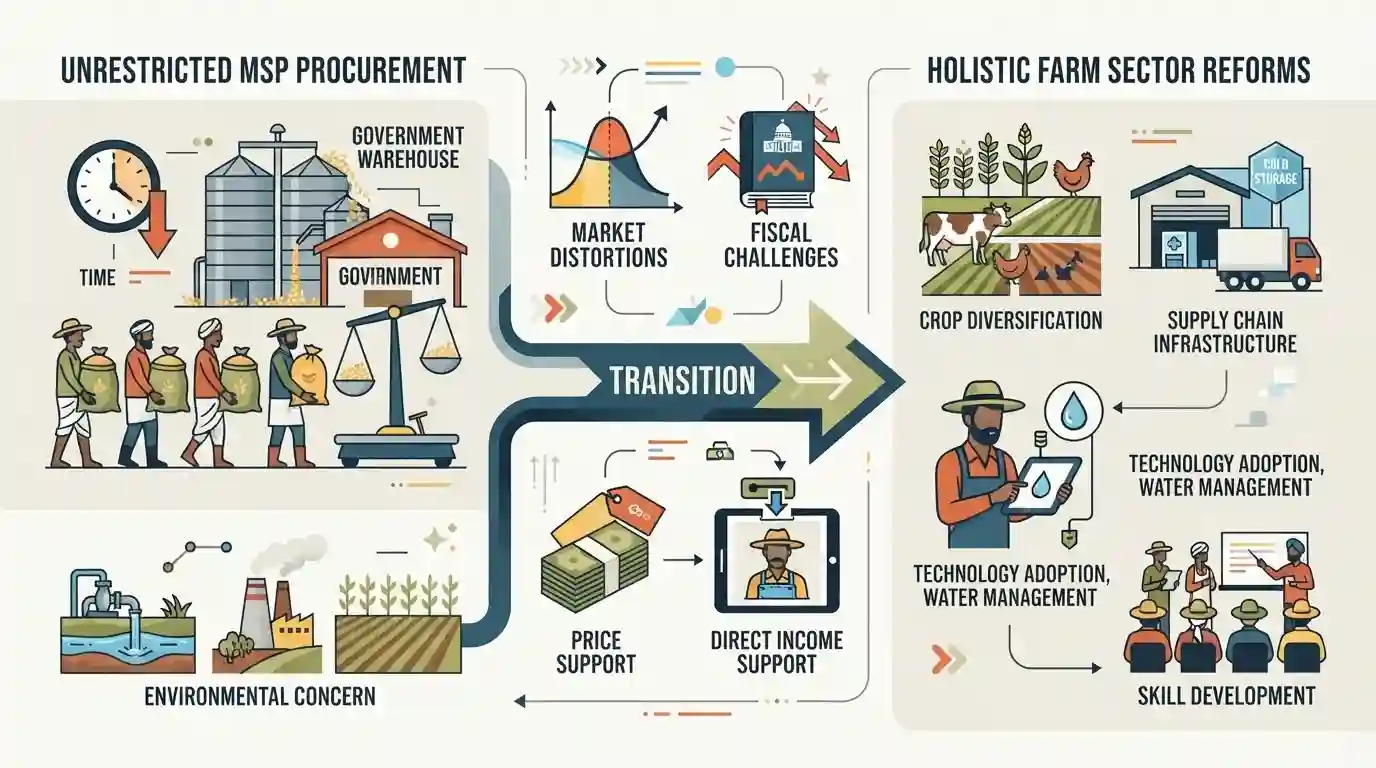
This editorial examines the persistent debate on Indian agricultural policy, arguing that Minimum Support Price (MSP) alone cannot resolve agrarian distress. It advocates for a transition from price support mechanisms to direct income support, highlighting the market distortions, fiscal challenges, and environmental concerns associated with unrestricted MSP procurement, while emphasizing holistic farm sector reforms.
Key Points
- The debate surrounding agricultural policy in India highlights the limitations of relying solely on Minimum Support Price (MSP) as a tool for ensuring farmer welfare.
- MSP procurement tends to distort cropping patterns, penalize non-procuring states, and cause environmental concerns like groundwater depletion, while only benefiting a fraction of farmers.
- Shifting from price support (MSP) to income support mechanisms (such as direct cash transfers) can offer a more equitable, market-neutral, and fiscally prudent strategy to tackle agrarian distress and low farm incomes.
- Comprehensive agricultural reforms must focus on boosting productivity, market integration, supply chain modernization, and direct income supplements rather than price interventions that market forces challenge.
Important Terms
Minimum Support Price (MSP)

A government intervention mechanism insuring farmers against steep market price drops by pre-announcing procurement rates for mandated crops before sowing seasons, recommended by the CACP.
UPSC context
UPSC Mains GS Paper 3: Agriculture, Economics of Farm Subsidies, and PDS. Tests knowledge of price support, food security, and procurement challenges.
PM-KISAN
A central sector scheme providing direct income support of ₹6,000 annually in three equal installments to eligible landholding farmer families via Direct Benefit Transfer.
UPSC context
UPSC Mains GS Paper 3: Agriculture and welfare schemes. Evaluates direct income support models versus traditional price support mechanisms.
World Trade Organization
An international organization regulating global trade, whose Agreement on Agriculture classifies domestic support into Amber, Blue, and Green boxes affecting farm subsidies.
UPSC context
UPSC Prelims and Mains GS Paper 3: International trade agreements, agriculture subsidies, and food security implications at global forums.
Prelims Trap
MSP guarantees a legally enforceable statutory price floor for all agricultural produce across all states in India.
Aspirants often assume MSP is a statutory right for all crops across all states, whereas it is only an administrative recommendation and actual procurement is largely restricted to specific crops and regions.
Static Concepts Connected
What are the key features and operational mechanism of Minimum Support Price (MSP) in India?
- Advisory Body: Calculated by the Commission for Agricultural Costs and Prices (CACP) for 22 mandated crops plus sugarcane (FRP).
- Legal Status: Not a statutory legal right; it is an administrative price recommendation meant to protect farmers from price crashes.
- Cost Formulae: Covers A2, A2+FL, and C2 cost structures, where C2 represents comprehensive costs including imputed rental value of land.
What are the WTO rules governing domestic agricultural support under the Agreement on Agriculture?
- De Minimis Limits: Limits are 10% of total value of production for developing nations and 5% for developed countries.
- Support Categories: Product-specific support is calculated on the specific crop, while non-product specific support covers inputs like power and fertilizer.
- Peace Clause: Public stockholding for food security purposes is currently protected under the WTO's peace clause agreed at the Bali Ministerial.
Cross-Topic Patterns
MSP Procurement and the Groundwater Crisis
Unrestricted MSP procurement of water-intensive crops in northwest India has severely depleted aquifers, linking agricultural price policy directly to India's deepening groundwater crisis and climate adaptation challenges.
WTO Agreement on Agriculture and Domestic Support
Administered price supports exceeding WTO de minimis limits frequently invite challenges under the Agreement on Agriculture, bridging domestic farm subsidies with international trade compliance.

MSP vs income support debate is a perennial Mains GS3 favorite; expect questions contrasting price floors with direct cash transfers.
Linked PYQs · 2
Linked PYQs · 2
- 2018MainsGS3
What do you mean by Minimum Support Price (MSP)? How will MSP rescue the farmers from the low income trap?
- 2015MainsGS3
In what way could replacement of price subsidy with Direct Benefit Transfer (DBT) change the scenario of subsidies in India ? Discuss.
