Agricultural Reforms Beyond MSP Toward Income Support Mechanisms
Source:Indian Express ↗
কেন এটি গুরুত্বপূর্ণ
This article directly addresses core components of the UPSC Civil Services Mains GS3 syllabus concerning Indian agriculture, subsidies, and pricing policies. It weighs the pros and cons of price support (MSP) versus income support, which is a frequent theme in economic policymaking and civil services examinations.
সারসংক্ষেপ
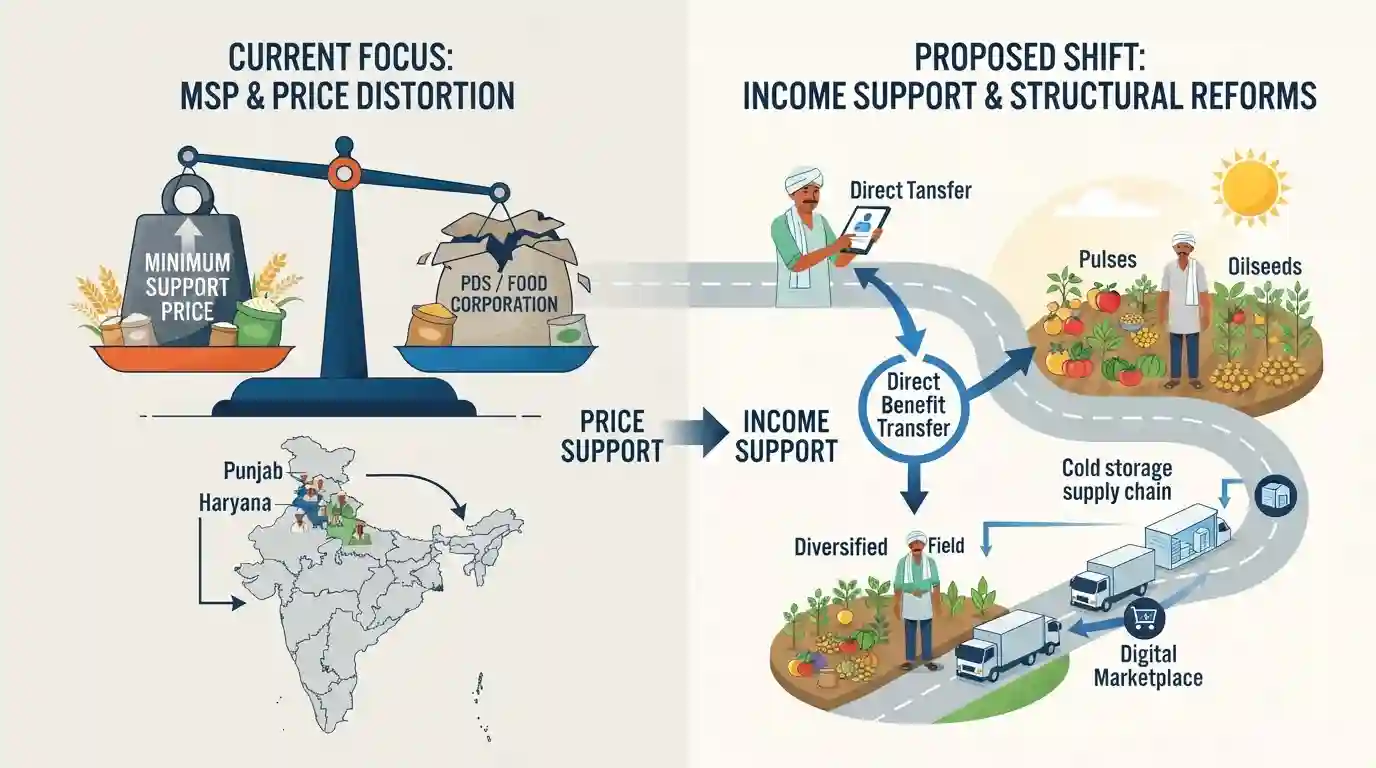
The editorial discusses the structural limitations of relying on Minimum Support Price (MSP) as the primary tool for agricultural welfare in India. It argues that price support mechanisms are fiscally unsustainable, market-distorting, and disproportionately favor a fraction of farmers growing specific crops in limited states. Instead, it advocates for shifting toward income support and structural reforms—such as better supply chains, agricultural diversification, and direct benefit transfers—to ensure broad-based and sustainable farmers' welfare.
মূল বিষয়
- The debate over agricultural support in India highlights the limitations of relying solely on Minimum Support Price (MSP) and price support mechanisms.
- Price support distorts markets, strains state finances, and primarily benefits a small percentage of farmers cultivating wheat and rice in select regions.
- Transitioning towards income support (such as direct benefit transfers or schemes like PM-KISAN) provides a more equitable, market-neutral way to safeguard farmers' livelihoods.
- Comprehensive agricultural reforms must include diversification, investment in agricultural research, robust supply chain infrastructure, and direct income transfers rather than market-distorting price interventions.
গুরুত্বপূর্ণ শব্দ
Minimum Support Price (MSP)

A government intervention tool guaranteeing a floor price for specified crops to protect producers from market volatility and distress sales, recommended by the CACP.
UPSC context
GS Paper III (Agriculture - MSP, Pricing Policy & PDS). Frequently tested for fiscal sustainability, food security, and market distortions.
PM-KISAN
A central sector scheme providing direct income support of ₹6,000 annually in three installments to eligible landholding farmer families across India via Direct Benefit Transfer.
UPSC context
GS Paper III (Direct and Indirect Subsidies, Farm Income Support). Evaluated as a structural alternative to price-support mechanisms.
World Trade Organization
An international organization regulating global trade, whose Agreement on Agriculture classifies domestic support into Amber, Blue, and Green boxes based on trade-distorting potential.
UPSC context
GS Paper II/III (International Institutions, Global Trade, Agriculture). Essential for questions on WTO compliance, public stockholding, and Amber Box caps.
প্রিলিমস ফাঁদ
statutory legal backing for all MSP crops across India
Aspirants often assume MSP has statutory backing for all announced crops. In reality, the CACP recommends MSPs for 22 crops plus sugarcane (FRP), but no law compels private or public procurement at MSP.
সংযুক্ত স্থির ধারণা
What are the key institutional mechanisms and criteria for determining Minimum Support Prices (MSP) in India?
- Advisory body: CACP Recommendation: The Commission for Agricultural Costs and Prices recommends MSPs for 22 mandated crops plus Fair and Remunerative Price (FRP) for sugarcane.
- Cost formulas: Cost Concepts: Considers A2 (paid-out costs), A2+FL (paid-out costs plus imputed value of family labor), and C2 (comprehensive cost including rental value of land).
- Final authority: Cabinet Decision: Final decision on MSP announcement is taken by the Cabinet Committee on Economic Affairs (CCEA) chaired by the Prime Minister.
আন্তঃবিষয় প্যাটার্ন
MSP Reform and WTO Agreement on Agriculture
While MSP creates domestic market distortions, input subsidies (fertilizer/power) face intense scrutiny under WTO Amber Box limits, pushing policy toward decoupled Green Box income supports like PM-KISAN.
Agri-Pricing Policy and Groundwater Depletion Crisis
Over-reliance on MSP for paddy in northwest India has severely depleted the water table, linking agricultural pricing policy directly to hydro-geological crises.

Expect UPSC to test the trade-off between price support (MSP) and direct income support (PM-KISAN) regarding fiscal deficit and WTO norms.
সংযুক্ত PYQ · 3
সংযুক্ত PYQ · 3
- 2018MainsGS3
What do you mean by Minimum Support Price (MSP)? How will MSP rescue the farmers from the low income trap?
- 2015MainsGS3
In what way could replacement of price subsidy with Direct Benefit Transfer (DBT) change the scenario of subsidies in India ? Discuss.
- 2023MainsGS3
What are the direct and indirect subsidies provided to farm sector in India? Discuss the issues raised by the World Trade Organization (WTO) in relation to agricultural subsidies.
