Uttar Pradesh Data Centre Policy and AI Infrastructure Development
Source:dailypioneer ↗
Why It Matters
This extraction highlights Uttar Pradesh's strategic push to attract high-tech industries and manage state-level economic disparities by moving infrastructure to Purvanchal and Bundelkhand. The integration of renewable energy targets (50% by 2030) with AI data centers offers crucial insights for UPPSC PCS GS-3 questions on sustainable infrastructure and technological innovation policies.
Summary
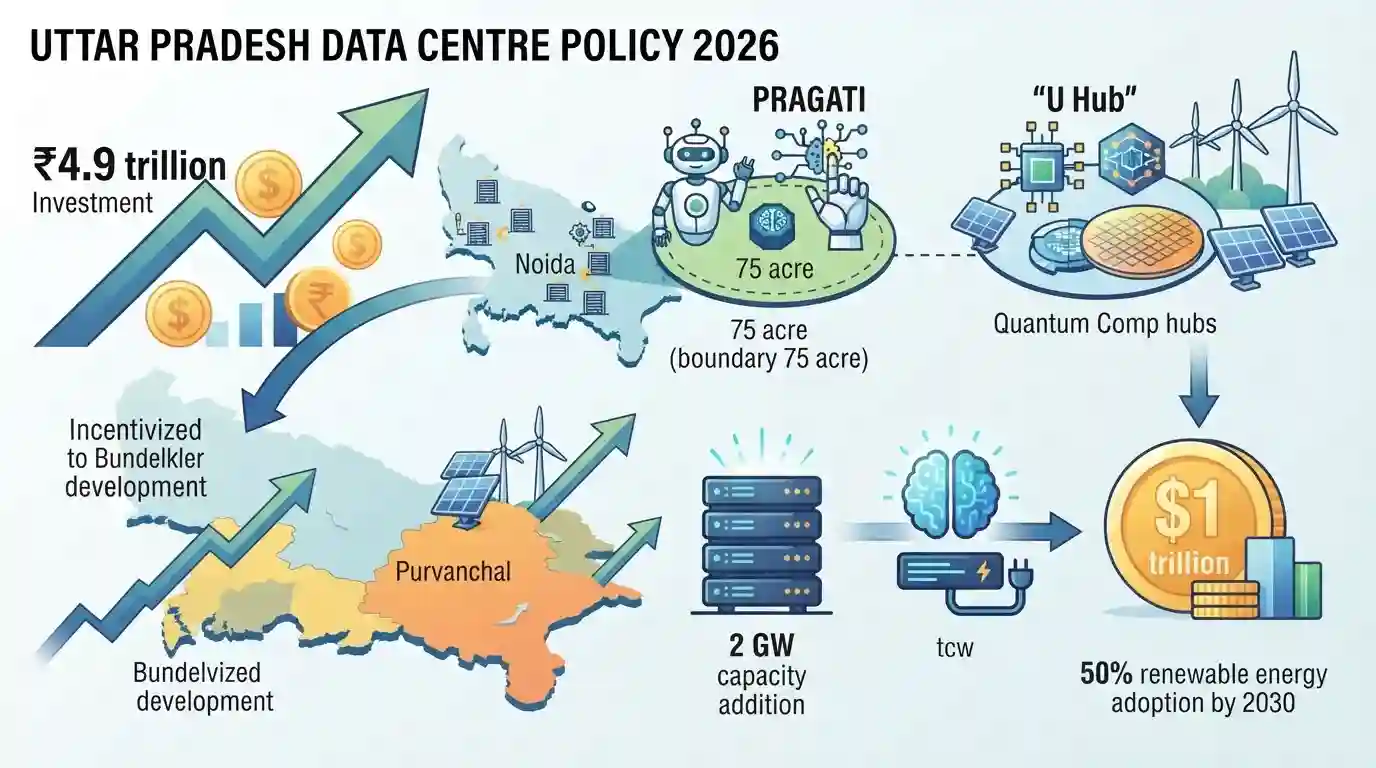
The Uttar Pradesh cabinet has approved the UP Data Centre Policy 2026, an ambitious framework aimed at transforming the state into India's central hub for artificial intelligence and deep-tech infrastructure. The policy targets a massive ₹4.9 trillion in private investment and the creation of an additional 2 GW of data center capacity to support the state's goal of a $1 trillion economy. Key initiatives include the establishment of the 75-acre PRAGATI project in Noida for AI and robotics, and the funding of specialized U Hubs for quantum computing and semiconductor design. In a bid to promote equitable growth and sustainability, the policy heavily incentivizes the development of data centers in the Bundelkhand and Purvanchal regions and mandates a 50% renewable energy adoption by 2030.
Key Points
- Uttar Pradesh approved the UP Data Centre Policy 2026 to position the state as India's AI infrastructure hub, targeting ₹4.9 trillion in private investment and an additional 2 GW of data center capacity.
- The PRAGATI (Park for Robotics, AI, GPU Clusters and Advanced Technical Innovation) project will be developed across 75 acres in Noida to anchor the deep-tech ecosystem.
- The policy allocates ₹100 crore for specialized 'U Hubs' focused on quantum computing and semiconductor design, alongside an AI Compute Booster initiative.
- To balance regional development, the state is incentivizing the shift of digital infrastructure from the NCR toward land- and power-rich regions like Bundelkhand and Purvanchal.
- The policy mandates that data centers must adopt at least 50% renewable energy by 2030 to ensure sustainable digital growth.
Important Terms
UP Data Centre Policy 2026

A state policy approved in July 2026 aiming to attract over ₹2 lakh crore in investment, build 2 GW additional capacity, and establish Uttar Pradesh as an AI-ready, green digital infrastructure hub.
UPSC context
GS Paper III: Infrastructure, IT & Computers; tests state policies enabling digital economy growth and green infrastructure.
PRAGATI project
An acronym for Park for Robotics, Artificial Intelligence, GPU Clusters and Advanced Technical Innovation; a proposed 75-acre integrated advanced manufacturing and robotics cluster in Noida to foster deep-tech R&D.
UPSC context
GS Paper III: Science & Tech, Indigenisation of Tech; tests strategies for advanced manufacturing and regional deep-tech ecosystems.
U Hubs
State-backed Centres of Excellence in Noida and Lucknow focusing on deep-tech, quantum computing, and semiconductor design to bridge research, startups, and commercial applications.
UPSC context
GS Paper III: Technology, Innovation; tests institutional mechanisms for commercializing R&D in frontier technologies.
Prelims Trap
The PRAGATI project under the UP Data Centre Policy is a multi-purpose interactive platform for proactive governance and grievance redressal.
Aspirants easily confuse UP's PRAGATI (Park for Robotics, AI, GPU Clusters and Advanced Technical Innovation) with the Union Government's PRAGATI (Pro-Active Governance and Timely Implementation) platform.
Static Concepts Connected
How do AI/GPU data centers differ from traditional data centers?
- Processing Architecture: Traditional centers use CPU-based servers for storage and hosting, while AI data centers deploy massive GPU clusters optimized for parallel processing.
- Energy & Cooling: AI workloads demand extreme power (30-100 kW per rack vs 5-10 kW traditionally), requiring advanced liquid-cooling mechanisms rather than standard air-cooling.
What are the key geographical and structural requirements for locating data centers?
- Resource Abundance: Requires dual-source uninterrupted power grids and massive water reserves for heat dissipation systems.
- Connectivity & Stability: Proximity to high-speed fiber-optic landing stations or backbones to minimize latency, combined with low seismic/disaster vulnerability.
Cross-Topic Patterns
Data Centers and the Water-Energy Nexus
Rapid data center expansion in water-stressed zones like Bundelkhand tests local carrying capacity, requiring dual planning for wastewater recycling and dedicated green energy grids.
Competitive Federalism in Deep-Tech Infrastructure
State-specific data policies highlight competitive federalism in high-tech sectors, actively decentralizing digital infrastructure away from traditional southern tech hubs to northern and central India.

GS-3 may test the balancing act between AI infrastructure expansion (GPU clusters) and its massive carbon-water footprint by 2026.
Linked PYQs · 3
Linked PYQs · 3
- 2023UPPSC_PRELIMSGS1
Which of the following Scheme/Programme is not the Central Government Programme and it is Uttar Pradesh Government's Programme?
- 2018UPPSC_PRELIMSGS1
Which of the following elements is a semi conductor?
- 2023UPPSC_PRELIMSGS1
Which of the following is not a sustainable development goal targeted to be achieved by 2030?
