Manufacturing led industrial corridors and urban real estate trends
Source:Indian Express ↗
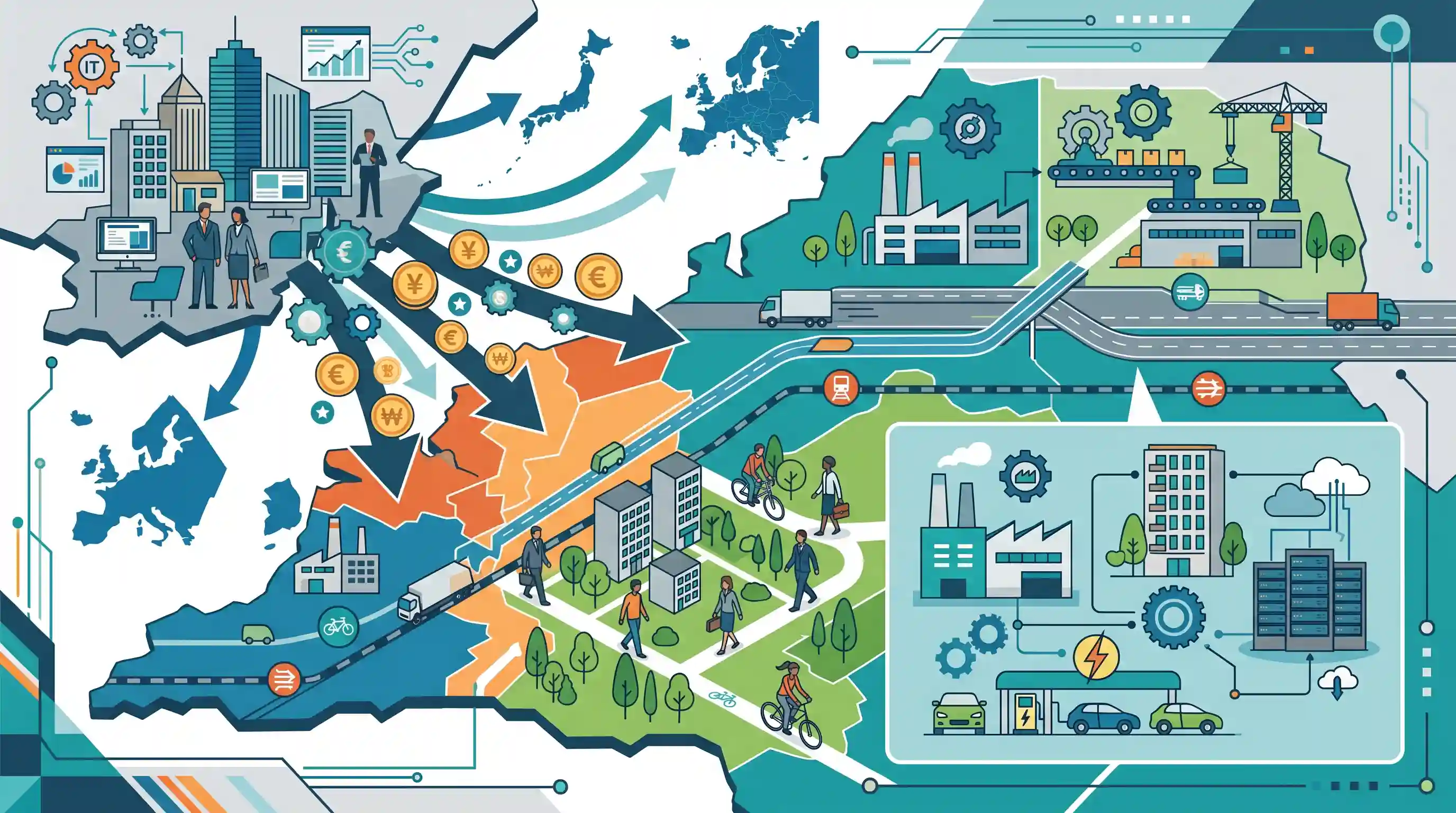
Why It Matters
Understanding the symbiotic relationship between manufacturing growth, foreign investment, and urban development is crucial for administrators. The shift towards integrated, walk-to-work townships highlights how industrial corridors can drive decentralized regional planning and help address modern urban challenges like traffic congestion and core-city overcrowding.
Summary
The real estate map around Gurgaon and the broader National Capital Region (NCR) is undergoing a significant transformation driven by global manufacturing investments. Historically centered around IT parks and corporate hubs, the region's development is now expanding into areas like Jhajjar and Manesar due to an influx of foreign capital from Japan, Korea, and Europe. This industrial growth has brought in international professionals who prefer living close to their workplaces, thereby spurring the creation of integrated, "walk-to-work" townships rather than relying on traditional city centers. Developments like Reliance MET City illustrate this shift, blending residential spaces with industrial setups, EV hubs, and data centers, highlighting the deep connection between industrial corridors and modern urban planning.
Key Points
- The real estate landscape in NCR is pivoting from IT and corporate-driven growth to manufacturing-led expansion, particularly around Jhajjar and Manesar.
- A steady influx of global capital, including significant investments like Daikin Industries' Rs 1,000 crore in Manesar, is driving this shift.
- The arrival of expatriate technical professionals from Japan, Korea, and Europe has created a demand for residential housing near industrial hubs, fostering a 'walk-to-work' culture.
- Large-scale integrated townships, such as the 140-acre residential footprint in Reliance MET City, are emerging to combine industrial zones with housing, EV hubs, and data centers.
- This trend underscores the spatial impact of industrial corridors on urbanization, reducing the pressure on traditional city centers and promoting decentralized regional development.
Important Terms
Make in India

A flagship national initiative launched in 2014 to facilitate investment, foster innovation, and build world-class manufacturing infrastructure, transforming India into a global manufacturing hub.
UPSC context
GS Paper 3: Indian Economy and issues relating to planning, mobilization of resources, growth, development, and employment.
Industrial Corridors
High-speed multimodal transport corridors connecting industrial hubs, designed to reduce logistics costs, promote industrial clustering, and foster balanced regional development through planned infrastructure.
UPSC context
GS Paper 1: Geography (Location of Industries) and GS Paper 3: Infrastructure (Energy, Ports, Roads, Airports, Railways).
Reliance MET City
An 8,250-acre integrated 'Model Economic Township' in Jhajjar, Haryana, blending industrial units (including a Japanese zone), residential areas, and smart city infrastructure like data centers.
UPSC context
GS Paper 3: Infrastructure and industrial development; case study of private-sector led integrated urban planning.
Foreign Direct Investment (FDI)
Investment made by a company or individual in one country into business interests in another, typically through establishing operations or acquiring assets.
UPSC context
GS Paper 3: Investment models and Indian Economy (External Sector).
Integrated Township
Self-sustained urban developments combining residential, commercial, industrial, and social infrastructure (schools/hospitals) within a single perimeter, promoting 'walk-to-work' cultures.
UPSC context
GS Paper 1: Urbanization, their problems and their remedies.
Daikin Industries
A Japanese multinational air-conditioning manufacturer; its recent ₹1,000 crore investment in a Manesar R&D center exemplifies global manufacturing's role in NCR's industrial expansion.
UPSC context
GS Paper 3: Industrial growth and foreign investment; relevant to India-Japan economic cooperation.
Prelims Trap
Recent decentralization in the NCR is exclusively driven by the expansion of IT and tertiary service-sector parks.
The current spatial shift in the NCR (Jhajjar/Manesar) is manufacturing-led (FDI in EVs, engineering) through integrated industrial townships, not traditional IT/service parks.
Static Concepts Connected
What is the framework of the Delhi-Mumbai Industrial Corridor (DMIC)?
- Core objective: To create globally competitive environment and next-generation infrastructure to boost manufacturing.
- Alignment: It spans 1,504 km, aligned with the Western Dedicated Freight Corridor (WDFC) as its backbone.
- Investment regions: It focuses on developing 'Smart Cities' and integrated investment regions, such as the Manesar-Bawal investment node in Haryana.
What factors drive the location shift of modern manufacturing to city peripheries?
- Land availability: Large, contiguous land parcels are cheaper and easier to acquire for mega-factories outside saturated urban centers.
- Decongestion policies: Environmental regulations and traffic congestion push heavy or polluting industrial units out of traditional city cores.
- Agglomeration economies: Proximity to existing auto hubs (like Manesar) attracts ancillary foreign direct investment (FDI) through supply-chain efficiencies.
Cross-Topic Patterns
Industrial corridors curbing urban sprawl
The shift towards Manesar and Jhajjar exemplifies how dedicated freight and transport corridors act as urban decentralizers, blending industrial zones with "walk-to-work" residential hubs.
FDI driving localized social infrastructure
Japanese and Korean manufacturing FDI brings expatriate technical staff, directly spurring localized real estate demand and organically driving the creation of integrated, mixed-use smart cities.

Expect a GS1/GS3 mains question on how manufacturing FDI and industrial corridors (like DMIC) are reshaping urban geography and sprawl.
Linked PYQs · 4
Linked PYQs · 4
- 2018MainsGS1
What is the significance of Industrial Corridors in India? Identifying industrial corridors, explain their main characteristics.
- 2017MainsGS1
"The growth of cities as I.T. hubs has opened up new avenues of employment, but has also created new problems." Substantiate this statement with examples.
- 2016MainsGS3
Justify the need for FDI for the development of the Indian economy. Why there is gap between MOUs signed and actual FDIs? Suggest remedial steps to be taken for increasing actual FDIs in India.
- 2025MainsGS1
How does smart city in India, address the issues of urban poverty and distributive justice?
