Artificial Intelligence Strategy and Digital Infrastructure in India
Source:Indian Express ↗
Why It Matters
Highlights the strategic shift required in India's tech policy—from merely chasing hardware manufacturing capabilities (like semiconductor fabs) to leveraging its software strength for AI application development. This addresses core GS3 themes around technological innovation, semiconductor missions, and digitalization.
Summary
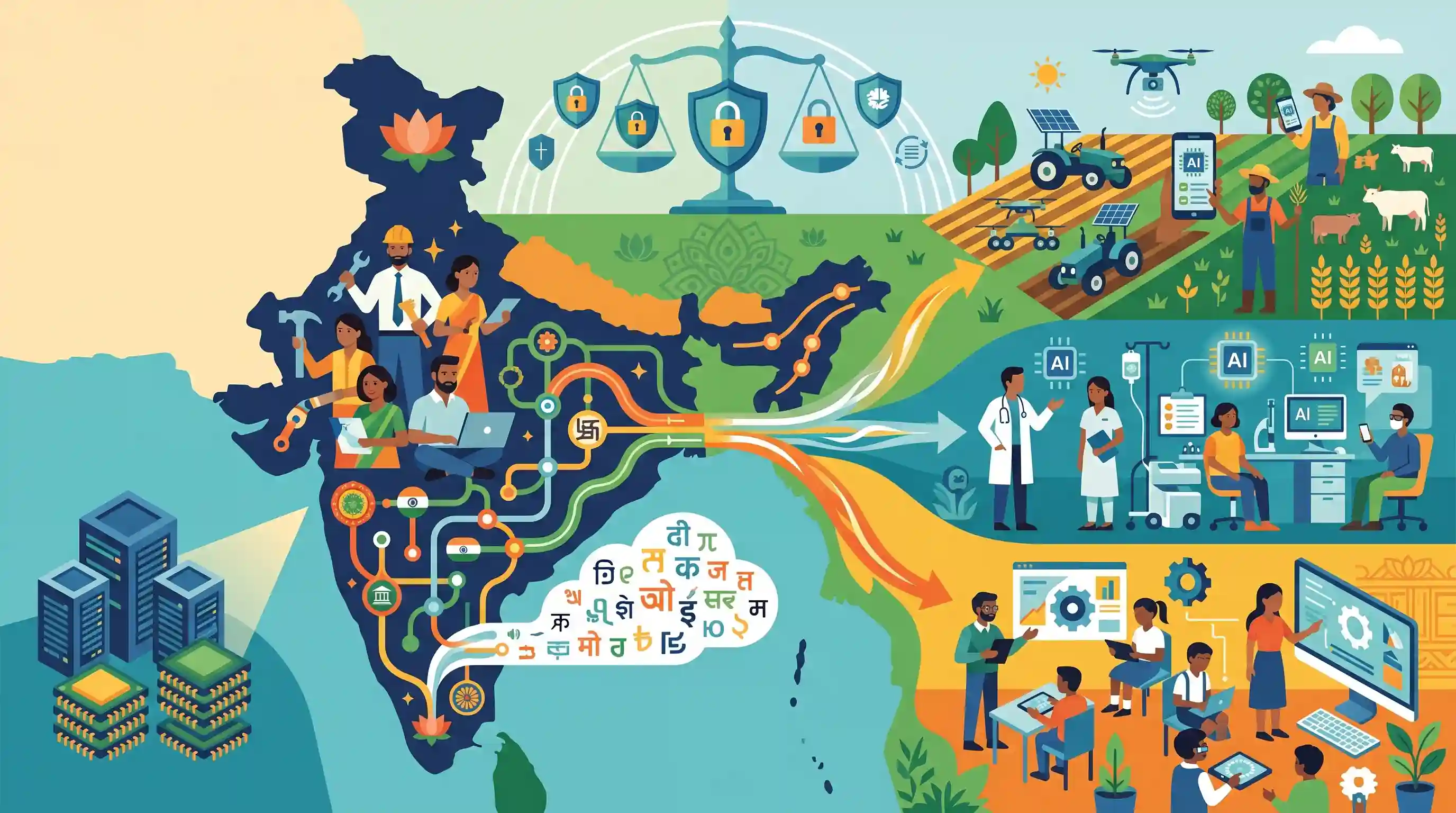
The article highlights that India's Artificial Intelligence (AI) strategy must extend beyond capital-intensive hardware investments like semiconductor chips and data centres. Instead, India’s strategic advantage lies in its vast software engineering talent, robust Digital Public Infrastructure (DPI), and diverse linguistic datasets. By focusing on application-driven innovation, India can develop localized AI solutions that address grassroots challenges in sectors such as agriculture, healthcare, and education. To fully realize this potential, policymakers must also establish an ethical regulatory framework that balances rapid technological adoption with data privacy and security.
Key Points
- While investing in capital-intensive hardware like semiconductor fabrication and data centres is critical, India's broader AI potential lies in software innovation and application-based solutions.
- Leveraging existing Digital Public Infrastructure (DPI) and a vast pool of IT talent can help develop cost-effective, scalable AI tools.
- India can lead in creating localized, language-specific AI models to address unique grassroots challenges in healthcare, education, and agriculture.
- Fostering a robust AI ecosystem requires balancing innovation with an ethical regulatory framework that ensures data privacy and security.
Important Terms
Digital Public Infrastructure (DPI)

Shared digital systems like identity (Aadhaar) and payments (UPI) that provide foundational functions for public and private service delivery, enabling inclusive digital growth.
UPSC context
GS Paper III (Digital Economy/S&T); tests knowledge of technology-led inclusive growth and India's global digital leadership.
IndiaAI Mission
A national initiative with a ₹10,372 crore outlay to build India's AI ecosystem through GPU compute capacity, indigenous datasets, and ethical innovation frameworks.
UPSC context
GS Paper III (Science & Tech); critical for topics on emerging technologies, indigenization, and digital sovereignty.
India Semiconductor Mission (ISM)
A nodal agency under the Digital India Corporation managing a ₹76,000 crore incentive scheme to establish a domestic semiconductor and display manufacturing ecosystem.
UPSC context
GS Paper III (Manufacturing/Infrastructure); vital for understanding self-reliance (Atmanirbhar Bharat) and global supply chain resilience.
Bhashini
An AI-led platform under the National Language Translation Mission that provides datasets and translation services in 22 Indian languages to ensure digital inclusion.
UPSC context
GS Paper II & III (Governance/S&T); relevant for bridging the digital divide and improving accessibility in a multilingual society.
India Stack
A unified set of open Application Programming Interfaces (APIs) encompassing identity, payments, and data-sharing layers that forms the backbone of India's DPI.
UPSC context
GS Paper III (IT & Economy); foundational architecture for digital governance and a key tool in India's technology diplomacy.
Prelims Trap
The IndiaAI Mission is exclusively focused on establishing indigenous semiconductor fabrication and data centres.
The IndiaAI Mission comprises 7 pillars, including the IndiaAI Datasets Platform, FutureSkills, and Application Development. It strongly emphasizes software innovation, not just hardware and compute.
Static Concepts Connected
What distinguishes Digital Public Infrastructure (DPI) from Digital Public Goods (DPG)?
- DPI: Foundational identity, payment, and data exchange networks (e.g., UPI, Aadhaar) built on open standards for societal-scale use.
- DPG: Open-source software, AI models, or datasets (e.g., Bhashini models, DIKSHA) that are non-rivalrous and freely accessible.
What are the core components of the Bhashini (National Language Translation Mission) initiative?
- Language inclusion: Aims to provide digital services and internet access across all 22 scheduled Indian languages using AI.
- Bhasha Daan platform: Creates massive, open-source linguistic datasets by crowdsourcing voice and text contributions from citizens across India.
- Open developer ecosystem: Provides open APIs for startups and developers to build localized AI applications for grassroots governance.
Cross-Topic Patterns
Agri-Stack merging with AI
Integrating India's Agri-Stack (DPI) with predictive AI models enables hyper-local credit scoring and crop disease detection, directly linking the digital economy with rural distress mitigation.
DPDP Act and AI Governance
Deploying application-driven AI in public services risks algorithmic bias. The DPDP Act's data fiduciary obligations form the baseline for addressing these emerging ethical and privacy governance challenges.

Expect a GS3 question evaluating India's DPI-led 'software-first' AI approach against the capital-intensive global AI hardware race.
Linked PYQs · 3
Linked PYQs · 3
- 2025MainsGS3
India aims to become a semiconductor manufacturing hub. What are the challenges faced by the semiconductor industry in India? Mention the salient features of the India Semiconductor Mission.
- 2023MainsGS3
Introduce the concept of Artificial Intelligence (AI). How does Al help clinical diagnosis? Do you perceive any threat to privacy of the individual in the use of Al in healthcare?
- 2023MainsGS3
What is the status of digitalization in the Indian economy? Examine the problems faced in this regard and suggest improvements.
