Evolving Security Architecture and Strategic Autonomy in West Asia
Source:The Hindu ↗
Why It Matters
The shifting power dynamics in the Middle East directly impact global energy markets and strategic stability. For UPSC aspirants, understanding the transition from a US-dominated security framework to an autonomous regional order involving Arab states and Iran is crucial for analyzing India's foreign policy challenges, diaspora security, and energy security interests in West Asia.
Summary
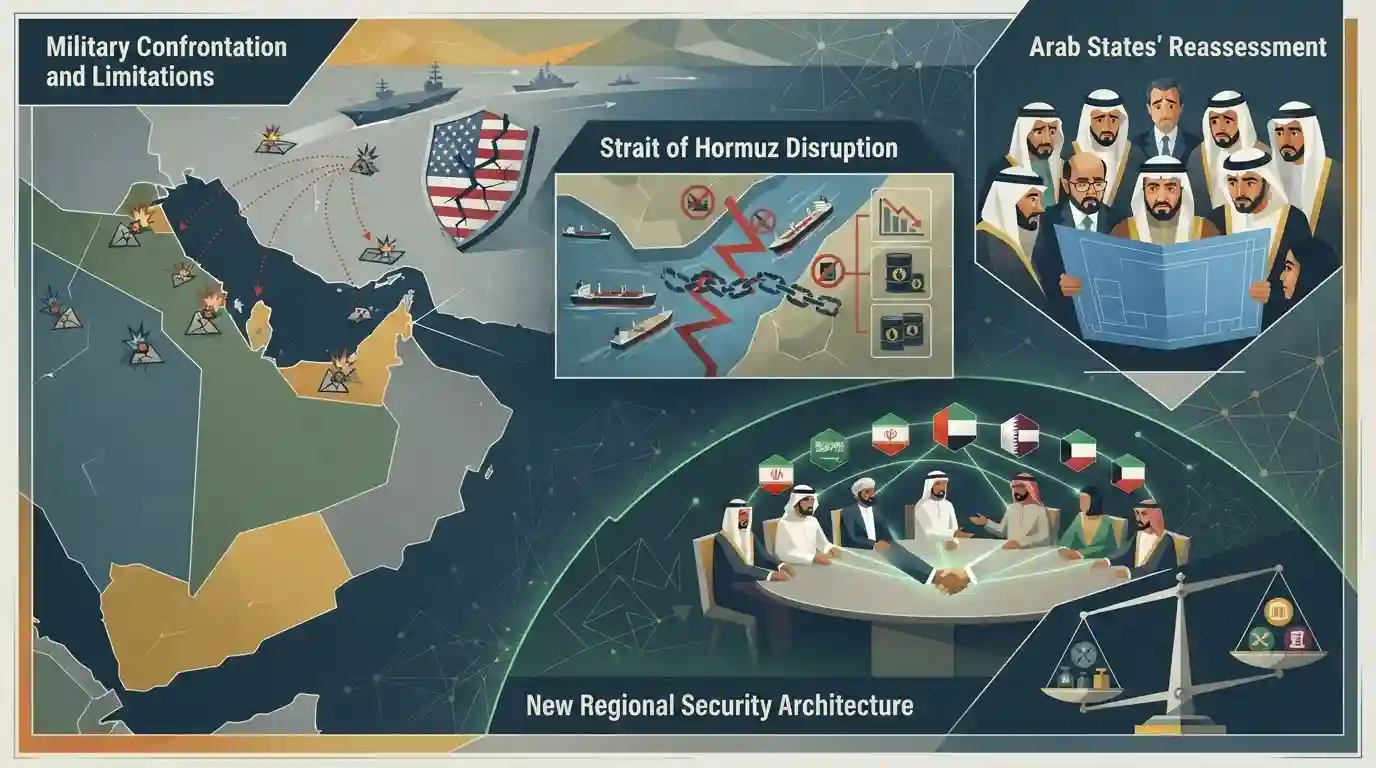
The editorial examines the evolving geopolitical landscape of the Persian Gulf following a military confrontation between the United States and Iran. It highlights how the conflict exposed the limitations of American power, evidenced by the damage to numerous US bases and the disruption of the strategically vital Strait of Hormuz. Consequently, Arab states are realizing that the traditional US security umbrella is no longer reliable. The article argues that these nations must now pivot towards regional self-reliance, potentially establishing a new security architecture that includes a pragmatic "cold peace" and direct diplomatic engagement with Iran, with countries like Oman continuing to play vital mediation roles.
Key Points
- A recent conflict between the US and Iran highlighted the diminishing effectiveness of the US security umbrella in the Persian Gulf, with numerous US bases (including the 5th Fleet HQ in Bahrain) suffering damage.
- The closure and disruption of the Strait of Hormuz underscored the extreme vulnerability of global energy supply chains and regional economies to geopolitical conflicts.
- Arab states in the Gulf are increasingly recognizing that reliance on American military power is no longer a viable long-term security strategy.
- Regional actors, facilitated by mediators like Oman, are likely to pursue a new security architecture involving direct engagement and a pragmatic 'cold peace' with Iran.
Important Terms
US 5th Fleet

A forward-deployed numbered fleet of the United States Navy headquartered in Bahrain, responsible for naval operations in the Persian Gulf, Red Sea, Arabian Sea, and parts of the Indian Ocean.
UPSC context
GS Paper II (IR) & GS Paper III (Security); tests awareness of major global military footprints and West Asian geopolitics.
Strait of Hormuz
A narrow, highly strategic waterway connecting the Persian Gulf with the Gulf of Oman and Arabian Sea, acting as the primary transit corridor for global oil exports.
UPSC context
GS Paper I (World Geography) & GS Paper III (Energy Security); tests vital maritime trade routes and geopolitical chokepoints.
Strategic Chokepoint
A narrow geographic passage, such as a strait or canal, whose control or closure can significantly disrupt global maritime trade, military movements, and energy supply lines.
UPSC context
GS Paper I (Geography) & GS Paper III (Security); tests concepts of maritime security, shipping freedom, and trade disruptions.
Cold Peace
A state of diplomatic relations characterized by the absence of active military conflict, combined with underlying tension, pragmatic cooperation, and lack of genuine trust.
UPSC context
GS Paper II (International Relations); tests understanding of regional power dynamics, conflict management, and shifting alliances in West Asia.
Security Umbrella
A formal or informal commitment by a powerful nuclear-armed state to defend its allies or client states from external military aggression.
UPSC context
GS Paper II (International Relations); tests power projection, military alliances, and the erosion of Western hegemony.
Prelims Trap
All petroleum exports from the Persian Gulf states must transit through the Strait of Hormuz.
While crucial, not all oil transits Hormuz. Saudi Arabia (East-West pipeline) and the UAE (Habshan-Fujairah pipeline) possess overland bypass routes to export oil directly to the Red Sea or Gulf of Oman.
Static Concepts Connected
Which major maritime chokepoints control energy flows in West Asia?
- Strait of Hormuz: Connects the Persian Gulf to the Gulf of Oman and Arabian Sea. It is the world's most critical oil transit chokepoint.
- Bab el-Mandeb: Links the Red Sea to the Gulf of Aden. A vital bottleneck for maritime trade between the Mediterranean and the Indian Ocean.
- Suez Canal: Connects the Red Sea to the Mediterranean Sea. The SUMED pipeline acts as a critical bypass for supertankers too large to transit the canal.
What are the key institutional and geopolitical security architectures in West Asia?
- GCC: A political and economic alliance of six Middle Eastern countries (Saudi Arabia, Kuwait, the UAE, Qatar, Bahrain, and Oman). It notably excludes Iran and Iraq.
- US Security Umbrella: The overarching maritime security and deterrence structure historically provided by the US Navy's Fifth Fleet, headquartered in Bahrain.
- Omani Neutrality: Oman maintains a strict doctrine of neutrality and non-intervention, frequently acting as a backchannel mediator between Washington, Tehran, and the GCC.
Cross-Topic Patterns
Hormuz disruption and India's CAD
A blockade at Hormuz directly inflates global oil prices, widening India's Current Account Deficit (CAD) and importing inflation, creating a direct linkage between West Asian geopolitics and Indian macroeconomic stability.
Strategic autonomy in West Asia
The shift of Arab states from a US-reliant unipolar umbrella toward regional self-reliance and a 'cold peace' with Iran mirrors India's own multialignment and de-risking strategies in a multipolar world.

Expect map-based Qs linking Persian Gulf chokepoints (Hormuz/Bab el-Mandeb) to bypass pipelines or specific littoral states.
Linked PYQs · 2
Linked PYQs · 2
- 2026PrelimsGS1
Ships from which of the following countries have to cross the Strait of Hormuz to reach out to the Indian Ocean ? 1. Bahrain 2. Syria 3. Qatar 4. Egypt Select the answer using the code given below :
- 2025MainsGS2
"Energy security constitutes the dominant kingpin of India's foreign policy, and is linked with India's overarching influence in Middle Eastern countries.” How would you integrate energy security with India's foreign policy trajectories in the coming years?
