Metabolic Factors and Rising Prevalence of Fatty Liver in India
Source:Indian Express ↗
Why It Matters
The high prevalence of NAFLD reflects India's shifting disease burden toward non-communicable and lifestyle-induced conditions. This necessitates an evolved public healthcare response, emphasizing preventive healthcare, nutritional awareness, and policy-level interventions under the NPCDCS.
Summary
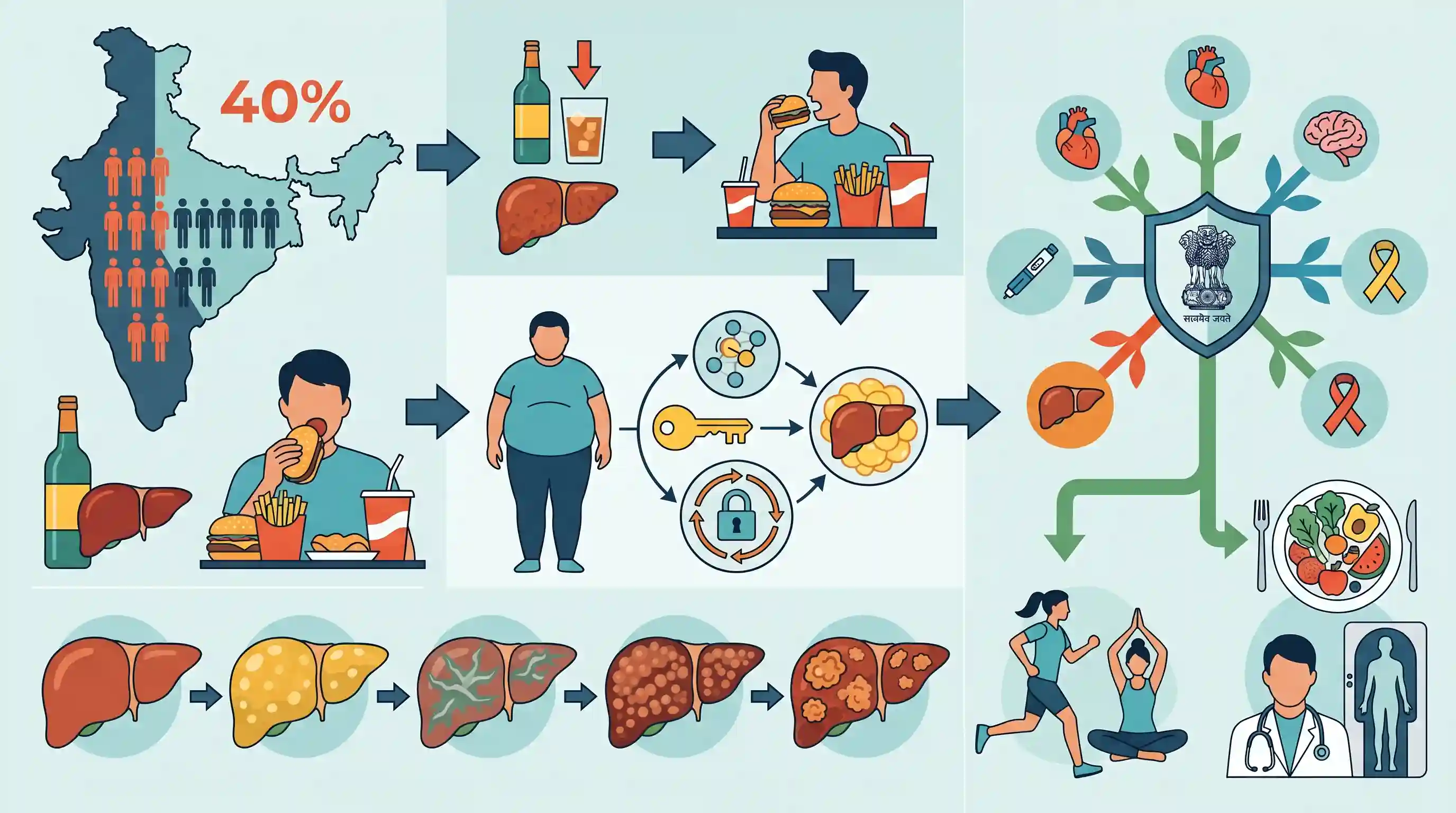
Non-Alcoholic Fatty Liver Disease (NAFLD) has emerged as a major public health crisis in India, affecting roughly 40% of the population. Unlike traditional liver diseases linked to alcohol abuse, NAFLD is driven by metabolic factors such as obesity, insulin resistance, and high-carbohydrate diets. The disease often progresses silently, posing a severe risk of liver fibrosis, cirrhosis, and liver cancer. In response to this growing epidemiological challenge, India has pioneered the integration of NAFLD into its flagship NCD initiative, the National Programme for Prevention and Control of Cancer, Diabetes, Cardiovascular Diseases and Stroke (NPCDCS), emphasizing the need for early detection and lifestyle modifications.
Key Points
- Nearly 40% of the Indian population suffers from Non-Alcoholic Fatty Liver Disease (NAFLD), a condition independent of alcohol consumption.
- NAFLD is strongly associated with metabolic syndrome, driven by obesity, type 2 diabetes, sedentary lifestyles, and diets high in refined carbohydrates.
- If left unchecked, NAFLD can silently progress into severe liver fibrosis, cirrhosis, and even hepatocellular carcinoma (liver cancer).
- Recognizing the severity of the issue, India became the first country to integrate NAFLD into its National Programme for Prevention and Control of Cancer, Diabetes, Cardiovascular Diseases and Stroke (NPCDCS).
Important Terms
National Programme for Prevention & Control of Non-Communicable Diseases (NP-NCD)

A national health initiative launched in 2010 to curb lifestyle diseases through infrastructure and early diagnosis; renamed in 2023 to include all non-communicable diseases beyond cancer, diabetes, and stroke.
UPSC context
GS II (Governance/Health); GS III (Science). Tests knowledge of India's flagship public health frameworks and disease management strategies.
Non-Alcoholic Fatty Liver Disease (NAFLD)
A spectrum of liver conditions caused by fat accumulation unrelated to alcohol consumption; now reclassified as Metabolic Dysfunction-Associated Steatotic Liver Disease (MASLD) to highlight underlying metabolic causes.
UPSC context
GS III (Science/Diseases). Relevant as India was the first country to integrate NAFLD into its national NCD program.
Metabolic Syndrome
A cluster of five medical conditions—abdominal obesity, hypertension, high blood sugar, high triglycerides, and low HDL cholesterol—that collectively increase the risk of heart disease and diabetes.
UPSC context
GS III (Science/Health). Tests understanding of physiological risk factors driving the current epidemiological transition in India.
Liver Fibrosis
The excessive accumulation of scar tissue in the liver due to chronic inflammation; it represents a potentially reversible stage of liver injury before permanent damage occurs.
UPSC context
GS III (Science/Human Physiology). Tests awareness of disease progression stages and early intervention in public health.
Liver Cirrhosis
The advanced, irreversible stage of liver scarring where healthy tissue is replaced by nodules, leading to impaired liver function, portal hypertension, and potential liver failure.
UPSC context
GS III (Science/Health). Important for understanding the terminal impact of non-communicable metabolic diseases on the healthcare system.
Insulin Resistance
A metabolic state where the body's cells do not respond properly to insulin, forcing the pancreas to produce more, which often leads to fatty liver and type 2 diabetes.
UPSC context
GS III (Science/Biology). A fundamental physiological concept linked to lifestyle-related chronic conditions and public health policy.
Prelims Trap
Liver cirrhosis is exclusively caused by chronic alcohol abuse or viral hepatitis infections.
Aspirants overlook NAFLD, an alcohol-independent metabolic condition affecting 40% of Indians, which silently progresses to irreversible cirrhosis and liver cancer if unchecked.
Static Concepts Connected
What is the NP-NCD (formerly NPCDCS) framework?
- Core Focus: Aims to prevent and control major Non-Communicable Diseases: Cancer, Diabetes, CVDs, Stroke, and now NAFLD.
- Infrastructure: Relies on opportunistic and population-based screening via Ayushman Arogya Mandirs at the primary healthcare level.
- Convergence: Integrates with Ayush systems to promote holistic lifestyle interventions, dietary changes, and yoga to combat metabolic syndromes.
How does the liver regulate human metabolism?
- Carbohydrate Storage: Converts excess blood glucose into glycogen (glycogenesis) for storage, releasing it when systemic energy is needed.
- Lipid Synthesis: Packages excess carbohydrates and proteins into fatty acids and triglycerides, which can lead to fatty liver (steatosis) if overloaded.
- Detoxification: Neutralizes toxins and metabolic waste, a critical function that is impaired when fat accumulation causes inflammation (steatohepatitis).
Cross-Topic Patterns
NAFLD + Double Burden of Malnutrition
NAFLD's rise highlights India's epidemiological transition, where overnutrition, high-carb diets, and metabolic syndromes increasingly coexist alongside traditional undernutrition (the double burden of malnutrition).
NCD Screening + Ayushman Bharat
Integrating NAFLD into the national NCD programme relies heavily on grassroots primary healthcare, shifting the screening burden to Ayushman Arogya Mandirs (health and wellness centres).

NAFLD's inclusion in NP-NCD + its link to metabolic syndrome (not alcohol) is highly likely as a 2026 Prelims Science/Schemes hybrid.
Linked PYQs · 4
Linked PYQs · 4
- 2022MainsGS3
The increase in life expectancy in the country has led to newer health challenges in the community. What are those challenges and what steps need to be taken to meet them?
- 2024MainsGS2
In a crucial domain like the public healthcare system the Indian State should play a vital role to contain the adverse impact of marketisation of the system. Suggest some measures through which the State can enhance the reach of public healthcare at the grassroots level.
- 2010PrelimsGS1
Consider the following statements: 1. Hepatitis B is several times more infectious than HIV/AIDS 2. Hepatitis B can cause liver cancer Which of the statements given above is/are correct?
- 2019PrelimsGS1
Which one of the following statements is not correct?
