River mouths and coastal air pollution linkage in estuaries
Source:The Hindu ↗
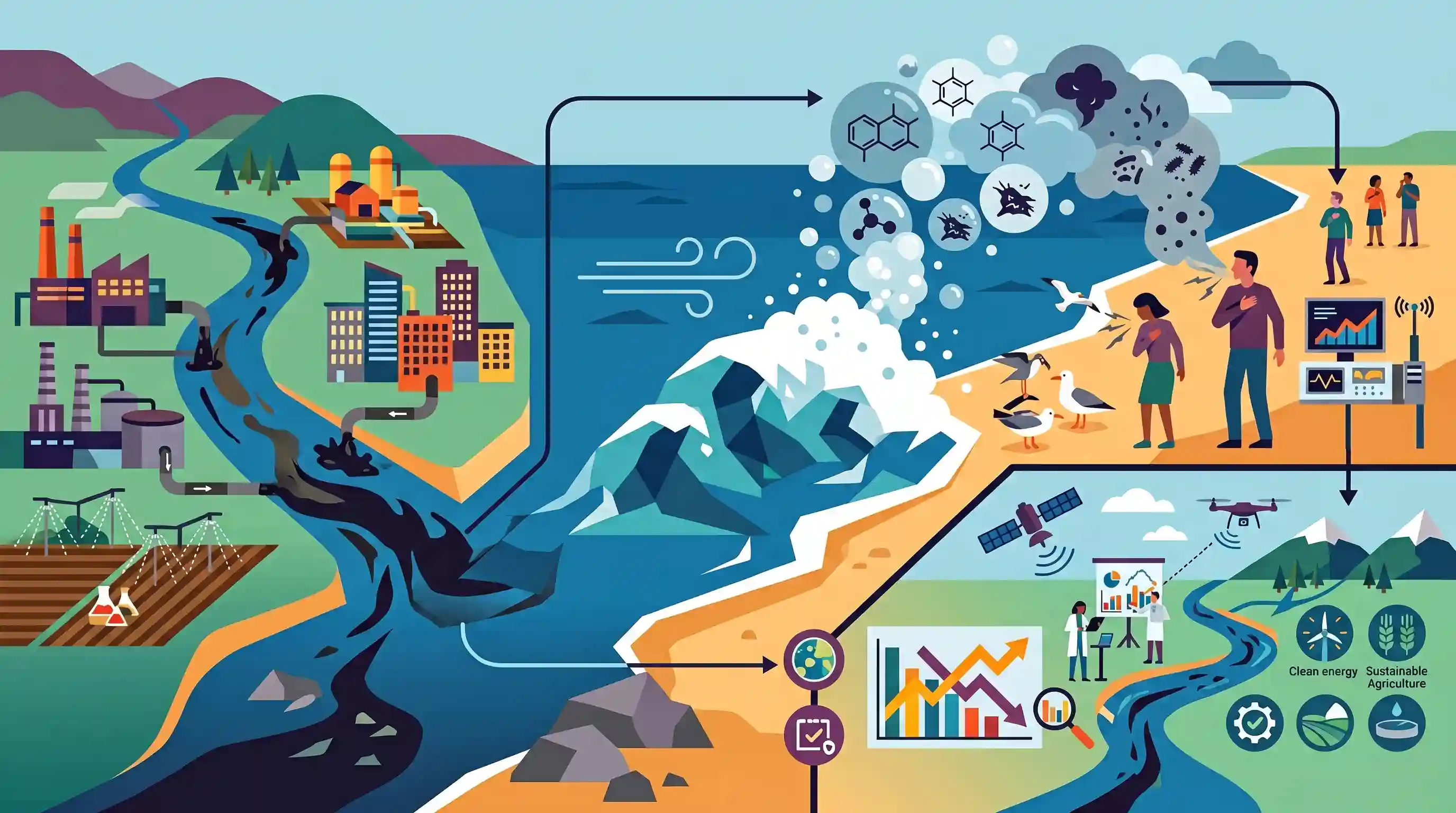
Why It Matters
It illustrates the complex interplay between water and air pollution at the land-ocean boundary. Understanding how riverine discharge becomes a source of coastal air pollution is critical for aspirants when discussing integrated environmental management, river rejuvenation, and coastal ecosystem conservation in GS3.
Summary
The article highlights an emerging environmental and health risk at beaches located near river mouths, where polluted river discharge significantly degrades local air quality. As rivers carry industrial, agricultural, and domestic waste into the sea, the natural churning of waves and wind facilitates the aerosolization of these contaminants. The resulting sea spray aerosols (SSAs) can carry volatile organic compounds (VOCs), noxious gases from decaying organic matter, and micropollutants into the coastal atmosphere. This dynamic demonstrates how severe water pollution can directly translate into localized air pollution, posing respiratory risks to coastal populations and underscoring the necessity for integrated coastal and river basin management.
Key Points
- River-Ocean Interface as Pollution Hotspots: Estuaries and river mouths act as convergence zones where upstream river pollutants (organic, industrial, and agricultural waste) accumulate and interact with coastal marine environments.
- Aerosolization of Waterborne Contaminants: Wind, wave action, and breaking surf at beaches facilitate the transfer of pollutants from the ocean surface into the atmosphere via Sea Spray Aerosols (SSAs).
- Emissions of Harmful Compounds: The mixing of heavily polluted fresh water with saline ocean water often leads to the release of volatile organic compounds (VOCs), greenhouse gases, and noxious emissions from decaying organic matter.
- Public Health Risks: The phenomenon effectively transforms water pollution into an air quality hazard, exposing beachgoers and coastal communities to respiratory irritants and airborne pathogens.
- Policy Implications: The issue underscores the critical need for holistic environmental policy, enforcing stringent upstream effluent standards and integrated coastal zone management to mitigate interconnected land-water-air pollution dynamics.
Important Terms
Coastal Regulation Zone (CRZ)

India's regulatory framework under the Environment (Protection) Act, 1986, classifying coastal areas (CRZ I-IV) to protect ecosystems while regulating human activity within 500m of the High Tide Line.
UPSC context
GS-III Environment; vital for coastal ecology, climate change adaptation, and sustainable development.
Sea Spray Aerosols (SSA)
Atmospheric particles formed by breaking waves and bursting bubbles. In polluted coastal zones, they act as carriers for pathogens and chemicals from river discharge into the air.
UPSC context
GS-III Environment/Science; tests understanding of the air-water pollution interface and its public health impacts.
Volatile Organic Compounds (VOCs)
Carbon-based chemicals with high vapor pressure that easily evaporate. They are precursors to ground-level ozone and arise from industrial runoff or decaying organic matter in coastal waters.
UPSC context
GS-III Environment; key atmospheric pollutant contributing to smog and respiratory health risks.
Integrated Coastal Zone Management (ICZM)
A multidisciplinary process for sustainable coastal resource management that integrates social, economic, and environmental objectives. In India, it is managed by the Society of Integrated Coastal Management (SICOM).
UPSC context
GS-III Governance/Environment; focuses on holistic planning and coastal resilience against climate change.
Environmental Impact Assessment (EIA)
A statutory process used to evaluate the environmental consequences of a proposed project before granting regulatory clearance, ensuring that development adheres to the precautionary principle.
UPSC context
GS-III Environment; a mandatory regulatory tool for balancing economic development with ecological conservation.
Prelims Trap
Sea spray aerosols only contain natural marine salts and do not act as atmospheric carriers for anthropogenic water pollutants.
Breaking waves actively aerosolize industrial VOCs, microplastics, and pathogens from polluted estuaries, directly transforming coastal water pollution into an airborne respiratory hazard.
Static Concepts Connected
What is the Coastal Regulation Zone (CRZ) framework in India?
- Statutory backing: Notified under the Environment (Protection) Act, 1986 to regulate activities and protect ecologically sensitive coastal ecosystems.
- Estuarine zones: Estuaries and river mouths fall under critical CRZ classifications requiring stringent restrictions on industrial effluents and solid waste dumping.
- ICZM approach: Implemented by SICOM, Integrated Coastal Zone Management seeks holistic governance of the land-water interface, moving beyond isolated regulatory zones.
How do Volatile Organic Compounds (VOCs) create secondary pollutants?
- Evaporation: VOCs are carbon-based chemicals (e.g., from industrial waste) that easily vaporize into the atmosphere at ambient temperatures.
- Ozone formation: In the presence of sunlight, VOCs react with nitrogen oxides (NOx) to create ground-level (tropospheric) ozone, a harmful secondary pollutant.
- Photochemical smog: This ozone contributes heavily to photochemical smog, severely impacting local air quality and human respiratory health.
Cross-Topic Patterns
Eutrophication and atmospheric GHG feedback
Upstream agricultural runoff causes coastal algal blooms. As organic matter decays at river mouths, it releases methane and nitrous oxide, linking upstream fertilizer usage directly to coastal climate feedbacks.
Microplastics crossing the air-water barrier
Similar to VOCs, wave-action and sea spray aerosolize marine microplastics and nanoplastics, shifting them from ocean sinks back into the terrestrial atmosphere where they can be inhaled.

Expect a 2026 prelims question linking 'Sea Spray Aerosols' to both natural cloud seeding (DMS) and anthropogenic VOC/microplastic transport.
Linked PYQs · 3
Linked PYQs · 3
- 2024MainsGS3
Industrial pollution of river water is a significant environmental issue in India. Discuss the various mitigation measures to deal with this problem and also the government's initiatives in this regard.
- 2022MainsGS3
Explain the causes and effects of coastal erosion in India. What are the available coastal management techniques for combating the hazard?
- 2021MainsGS3
Describe the key points of the revised Global Air Quality Guidelines (AQGs) recently released by the World Health Organisation (WHO). How are these different from its last update in 2005? What changes in India's National Clean Air Programme are required to achieve these revised standards?
