Judicial Intervention in Ministerial Corruption and Public Morality
Source:The Hindu ↗
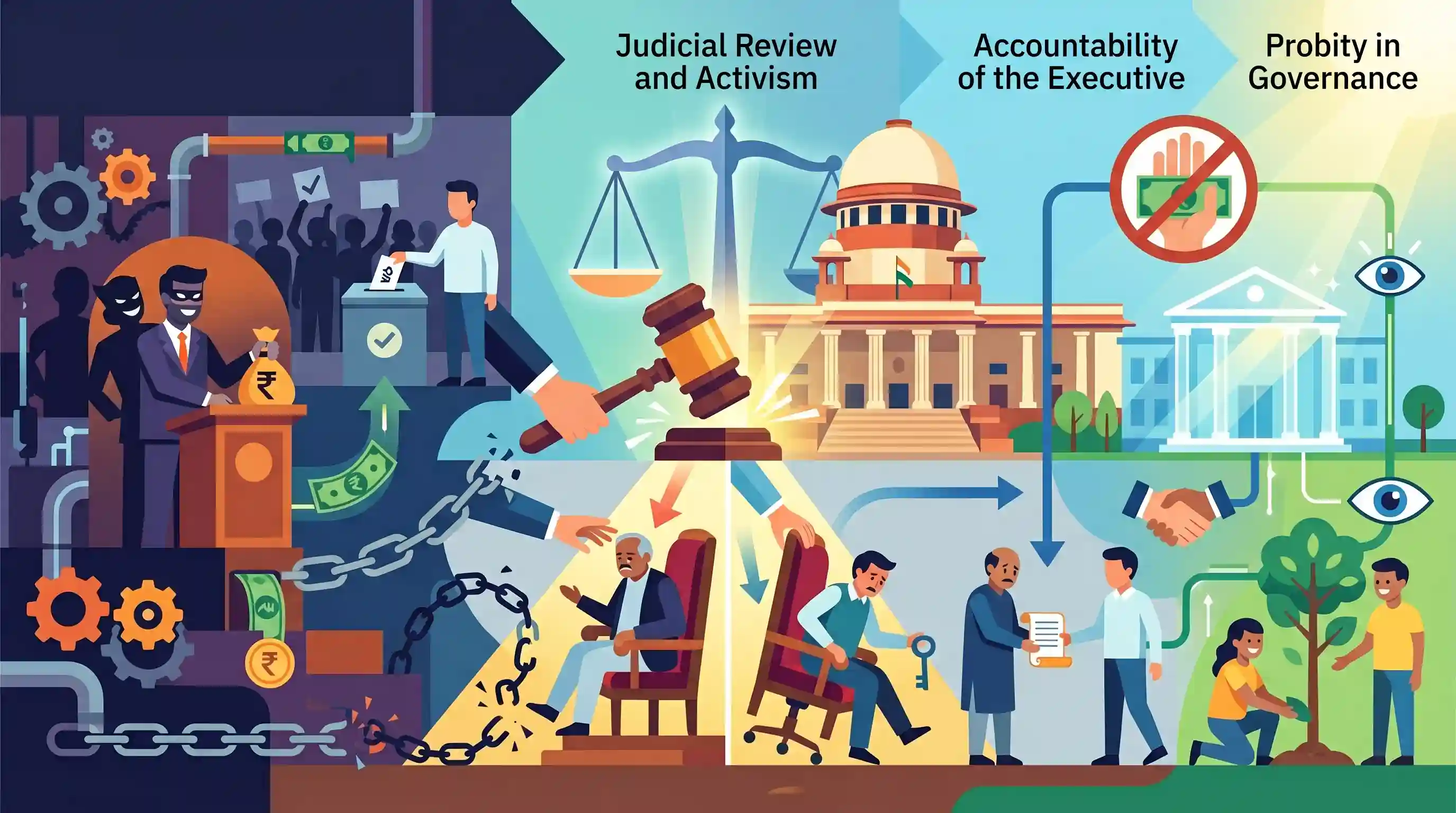
Why It Matters
The article illustrates the tension between electoral success and political morality. It is highly relevant for GS-2 (judiciary's role in governance and curbing political corruption) and GS-4 (probity in public life, ethical governance, and the behavior of public servants).
Summary
The editorial discusses the resignations of Tamil Nadu Ministers V. Senthilbalaji and K. Ponmudy prompted by judicial interventions from the Supreme Court and Madras High Court over corruption charges. It argues that while corrupt politicians often find electoral success, the judiciary serves as a vital safeguard by proceeding against them. Emphasizing that corruption by public servants is an offence against society, the piece underscores the need for probity, morality, and zero tolerance towards corruption in public life, regardless of claims of judicial overreach.
Key Points
- Tamil Nadu Ministers V. Senthilbalaji and K. Ponmudy resigned following adverse remarks by the Supreme Court and Madras High Court over corruption, money laundering, and derogatory speech.
- The Supreme Court emphasized that corruption by a public servant is an offence against the State and society at large.
- While court interventions in political corruption might sometimes appear as judicial overreach, they act as a crucial check when the political executive fails to show zero tolerance.
- The episode highlights the necessity of maintaining propriety, morality, and dignity in public life, irrespective of the electoral success often enjoyed by corrupt politicians.
Important Terms
Probity in Governance

Adherence to high ethical and moral standards, including honesty and integrity, ensuring public interest always supersedes personal gain in administration.
UPSC context
GS Paper IV (Ethics); fundamental for maintaining public trust and assessing the moral character of public officials.
Criminalisation of Politics
The entry and active participation of individuals with criminal records or pending criminal charges in the electoral and law-making process.
UPSC context
GS Paper II (Polity/Governance); tests knowledge of systemic threats to democracy and the rule of law.
Representation of the People Act, 1951
An Act of Parliament governing election conduct, qualifications/disqualifications of legislators, and the prevention of corrupt practices during polls.
UPSC context
GS Paper II (Salient features of RPA); crucial for understanding legal barriers against criminals in the legislature.
Judicial Review
The power of the Supreme Court and High Courts to examine and potentially invalidate legislative acts or executive orders that violate the Constitution.
UPSC context
GS Paper II (Constitution); a basic structure feature used to uphold constitutional morality and executive accountability.
Disqualification of Legislators
The legal removal of a legislator from office under Articles 102 or 191 (Constitution) or Section 8 of the RPA 1951.
UPSC context
GS Paper II (Legislature); key mechanism for vetting the eligibility of law-makers facing criminal convictions.
Suo Motu Cognizance
The inherent power of a court to initiate a legal proceeding on its own initiative without a formal complaint or petition.
UPSC context
GS Paper II (Judiciary); an instrument of judicial activism used by courts to address issues of urgent public importance.
Prelims Trap
A sitting Minister faces immediate and automatic disqualification upon the framing of serious corruption charges by a court.
Disqualification under the RPA, 1951 is triggered exclusively upon *conviction*, not merely upon the framing of charges, FIRs, or pending trials.
Static Concepts Connected
What are the criteria for legislator disqualification under the RPA, 1951?
- Section 8(1): Conviction for specific offences like corruption or bribery disqualifies a legislator immediately, even if the penalty is merely a fine.
- Section 8(3): Conviction for any offence resulting in a prison sentence of two years or more triggers immediate disqualification.
- Lily Thomas ruling: Struck down Section 8(4) of the RPA, ending the automatic three-month protection sitting legislators had to file an appeal against conviction.
What is the Doctrine of Constitutional Trust regarding ministerial appointments?
- Manoj Narula Case: The Supreme Court ruled that the Constitution does not explicitly legally bar individuals with pending criminal charges from ministerial appointments.
- Constitutional Morality: The doctrine trusts the Prime Minister or Chief Minister to exercise moral judgment and exclude tainted individuals from the Council of Ministers to uphold constitutional morality.
Cross-Topic Patterns
GS-4 Probity and GS-2 Elections
Nolan Committee principles (integrity, accountability) form the ethical baseline that legal mechanisms like the Representation of the People Act, 1951 attempt to enforce in Indian politics.
Judicial Review vs. Executive Void
Judicial intervention in political corruption cases is often debated as judicial overreach, but courts justify it as a necessary check when the executive fails its constitutional trust.

Interplay between RPA Section 8 disqualifications, Constitutional Trust, and Lily Thomas ruling will likely form a complex Prelims question.
Linked PYQs · 4
Linked PYQs · 4
- 2025MainsGS2
Discuss the 'corrupt practices' for the purpose of the Representation of the People Act, 1951. Analyze whether the increase in the assets of the legislators and/or their associates, disproportionate to their known sources of income, would constitute 'undue influence' and consequently a corrupt practice.
- 2020MainsGS2
There is a need for simplification of procedure for disqualification of persons found guilty of corrupt practices under the Representation of Peoples Act". Comment.
- 2019MainsGS4
What do you understand by probity in governance ? Based on your understanding of the term, suggest measures for ensuring probity in government.
- 2025MainsGS4
"Constitutional morality is not a natural sentiment but a product of civil education and adherance of the rule of law." Examine the significance of constitutional morality for public servant highlighting the role in promoting good governance and ensuring accountability in public administration.
