Applied AI Strategy and Public Welfare Integration in India
Source:Indian Express ↗
Why It Matters
Provides a strategic framework for India's technological trajectory, contrasting the Western profit-driven AI race with an Indian model of 'AI for All'. Highly relevant for GS3 (S&T applications) and GS2 (welfare delivery and e-governance).
Summary
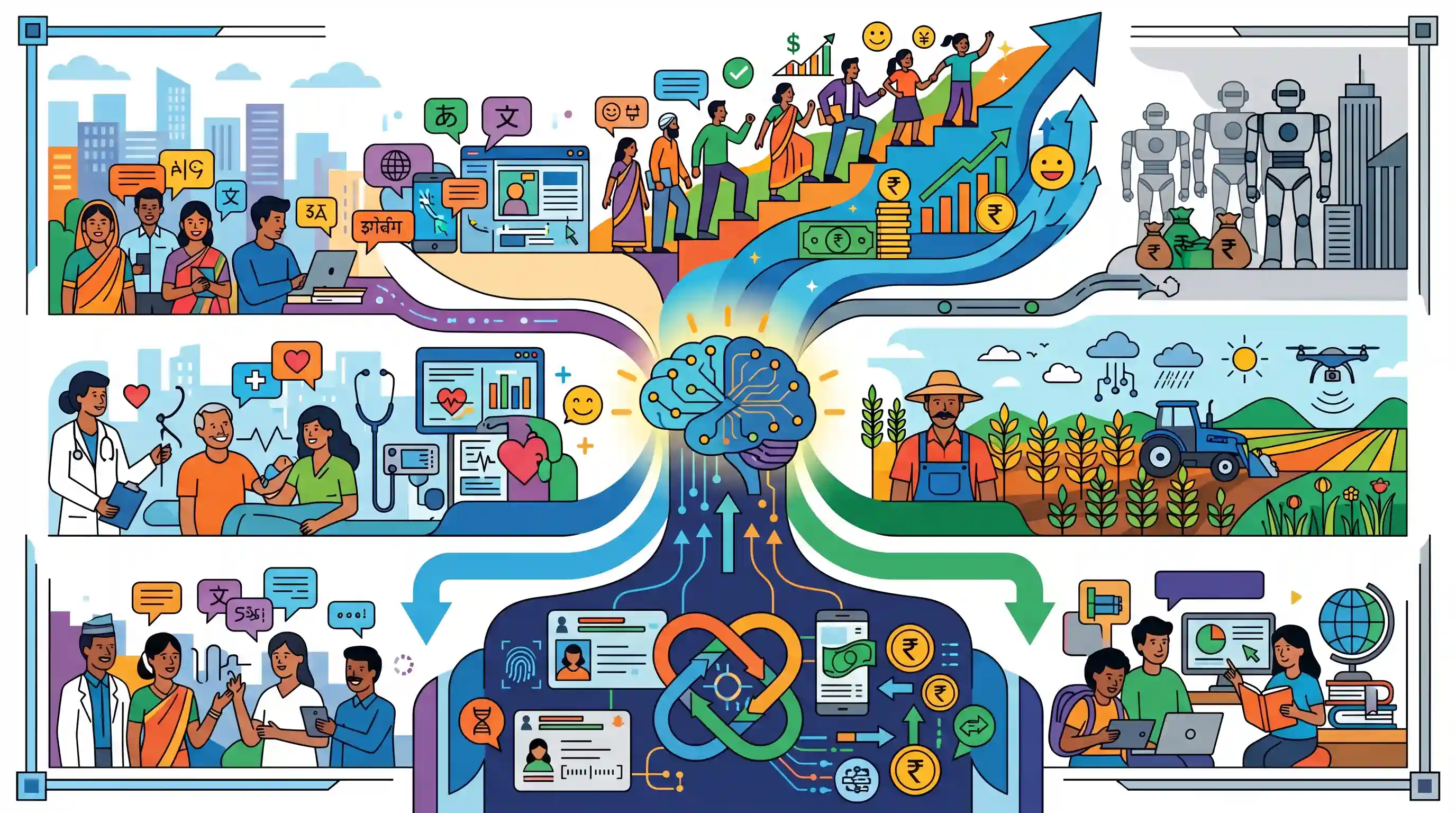
The article argues that India should chart a unique path in the global Artificial Intelligence (AI) race by prioritizing AI for social welfare rather than mere corporate dominance. By integrating AI with its robust Digital Public Infrastructure (DPI), India can solve population-scale challenges in healthcare, agriculture, and education. A strategy focused on inclusive growth—such as using AI to break language barriers—will bridge the digital divide and ensure that technological advancements translate into tangible socio-economic empowerment for all citizens.
Key Points
- Instead of competing purely on foundational models or computational brute force, India's AI strategy should focus on 'Applied AI' to solve grassroot socio-economic challenges.
- Integrating AI with India's existing Digital Public Infrastructure (DPI) can dramatically improve the targeted delivery of welfare schemes, enhancing transparency and accountability.
- AI holds immense potential for population-scale welfare in sectors like agriculture (precision farming, crop advisory), healthcare (clinical diagnosis, rural health access), and education (personalized learning).
- Deploying natural language processing AI tools in local Indian languages is critical to overcoming digital illiteracy and ensuring inclusive access to digital governance.
- A user-centric approach is necessary to ensure AI-driven e-governance projects empower the marginalized rather than exclusionary, profit-driven tech deployment.
Important Terms
Digital Public Infrastructure (DPI)

Foundational, open, and interoperable digital platforms (like Aadhaar, UPI, and DigiLocker) that enable societal-scale service delivery and facilitate innovation in the public and private sectors.
UPSC context
GS-2 (Governance) and GS-3 (Economy); crucial for topics on e-governance, financial inclusion, and India's 'India Stack' global model.
IndiaAI Mission
A national initiative implemented by MeitY to build a robust AI ecosystem, focusing on compute infrastructure (GPUs), indigenous foundational models, and datasets for societal applications.
UPSC context
GS-3 (Science & Technology); tests knowledge of national missions, technological sovereignty, and indigenous R&D in emerging tech.
Bhashini
An AI-led language translation platform under the National Language Translation Mission designed to provide digital services in local Indian languages to bridge the linguistic digital divide.
UPSC context
GS-2 (Social Justice/Governance); vital for digital inclusion, empowering linguistic minorities, and improving rural access to e-services.
NITI Aayog
India’s apex policy think tank that authored the 'National Strategy for Artificial Intelligence,' coining the mantra '#AIforAll' to guide inclusive and responsible AI development.
UPSC context
GS-2 (Governance/Institutions); tests the role of advisory bodies in drafting long-term strategic frameworks for national development.
Ministry of Electronics and Information Technology (MeitY)
The nodal ministry responsible for India's digital transformation, overseeing the implementation of the IndiaAI Mission, Digital India, and the governance of digital infrastructure.
UPSC context
GS-2 (Governance); tests the function of executive departments in implementing science and technology policies.
Prelims Trap
Bhashini is India's proprietary foundational Large Language Model (LLM) designed to compete globally.
Bhashini is an NLP translation platform using crowdsourced data, not a foundational LLM built from scratch. India's official AI strategy emphasizes 'Applied AI' for welfare over competing in the global foundational model race.
Static Concepts Connected
What are the foundational layers of India's Digital Public Infrastructure (DPI)?
- Identity Layer: Provides unique, digital, scalable, and verifiable identity verification (e.g., Aadhaar).
- Payments Layer: Enables fast, interoperable, and zero-cost digital financial transfers at a population scale (e.g., UPI).
- Data Empowerment Layer: Uses consent frameworks to allow users to securely share their data across institutions (e.g., Account Aggregator, DEPA).
How can Artificial Intelligence aid farmers under GS3 e-technology applications?
- Precision Agriculture: AI models analyze satellite imagery and soil sensors to optimize water, fertilizer, and pesticide use, reducing input costs.
- Predictive Advisory: Machine learning processes micro-climate data to issue localized pest alerts and extreme weather warnings in regional languages.
- Price Discovery: AI algorithms analyze historical agricultural market data to predict future crop prices, aiding farmers' sowing decisions.
Cross-Topic Patterns
AI + DPI for MSME Credit Access
Integrating AI algorithms with India's Account Aggregator framework (DPI) allows banks to analyze alternative data, enabling cash-flow-based lending for MSMEs that lack traditional physical collateral.
NLP + Citizen-centric Governance
Language barriers hinder GS2's e-governance goals. Tools like Bhashini democratize digital access, ensuring non-English speakers can interface with state welfare portals and grievance redressal systems via voice.

Expect a 2026 prelims multi-statement question mixing the IndiaAI Mission's compute capacity targets with Bhashini's NLP capabilities.
Linked PYQs · 4
Linked PYQs · 4
- 2023MainsGS3
Introduce the concept of Artificial Intelligence (AI). How does Al help clinical diagnosis? Do you perceive any threat to privacy of the individual in the use of Al in healthcare?
- 2025MainsGS2
e-governance projects have a built-in bias towards technology and back-end integration than user-centric designs. Examine.
- 2024MainsGS2
e-governance is not just about the routine application of digital technology in service delivery process. It is as much about multifarious interactions for ensuring transparency and accountability. In this context evaluate the role of the 'Interactive Service Model' of e-governance.
- 2021MainsGS2
Has digital illiteracy, particularly in rural areas, coupled with lack of Information and Communication Technology (ICT) accessibility hindered socio-economic development? Examine with justification.
