India Must Prioritize Bilateral Ties with US Amid Strategic Autonomy
Source:Indian Express ↗
Why It Matters
The India-US bilateral relationship is a foundational element of India's contemporary foreign policy. Understanding how India balances its strategic autonomy with its indispensable US partnership is critical for GS2 Mains, particularly concerning the Indo-Pacific, defense ties, and global geopolitics.
Summary
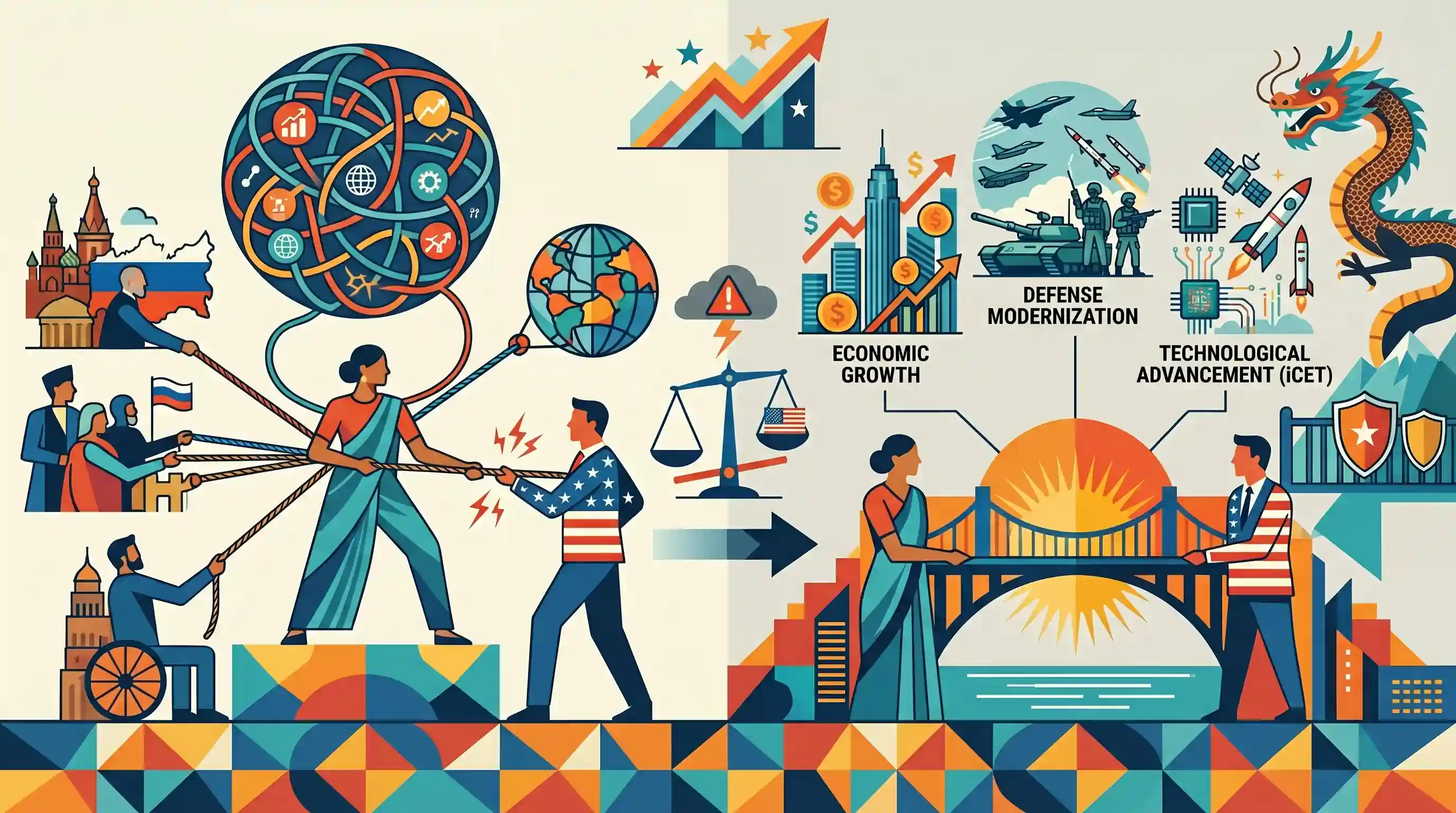
The article argues that India must prioritize repairing and strengthening its bilateral relations with the United States amid recent diplomatic frictions. While India's foreign policy currently emphasizes strategic autonomy and multi-alignment—allowing it to maintain historical ties with Russia and engage with various global blocs—the author cautions against letting these balancing acts undermine the crucial US partnership. The US is indispensable for India's economic growth, defense modernization, and technological advancement, particularly through initiatives like iCET. Furthermore, a robust Indo-US alliance is essential for maintaining stability in the Indo-Pacific and countering a rising China. Thus, India needs to proactively manage its differences with Washington to truly leverage the 'best of both sides' in global geopolitics.
Key Points
- The article underscores the urgency for India to repair and strengthen its bilateral ties with the United States in the wake of recent diplomatic frictions.
- While India successfully practices strategic autonomy and multi-alignment—managing ties with Russia and the Global South—this must not jeopardize the indispensable US partnership.
- The US remains critical for India's long-term strategic interests, including defense modernization, technology transfers (like iCET), and countering China's influence in the Indo-Pacific region.
- India must proactively navigate and manage divergences with Washington, such as trade issues and domestic controversies, to secure long-term geopolitical and economic benefits.
Important Terms
Strategic Autonomy

A foreign policy framework where a nation makes sovereign decisions on security and diplomacy based on national interest, without external coercion or binding military alliances.
UPSC context
GS Paper II: International Relations. Tests the ability to analyze India's independent posture amidst US-Russia-China power competition.
Multi-alignment
A pragmatic diplomatic strategy of engaging with multiple, often competing, global powers and blocs simultaneously to maximize national interest and strategic leverage.
UPSC context
GS Paper II: International Relations. Crucial for questions on India's transition from non-alignment to active, issue-based global partnerships.
Initiative on Critical and Emerging Technology (iCET)
A 2023 Indo-US partnership led by National Security Councils to expand cooperation in high-tech areas like AI, space, semiconductors, and defense innovation.
UPSC context
GS Paper II/III: Bilateral Agreements and S&T. Key for topics on defense indigenization and tech-driven strategic ties.
CAATSA
A US law (2017) imposing sanctions on nations engaging in significant transactions with Russia’s defense sector, creating a major friction point in Indo-US ties.
UPSC context
GS Paper II: Effect of policies of developed countries. Specifically relevant for India’s S-400 deal and defense-dependence on Russia.
Indo-Pacific
A geopolitical theater spanning the Indian and Pacific Oceans, central to global trade and the US-India goal of a free and rules-based maritime order.
UPSC context
GS Paper II: Regional Groupings. Essential for maritime security and the Quadrilateral Security Dialogue (Quad) dynamics.
Prelims Trap
"The 'Major Defense Partner' status makes India a formal treaty ally of the United States."
While the designation elevates defense trade and tech transfer to an ally-like level, India explicitly avoids mutual defense treaties to preserve its 'Strategic Autonomy'.
Static Concepts Connected
What are the four foundational Indo-US defense agreements?
- GSOMIA & LEMOA: GSOMIA (2002) protects classified military information. LEMOA (2016) permits reciprocal logistical support, docking, and refueling at each other's military bases.
- COMCASA (2018): Grants India access to encrypted communication equipment, ensuring secure interoperability between the two militaries during joint operations.
- BECA (2020): Enables the sharing of advanced American geospatial intelligence, aeronautical data, and nautical charts for high-precision targeting and navigation.
What is the Initiative on Critical and Emerging Technology (iCET)?
- NSC Leadership: Spearheaded directly by the National Security Councils of both nations, framing technological cooperation as a core component of national security rather than mere trade.
- Strategic Tech Domains: Expands bilateral collaboration in cutting-edge domains like artificial intelligence, quantum computing, semiconductor supply chains, space exploration, and 6G telecom.
Cross-Topic Patterns
iCET + Domestic tech indigenization
Blends GS2 strategic diplomacy with GS3 economic policy, using US tech transfers and iCET to catalyze India's self-reliance in semiconductors and defense manufacturing.
Multi-alignment vs Cold War NAM
Illustrates the shift from Cold-War Non-Alignment to issue-based multi-alignment—allowing India to balance advanced US defense interoperability with discounted Russian energy imports.

Expect a Prelims match-the-following on US foundational agreements (LEMOA, BECA) or a multi-statement question on iCET's tech domains.
Linked PYQs · 2
Linked PYQs · 2
- 2023MainsGS2
‘The expansion and strengthening of NATO and a stronger US-Europe strategic partnership works well for India.’ What is your opinion about this statement ? Give reasons and examples to support your answer.
- 2020MainsGS2
What is the significance of Indo-US defence deals over Indo-Russian defence deals? Discuss with reference to stability in the Indo-Pacific region.
